

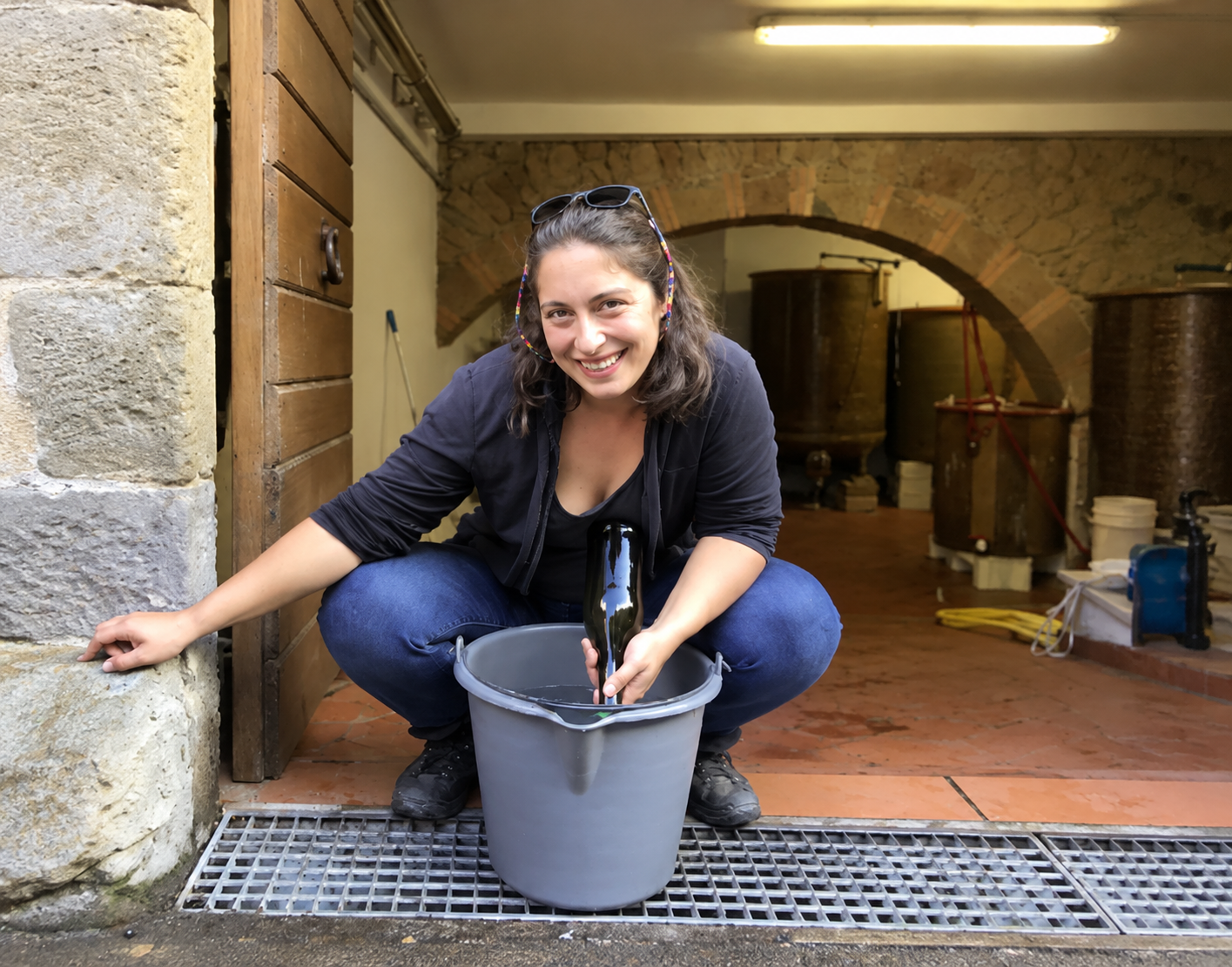
For many businesses, understanding what consumers want is the starting point for innovation. But at La Villana, near Italy's Lake Bolsena, winemaker Joy Alessandro Kull is taking a different approach. Her philosophy raises an intriguing question: What happens when a business is guided not primarily by market demand, but by the values of the person behind it?
In an increasingly competitive wine industry, producers are often encouraged to listen closely to consumers, anticipate changing preferences and adapt their offerings accordingly. Innovation, in this context, is frequently associated with identifying new market opportunities and responding to demand.
But not every winemaker sees things this way. For Joy, the founder of La Villana, winemaking is as much a form of personal expression as it is a commercial enterprise. Rather than developing wines around what consumers might want, she prefers to produce wines that reflect her own philosophy, allowing customers who appreciate that approach to discover them.
"I would rather remain small, doing purely what it is that I want to do," Kull explains. It is a statement that captures something fundamental about her approach to entrepreneurship: success does not necessarily mean becoming bigger, selling more or continually adapting to the market. Sometimes, it means protecting the freedom to do things differently.
A different route into Italian winemaking
Joy's journey into winemaking was far from conventional. Born and raised in the United States to Swiss parents, she initially studied hospitality management before developing an interest in wine through her father's wine shop in Connecticut.
After working in different areas of the wine industry, including a startup in New York, she began to feel disconnected from the product that had originally inspired her. A decision to spend a year working at a winery in Italy changed the direction of her career. She stayed, and approximately two years later established her own winery.
Unlike producers who inherit vineyards and generations of family knowledge, Joy has built her business around her own experiences, convictions and willingness to experiment. This independence is central to how she approaches both wine production and business decisions.
When values come before the market
What is particularly striking about Joy's philosophy is her relationship with consumer expectations. Many wine businesses invest considerable effort in understanding changing tastes, developing products for emerging markets and responding to commercial trends.
Joy takes a different position. She does not want consumer preferences to dictate the wines she makes. Instead, she would rather remain a small, independent producer, attracting people who appreciate what she already creates.
This is not necessarily a rejection of consumers. It is a different understanding of the relationship between producer and customer. Rather than asking "What does the market want me to make?" her approach begins with another question: "What kind of wine do I believe in making?"
There is an important distinction here. Joy is not opposed to innovation or new knowledge. On the contrary, curiosity, experimentation and continuous learning are central to her work in the winery.
But the purpose of learning is not automatically to become more commercially responsive. It is to develop her craft, explore new possibilities and remain faithful to her principles.
Regenerating the land, not simply producing grapes
Perhaps the clearest expression of Joy's values-driven philosophy can be found in her approach to the vineyard. For Joy, sustainability is not simply a marketing proposition or a way of producing better-quality grapes. It reflects a deeper responsibility toward the land. At one point in her journey, she began questioning the very idea of land ownership and what it means to farm responsibly.
This prompted a shift in how she understood her role as a wine producer. Her commitment to regenerative agriculture influences everyday decisions, from maintaining vegetation and reducing soil disturbance to experimenting with alternative grape varieties and vineyard planting systems.
She describes the relationship between environmental stewardship and production in particularly revealing terms: "I'm improving soils and, as a benefit, have healthy grapes." The distinction is subtle but significant.
In a conventional production-oriented model, healthy soil might be regarded primarily as a means of achieving better grapes. For Joy, improving the soil is itself an objective, with healthy grapes emerging as a welcome consequence. Her values do not simply influence how she produces wine. They help determine what she considers worth achieving.
Innovation without following trends
Joy's approach also challenges the assumption that innovation must be driven by commercial opportunities. Her concern about climate change is considerable, and she questions whether current approaches to wine production will remain viable under changing environmental conditions.
Experimentation, however, is not simply about finding a competitive advantage. Joy also sees value in sharing what she learns. She welcomes people into the winery during harvest and regards her experimental vineyard as an opportunity for others to learn, including from mistakes.
This openness reflects another important aspect of her philosophy: knowledge does not always have to be protected as a commercial resource. It can also be shared for the benefit of a wider community.
Authenticity without an inherited story
Italy's wine industry is deeply connected to history, family traditions and regional identity. For a first-generation winemaker without an inherited estate, these expectations can present another challenge.
Joy recognizes that visitors may arrive with romantic images of Italian winemaking, expecting a casale, generations of family expertise and a greater sense of tradition. But she has no desire to invent a heritage story that does not belong to her. Instead, she embraces the reality of her own journey, combining modern approaches with traditional practices where they align with her philosophy.
For Joy, authenticity is not necessarily about preserving the past. It is about being honest about who you are, what you believe and why you make the decisions you do.
Rethinking what success looks like
Joy's story raises questions that extend well beyond wine. In business, innovation is often associated with growth, competitiveness and the ability to respond to changing market conditions. Yet her experience suggests another possibility.
A business can be curious, innovative and adaptive while remaining firmly guided by the personal and environmental values of its founder. This does not mean commercial realities disappear. Small producers still need customers and sufficient revenue to survive.
But it does suggest that market demand does not always have to be the primary force shaping decisions. For Joy, remaining independent, improving the land, sharing knowledge and making wines she believes in are not simply ways of running a business. They are central to why the business exists. And perhaps that is what makes her approach so interesting.
In an industry where producers are continually encouraged to ask what consumers want, Joy reminds us that there is another question worth asking: What do we believe is worth creating?
Want to be the first to know about Italian food events, restaurant openings and culinary travel? Subscribe to the Appetito weekly newsletter.