
Sardinia confused me a little at first.
This is an island with almost 2,000 kilometeres of coastline, surrounded by the Mediterranean Sea and home to some of the clearest water I've seen in Europe. Naturally, I expected the food to be dominated by the sea.
And there was seafood. I ate mussels in Alghero, prawns and shellfish in La Maddalena, grilled octopus in Olbia and bottarga (salty, cured fish roe) all around the island.
But then there was the suckling pig. And sheep's cheese everywhere I looked. Pane carasau, thin sheets of crisp Sardinian bread, seemed to accompany almost every meal.
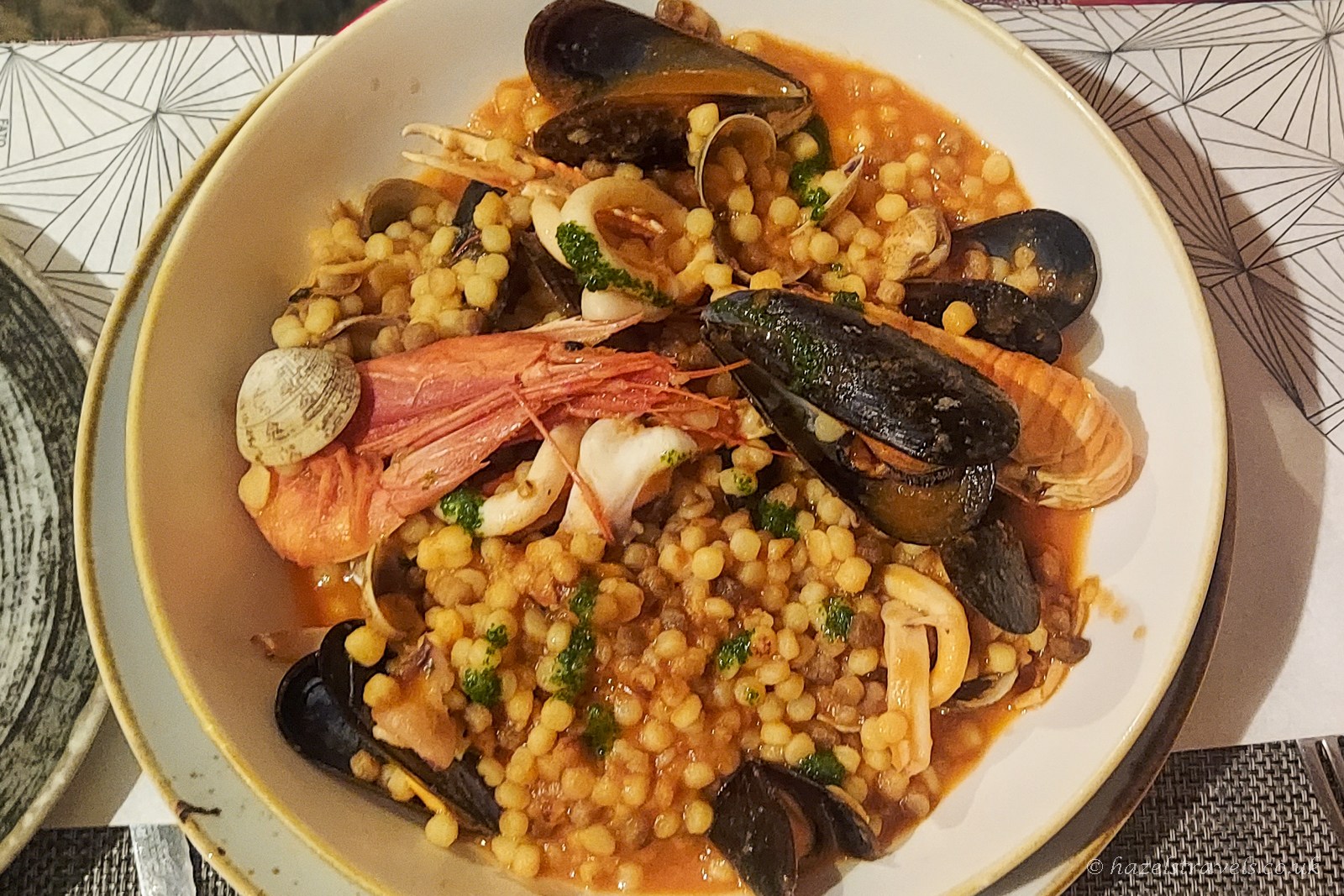
There were culurgiones, stuffed pasta parcels filled with potato, pecorino and mint, and tiny toasted balls of fregola instead of the pasta shapes I was more familiar with from mainland Italy.
Sardinia, I was beginning to realize, wasn't going to fit neatly into my expectations of either Italian or Mediterranean food.
The island that looks inland
You don't have to travel particularly far from Sardinia's beaches before the scenery begins to change.
Away from the coastal towns and resorts, much of the island is mountainous and rural. Sheep farming has been part of Sardinian life for thousands of years, and pastoral traditions continue to shape the island's food. Even today, the island is home to around 3 million sheep—almost half of Italy's entire flock.
Pecorino Sardo is perhaps the most obvious result.
Made exclusively from whole sheep's milk produced in Sardinia, the cheese has held protected designation of origin status since 1996. It can be eaten relatively young and soft or matured until firmer and stronger, but it doesn't stay confined to the cheeseboard. It appears in fillings, pasta dishes and desserts.
Porceddu made the point slightly more emphatically. Roast suckling pig wasn't what I'd imagined eating on a Mediterranean island, but it is one of the dishes most closely associated with Sardinia's rural interior.
Traditionally, the pig is slowly roasted over a fire, sometimes using myrtle to perfume the meat. Mine arrived without quite so much ceremony: several substantial pieces of pork on a plate.
Want to be the first to know about Italian food events, restaurant openings and culinary travel? Subscribe to the Appetito weekly newsletter.
It wasn't particularly glamorous, but then much of Sardinia's traditional food isn't. That's partly what makes it interesting. These dishes weren't created to photograph well for restaurant menus. They developed because they made sense in the places where people were cooking them.
Pane carasau was everywhere.
At first, I treated it as I would any restaurant bread basket: broke off a piece, ate it and carried on with dinner. After it had appeared for what felt like the hundredth time, I started wondering why Sardinia was so attached to something that looked like enormous sheets of edible parchment.
It turns out there was a practical reason.
Traditionally associated with Sardinia's shepherding communities, pane carasau is rolled extremely thinly and baked until the dough balloons. The two layers are then separated and baked again, producing the dry, crisp sheets I'd been finding on restaurant tables.
Its long shelf life made it particularly well suited to shepherds who would often spend extended periods away from home. The bread is also known as carta da musica, or music paper, a nickname generally attributed to its paper-thin appearance and the sound it makes when broken.
Suddenly, the bread basket was telling me rather more about Sardinia than I'd given it credit for.
A different kind of Italian pasta
The chef in me was interested in culurgiones for a different reason.
Associated particularly with Ogliastra in eastern Sardinia, these stuffed pasta parcels traditionally contain potato, cheese and mint. They're closed with a distinctive braided seal known as sa spighitta, shaped to resemble an ear of wheat.
But, as I discovered, there isn't one definitive recipe.
Even within their home territory, the filling can change between communities, with different cheeses, garlic, onion or herbs appearing in different versions. Culurgionis d'Ogliastra now have protected geographical indication status, but that hasn't erased those variations at all. They are still very much alive and well (and tasty).
That interested me almost as much as the pasta itself. Sardinia isn't a particularly large island, yet its food can be intensely regional.
Fregola was different again.
Made from durum wheat semolina, the pasta is formed into tiny, irregular balls and toasted, giving the individual pieces different shades of gold and brown. At first glance, it looks closer to couscous than the pasta I'd eaten elsewhere in Italy.
It can be prepared in numerous ways, but one of Sardinia's best-known versions takes us back toward the coast.
The sea makes its way onto the plate
Of course, you can only spend so long on a Mediterranean island before the sea makes its way onto the plate.
Fregola isn't inherently a seafood dish, but one of its best-known preparations pairs it with clams (which is glorious, in case you were wondering). Another version came with mussels and prawns, the toasted pasta sitting underneath the shellfish and absorbing the broth around it.
And, of course, I can't forget the bottarga. Made by salting and curing fish roe, bottarga has a long history in Mediterranean cooking. In Sardinia, gray mullet roe is particularly associated with the lagoons around Cabras on the island's western coast.
I encountered it in pasta dishes, where only a small amount was needed to bring an intensely salty, savory flavour.
A taste of Catalonia in Alghero
In Alghero, there is another influence altogether.
Walk through Alghero's old town, and Sardinia's historical relationship with the rest of the Mediterranean becomes difficult to ignore. Alghero spent centuries under Catalan and later Spanish rule, and a form of Catalan language is still spoken there today.
The connection survives in its food too. Aragosta alla catalana, Catalan-style lobster, is a signature dish of the city, typically combining lobster with tomatoes and onion.
Then there's paella algherese, a local interpretation of Spanish paella that replaces rice with Sardinian fregola, often adding seafood, sausage and the ever-present bottarga. A Spanish-inspired dish made with ingredients that couldn't be much more Sardinian.
And somehow, we're back to cheese
Of course, you can't go too far in Sardinia without bumping into my old mate, sheep's cheese.
Seadas are made from pastry, fried until crisp and covered generously with honey. Cut through the pastry and the filling isn't custard, chocolate or fruit. It's cheese.
Traditionally, that's fresh sheep's cheese, sometimes flavored with citrus zest, giving the finished dish a mixture of salty, sweet and sharp flavors. It's utterly delicious. I'd already tried pecorino grated over pasta, tucked inside culurgiones or simply eaten on its own. And now here was another form of sheep's cheese, this time beneath a layer of honey. I couldn't think of a more fitting way to finish a Sardinian meal.
More than a list of Sardinian dishes
Looking back, what interested me most about Sardinian food wasn't any one particular dish, but how much I learned about the island simply by eating my way around it.
The pane carasau I'd snapped absentmindedly at restaurant tables had its origins in the lives of shepherds. Pecorino reflected a farming tradition that remains important today. Bottarga told a different story, one connected to the coastal lagoons, while culurgiones revealed just how much food traditions could vary between communities.
Even in Alghero, where I'd happily sat eating mussels beside the harbor, there were reminders of Sardinia's historical connections with Catalonia.
But sometimes, of course, I wasn't thinking about any of that. I was just drinking a cold bottle of Ichnusa beer on the beach, enjoying the sunshine and wondering just how much sheep’s cheese would be involved in tonight’s dinner.