

For more than a century, the streets of Manhattan’s Little Italy have carried the sounds, smells, rituals and memories of generations of New Yorkers. On Mulberry Street, food became language, family became community, and faith became a way for immigrants to remain connected to the towns they left and their beloved homeland while building an entirely new life in America.
At the center of that story stands the Feast of San Gennaro.
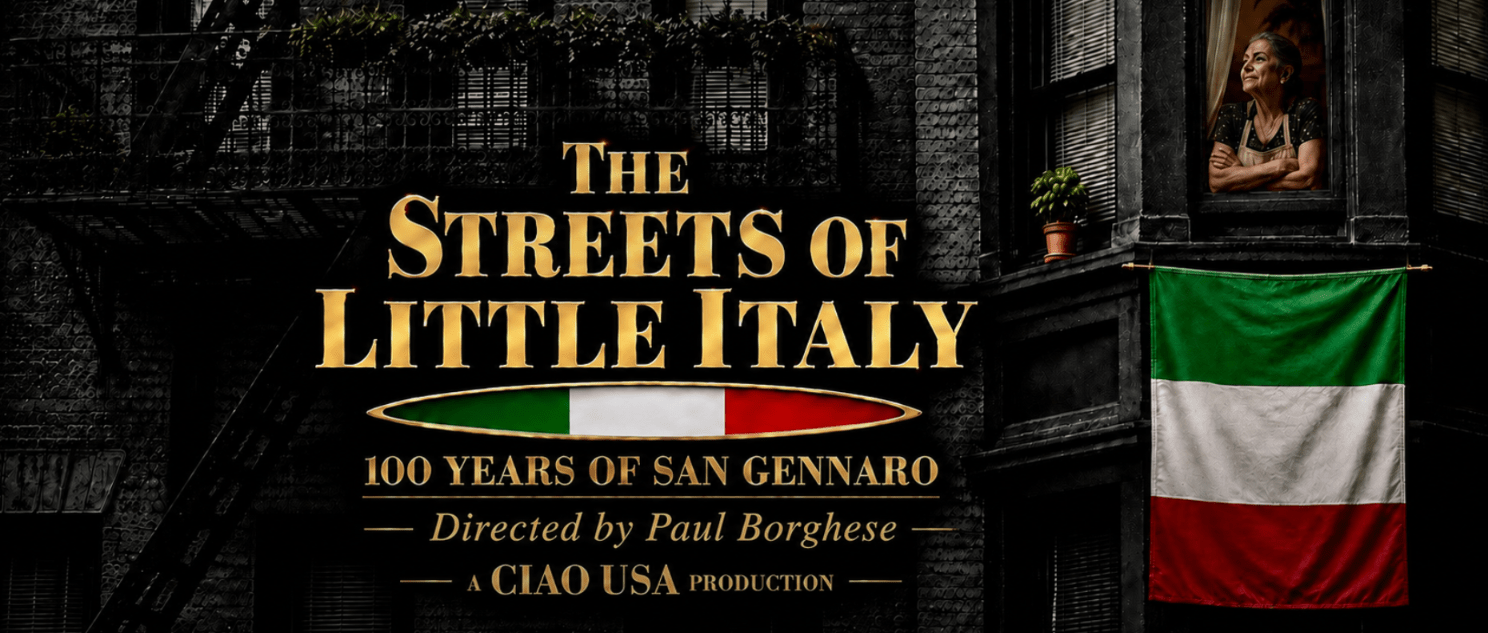
The Streets of Little Italy: 100 Years of San Gennaro is a feature-length documentary that uses this legendary New York celebration as a lens through which to examine a much larger cultural journey: the transformation of Italian immigrants into Italian Americans, the evolution of Little Italy, and the remarkable ability of traditions to endure even as the neighborhoods around them change.
This project resonates deeply with me. Growing up in Astoria, Queens, Little Italy was just a drive or train ride away, and I visited Little Italy often with my family, especially during the holidays. Those experiences gave me an early appreciation for the unique Italian American culture woven into the streets of New York. As a teenager, my friends and I truly appreciated going to Italian feasts throughout New York City, and in recent years, I have had the pleasure of taking my own children to the San Gennaro Feast. Yet, with each visit, the dialogue was often nostalgic, reflecting on how this iconic neighborhood had evolved.
As the daughter of a Sicilian immigrant and construction worker who, like so many Italians before him, helped build New York City, these neighborhoods and the traditions they preserve feel deeply personal. The streets of Little Italy represent more than a historic neighborhood to me; they represent the sacrifices, resilience, and cultural identity of generations of Italian Americans, including my own family.
That personal connection is what makes this documentary so meaningful to me. It is an opportunity to help preserve and share the history behind the traditions that shaped our city, while giving future generations of Italian Americans a way to understand, celebrate, and remain connected to the legacy of their ancestors.
For Giuseppe “Joe” Barone, the documentary’s Producer, Creator, and Executive Producer, that preservation is at the heart of why the film was made.
“I created The Streets of Little Italy to preserve something far greater than buildings, food, or memories. I wanted to honor the people, families, traditions, faith, and values that built Little Italy and made it feel like home,” said Mr. Barone. “These are the stories of the streets we grew up on, the generations who came before us, and the traditions that continue to connect us today. Because communities aren’t kept alive by buildings alone—they’re kept alive by the people who remember, who care, who show up, and who stand together. Faith built Little Italy, and loyalty kept it alive. This film is my way of making sure those streets, those stories, and that spirit are never forgotten.”
Through rare archival material, personal histories, contemporary interviews and immersive footage of the Feast, the film asks a deceptively simple question: What happens to a culture when the neighborhood that created it begins to disappear?
The answer is not necessarily disappearance. Sometimes, culture moves. Sometimes it changes. And sometimes, it survives in a street festival, a family recipe, a photograph, a church, a story told by a grandparent—or a saint carried through the streets of Manhattan.
The story of San Gennaro begins in southern Italy, where devotion to Saint Januarius was deeply rooted in the religious and cultural life of Naples and the Campania region. When Italian immigrants arrived in New York, they brought those traditions with them, creating communities in neighborhoods like Little Italy where religion, food, family, language, and shared customs provided a sense of belonging in an unfamiliar city.
Little Italy became more than a geographic location—it was a social ecosystem where churches, tenements, businesses, family kitchens, and neighborhood institutions helped preserve a connection to the Old World. The Feast of San Gennaro transformed that private faith into a public celebration, bringing religion, food, music, family, and community together on the streets of New York.
As generations passed, the meaning of the Feast evolved alongside the Italian American experience. It became a place where two identities could exist together: Italy and America; the Old World and the New; parents and children; grandparents and grandchildren.
Food became a powerful form of cultural preservation, with family recipes and traditions carrying memories from one generation to the next. While Little Italy itself changed as families moved, immigration patterns shifted, and the neighborhood's physical footprint changed, its culture did not disappear—it traveled.
Italian Americans carried their food, traditions, faith, and memories into other neighborhoods and communities, ultimately transforming what began as an immigrant tradition into a recognizable part of American and New York culture. In this way, San Gennaro is not only an Italian American story, but an American story about how immigrant cultures become woven into the fabric of a nation.
At its heart, The Streets of Little Italy: 100 Years of San Gennaro is a story about memory and cultural survival. Through archival photographs, historical footage, and personal interviews, the documentary preserves the voices and experiences of people who remember a Little Italy that no longer exists in quite the same way.
The film connects the journey of Italian immigrants—from leaving their homeland and arriving in New York to building families, communities, and traditions—to the living Feast that continues today. San Gennaro is therefore not simply a relic of immigrant history, but a tradition that survives because each generation reinterprets and passes it forward.
The neighborhood may have changed, but its cultural legacy remains alive in the people, food, faith, stories, and traditions that continue to return to Mulberry Street.
And perhaps that is the enduring power of Little Italy: the streets may change, but the spirit carried through them can survive for generations.
To learn more about The Streets of Little Italy: 100 Years of San Gennaro, the documentary, its history, and the story behind the film, visit Streets of Little Italy – Official Documentary Film Site.
Love discovering Italy one bite at a time? Subscribe to the free Appetito newsletter for the latest restaurant openings and Italian travel news.