

In Emilia-Romagna, there is a savory pie that is crisp on the outside, soft and colorful within. But it is not just one of those foods that taste like home or a street-food favorite: in Reggio Emilia, people even eat it for breakfast. With a cappuccino.
Yes, a cappuccino.
An extraordinary break from the rules for us Italians, for whom cappuccino and a sweet cornetto are a marriage that rarely welcomes intruders. But in this case, the exception is worth every single bite.
This very Reggiano exception has a name: erbazzone. Or scarpazzone.
Its origins belong to rural culture, to a time when people cooked with whatever the garden provided and used everything they had at their disposal. And when I say everything, I mean everything. Even the ribs of Swiss chard, the thick, fleshy parts of the stalks, which in the local dialect were called scarpe, or “shoes.” Hence the other name by which erbazzone is known: scarpazzone, or scarpasòun in the Reggio dialect.
Love discovering Italy one bite at a time? Subscribe to the free Appetito newsletter for the latest in Italian food, travel and favorite recipes.
Today, we hear a lot about zero waste. Well, let me tell you, we haven't invented anything: we've simply given a new name to something that was part of everyday life in rural culture.
Its origins are generally traced back to the Middle Ages and, century after century, erbazzone became one of the signature dishes of Reggio Emilia's cuisine, eventually receiving protected geographical (PGI) status in March 2026.
But a recipe that travels through centuries rarely stands still.
In Correggio, for example, you can try scarpasòt, made without a pastry crust and cooked directly in a pan. In the Reggio Apennines, meanwhile, scarpasòun muntanèr contains a seemingly unexpected ingredient: rice.
And behind that rice is a story. It is said to have found its way into the recipe through the women who came down from the Apennines to work seasonally as mondine, rice-field workers in the Po Valley. When they returned home, they brought back not only memories of that work but also a new ingredient for an old recipe.
I imagine the kitchens of those days, the aroma of pancetta sizzling with Swiss chard and the skilled hands of the rezdore rolling out the foieda, the thin sheet of dough made with water, flour, lard and salt that would encase the filling.
The rezdora was much more than the woman at the stove: in rural Emilian society, she played a central role in running the home and family. Today, the rezdore, or zdore, are known far beyond the borders of Emilia-Romagna, especially for their extraordinary skill in rolling out sheets of fresh pasta, from which tagliatelle, tortellini and so many other wonders of Emilian cuisine are born.
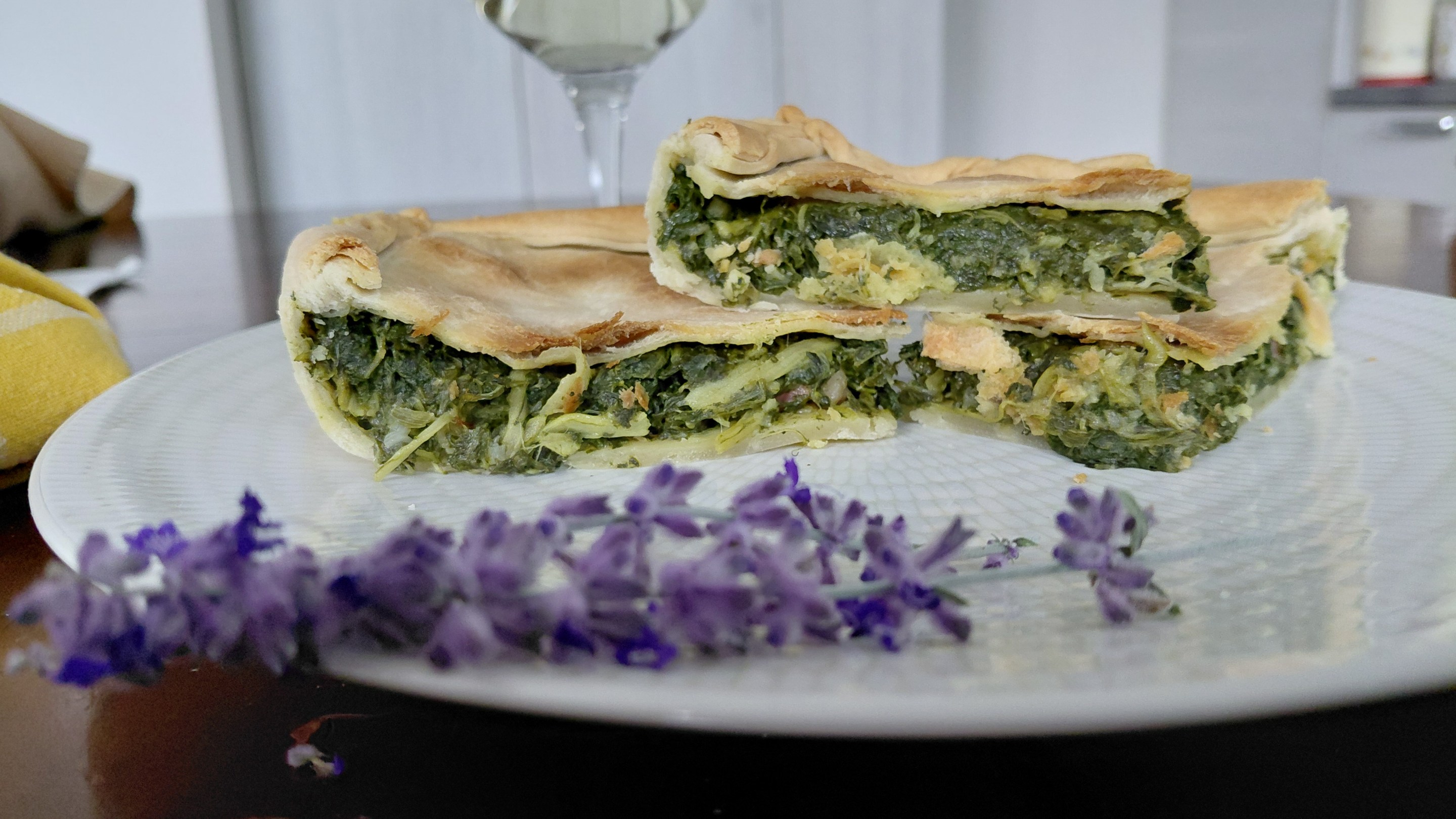
I had never made erbazzone before, so I couldn't wait to taste it. At first bite, you notice the gentle bitterness of the Swiss chard. Then come the sweetness of the pancetta, the savory depth of Parmigiano Reggiano, the lively kick of black pepper and the freshness of parsley, all enclosed between two thin, crisp layers of pastry.
Together, they create a rich, rounded flavor that is deeply satisfying.
If you'd like to pair it with wine, I suggest a lambrusco or a spergola from the Colli di Scandiano e Canossa. But trust me, it's pretty great with a cold beer, too!
Erbazzone
6
servings30
minutes40
minutesNotes: Use a 12 x 14 inch pan. If fresh Swiss chard is unavailable, frozen Swiss chard can also be used. Thaw it completely, drain thoroughly, and squeeze out as much excess water as possible before weighing it. Keep in mind that frozen Swiss chard can lose roughly half its weight once thawed and thoroughly drained.
For the dough
4 cups 4 00 flour
5 tbsp. 5 lard, softened, plus more for greasing the pan and brushing the top
7 1/2 - 8 oz. 7 1/2 - 8 warm water
2 tsp. 2 fine salt
- For the filling
2 lb. 2 fresh Swiss chard, trimmed
5 oz. 5 scallions, white and green parts
4 1/4 oz. 4 1/4 sweet unsmoked pancetta, finely chopped
5 1/4 oz. 5 1/4 Parmigiano Reggiano, finely grated
3/4 oz. 3/4 fresh flat-leaf parsley, finely chopped
2 small 2 garlic cloves, finely chopped
1 tbsp. 1 plus 2 tsp. extra-virgin olive oil
freshly ground pepper
fine salt, if needed
Directions
- Dissolve the salt in the warm water.
- Place the flour in a large bowl.
- Add the softened lard and work it briefly into the flour with your fingertips.
- Gradually add the salted warm water, starting with the smaller amount, and knead until the dough is smooth, soft, and elastic but not sticky. Add the remaining water only if needed.
- Shape the dough into a ball, cover with an inverted bowl or plastic wrap, and let rest at room temperature for at least 30 minutes.
- Wash the Swiss chard thoroughly. Remove only the toughest or damaged parts of the stalks, then roughly chop the remaining stalks and leaves.
- Finely slice the scallions, using both the white and green parts.
- Heat the extra-virgin olive oil in a large skillet. Add the pancetta and finely chopped garlic and cook gently until the pancetta begins to release its fat but does not become crisp.
- Add the scallions and cook over medium-low heat until softened.
- Add the Swiss chard a little at a time, allowing it to wilt as you go.
- Continue cooking until the chard is tender and its excess moisture has completely evaporated. The filling should be fairly dry so it does not make the pastry soggy. Let cool completely.
- Once the chard mixture is cool, add the parsley, Parmigiano Reggiano, and a generous grinding of black pepper. Taste and add salt only if necessary, as both the pancetta and Parmigiano Reggiano are already salty.
- Preheat the oven to 400°F.
- Divide the dough into two portions, making the portion for the bottom crust slightly larger.
- Roll out the larger portion very thinly, large enough to cover the bottom and sides of the pan.
- Lightly grease the pan with lard and line it with the dough.
- Spread the filling evenly over the dough without pressing it down too firmly.
- Roll out the second portion of dough even more thinly and place it over the filling.
- Trim away any excess dough and seal the edges well.
- Prick the surface all over with a fork and brush it very lightly with lard.
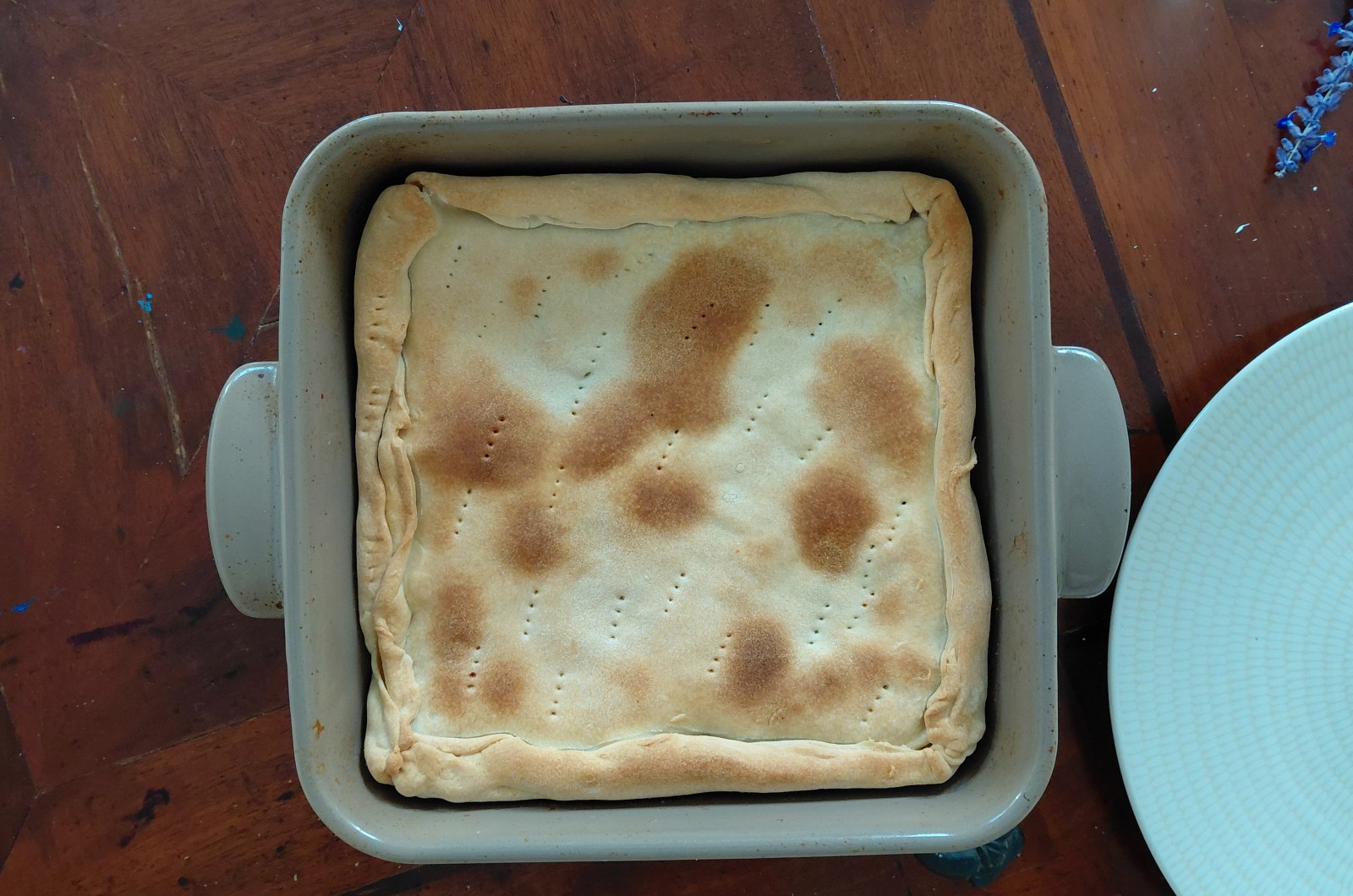
- Bake for 30–35 minutes, or until the top is golden, dry, and slightly irregular.
- Let the Erbazzone cool until warm before cutting it into squares. Serve warm or at room temperature.
Did you make this recipe?
Tag @appetitomagazine on Instagram and hashtag it with #italianfoodanddrink
Like this recipe?
Follow @Appetitomagazine on Pinterest
Follow us on Facebook!
Follow us on Facebook