

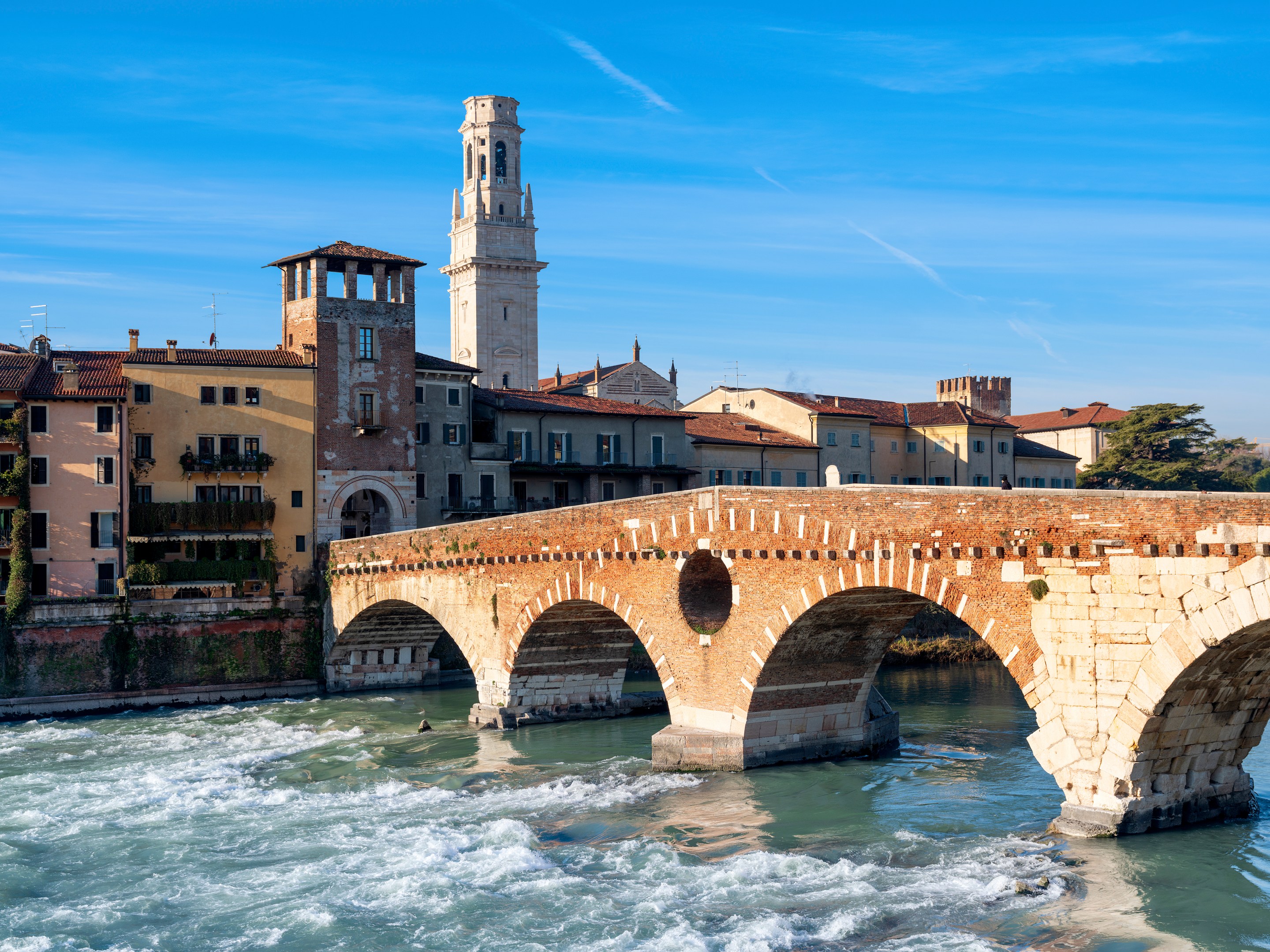
Everyone comes to Verona for the balcony. Fair enough — it's a good balcony. But a few days here and you start to notice the city has been quietly getting on with its own life for centuries, mostly without asking Shakespeare's permission. There's a wine bar that's been pouring since the 1800s, a spa where you can soak surrounded by real Roman ruins, and a bartender two streets from Juliet's house who will happily tell you his cocktails have have nothing to do with star-crossed lovers, thank you very much. This is that Verona.
Home base: Hotel Trieste
I stayed here, just a few minutes' walk from the arena and just far enough from the tourist crush to feel like your own discovery. This boutique hotel is different.
I sat down with Andrea Quiriconi, owner of Hotel Trieste and longtime collector of decorative art, to talk about what draws someone to spend a lifetime collecting objects rather than passing through them.
Tell me about the hotel's history.
It's been in the family since my grandfather bought it in 1953; we're now the third generation. My son, 23, could be the fourth, but he's studying engineering first. I did the same: studied law, planned to be a lawyer, but family circumstances pulled me in. We had to buy out the other side of the family, who co-owned it, and that got complicated. I never practiced law in the end.
What was the hotel like before your changes?
Completely different. My father made a huge financial effort to buy it outright in the 1990s, and for over 10 years afterward, we had no money to reinvest. That turned into luck. With no capital to act on, I just kept refining ideas: from classic to artistic to increasingly unconventional. I traveled specifically to see design hotels, and every six months had a better idea. That's how I learned this hotel could be done a thousand different ways.
Are you a collector in your private life too?
Absolutely. "Collector" is the right word. My home is small, so things move back and forth between there and the hotel, which I really treat as my private space. I fill it with things I can enjoy and change often, so it's never the same twice. I also stay pretty unplugged: no email, barely any news or TV, so my taste stays personal and self-taught rather than shaped by common thinking. That's actually a strength, not a limitation.
Love discovering Italy one bite at a time? Subscribe to the free Appetito newsletter for the latest in food, travel, recipes, and Italian culture stories.
We're moving to fewer, bigger rooms, 60 to 70 square meters, down from 40 rooms to 16 and shrinking further. Instead of filling a room with a standard armchair-sofa-coffee table set, I now want one extraordinary piece — a striking armchair, a side table, a dramatic pendant lamp overhead, so the moment you walk in, you're in an unusual atmosphere. Everything still has to be functional, but guests who recognize a piece treat it with real respect.
Any specific items?
We have the "Terrazzo" sofa by De Sede and several Gio Ponti headboards, among other special pieces. I source things as the opportunity arises, sometimes by chance, and if something doesn't work out, I resell or trade it on the market rather than force it into the hotel.
What kind of guests do you have?
Creatives. People with soul, not necessarily unconventional, just people who appreciate things. Sometimes it's obvious someone isn't the right fit: they'll ask why there's no proper desk or reading lamp. Someone even tried to copy the hotel once; his architect told him it couldn't be replicated because of how much soul was behind every choice.
What's the vibe with guests in the evenings?
Since I don't watch TV, my own "news" comes from the evenings: we host extraordinary people with extraordinary stories. We offer a drink, some prosecco, and the place turns into a kind of therapy session where people open up. During business or trade fair periods especially, real relationships form here between guests.
What is your take on the word luxury?
It’s outdated. People are looking for meaningful connections and unique experiences, like sitting in a museum-quality 1960s armchair or having something you'd normally have to travel far to get. I think if a trip gives you three or four special moments, it's already a success. A hotel that's just for sleeping and breakfast can't give you that.
Where to Eat
Perbellini is a name synonymous with fine dining in Verona, and Casa Perbellini 12 Apostoli holds the coveted three Michelin stars. In January 2012, four cooks, protégées, and now business partners of Giancarlo Perbellini, opened Locanda 4 Cuochi, a casual and contemporary take on Italian cuisine. Today, Dario and Moreno are chefs and maître d’. The menu changes six times per year, and the offerings are as playful as they are delicious. As a nod to the name, four colored pencils are set on every table to allow guests to doodle while they await their meal.
Tapasotto defines itself as "a gourmet break for small pleasures": this innovative venue offers charcuterie and cheese boards alongside signature tapas, perfect for an aperitivo or a full meal, complemented by a curated wine list. This is another Perbellini creation, with Federico Zonta as head chef. The modern, informal setting features an ever-changing menu of original dishes, including icons like the egg in a glass and beef tartare crafted from carefully selected ingredients personally chosen by Federico.
For a classic Veronese meal, there's really only one answer: Antica Bottega del Vino has been drawing people through its doors since 1890. It still feels less like a restaurant and more like a Verona institution that happens to feed you. Its Amarone risotto is a showstopper. You can even sidle up to the bar at lunchtime and order a little cicchetto, a bite to accompany your glass of wine.
Where to have a good cocktail
Verona's bar scene doesn't shout about itself, which is part of the charm. You have to go looking, and that’s half the fun.
Velvet is the newest name on everyone's list, with the quiet confidence of a place that's actually good rather than just new. Bar Manager Samuele Pica explained the concept: Velvet was designed as the bar for a five-star hotel that didn't exist yet. Michelin-starred restaurant Iris opened first, Velvet followed in December 2024, and a spa set among real Roman ruins opened in June 2025.
The hotel itself, with around 30 rooms, is due to open within the year. Launching the satellite venues first let locals adopt the space before the hotel could make it feel exclusive, so Velvet now runs on loyal regulars as much as tourists. It's open 4 p.m. to 2 a.m., with natural crossover as Iris's diners drift over after dinner and Velvet's regulars head there to eat.
The menu is built for range: revisited classics, a wine list, a small sake selection and a growing nonalcoholic and low-alcohol program. The current signature menu takes its structure from the life of a tree — earth, root, bark, flower, fruit, leaf — with the “Fiore” (gin, San Lugo wine, sugar) as the bestseller. The martini remains the most-ordered drink, and head bartender Matteo Bianconi can whip up the perfect one — from the classic through espresso, Tangertini and brunch variations.
Archivio Bar feels exactly like its name suggests — a little bit like drinking inside a memory. Low light, old bottles, the sense that someone here has strong opinions about vermouth. Co-owners Raffaele Bellomi and Tommaso Gecchele even make and market their own, called Volume Primo. Archivio is an institution, and their sister bar Amaro is open day and night, featuring a huge selection of, you guessed it, amaro.
Grande Giove (which actually means “Great Scott!”) moved to larger premises, but its concept remains solid: perfectly prepared drinks, a friendly and laid-back atmosphere and tunes are cranked out on the LP in the corner. Apart from their signature serves, the Agave Experience section of the menu suggests an array of tequila and mezcal libations that are hard to find elsewhere.
Now it’s time to give Romeo his due, with a cocktail bar that grabbed his name. This former church from the 1200s wows with a floor-to-ceiling back bar, and upstairs a balcony, from which to view the action. The cocktail list is solid, no gimmicks here, just finely prepared libations. The amphora aged Negroni sits four years in a terra cotta vessel before meeting your lips. Delicious!
Ok, Romeo, you got the balcony, the play, the postcards. But Verona was a thing long before you showed up, and it’s doing just fine. I discerned it one collector, one cocktail, one plate of food at a time. Give the city a chance to be more than a backdrop, and it will happily oblige.