
Most Americans met Alessandra Spisni on Netflix. In "Chef's Table: Noodles," she is the teacher behind Los Angeles chef Evan Funke, the woman who taught him to roll pasta by hand in Bologna.
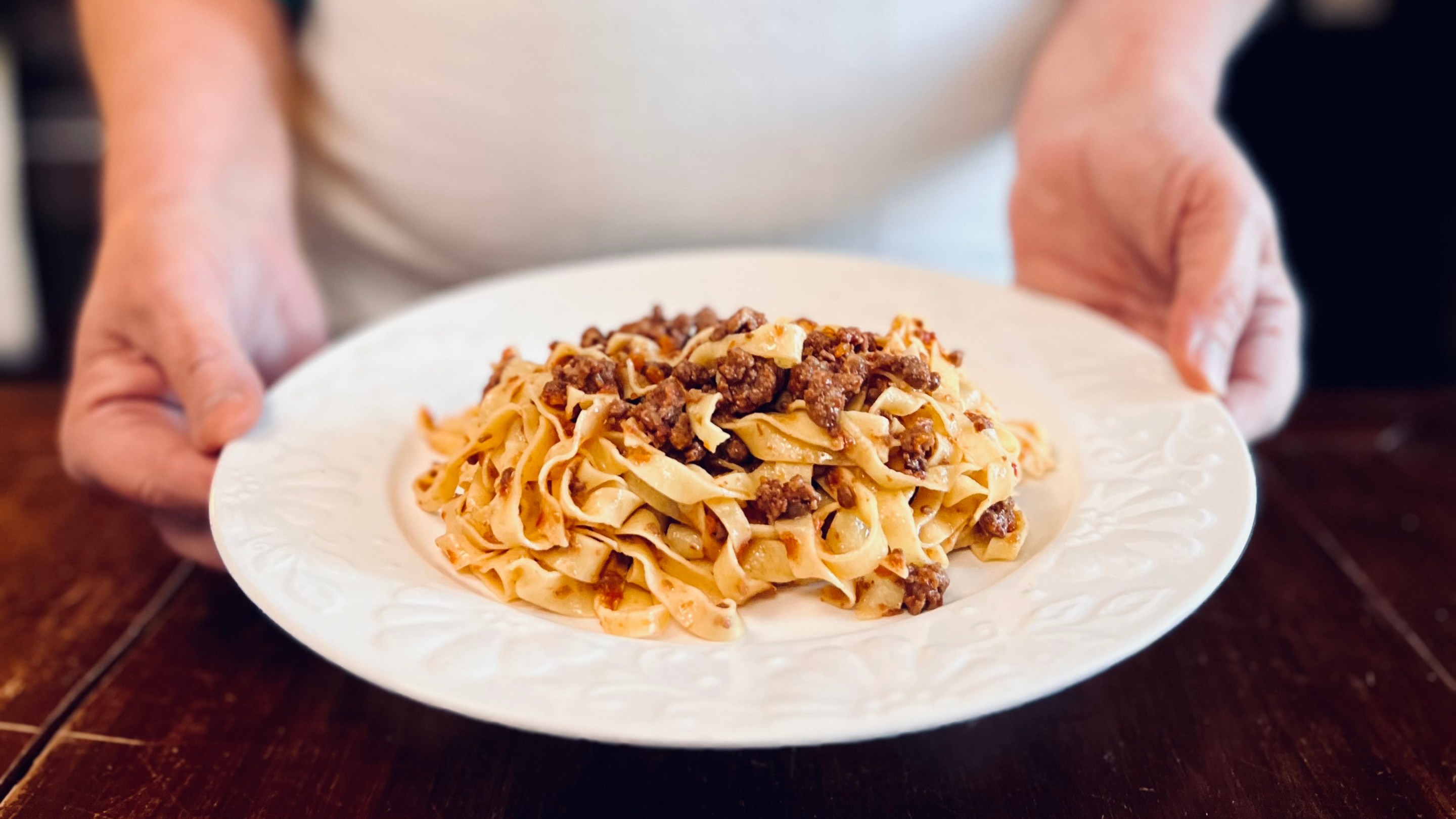
In November 2024, I asked her to do something different: leave her school in the city and come with me to a stone house in the Apennines to make tagliatelle al ragù in an old kitchen. I filmed her alone, with an iPhone.
It was a perfect day. The light was soft and low, the kind you get in the mountains in late autumn, and the family who runs Agriturismo Ca' Gabrielli opened their home and their kitchen to us with a generosity I still think about.
Working in silence
For three years, Spisni and I had made videos together for her channels. In all of them, she talks. She explains every step, jokes with the audience and corrects the way you hold the rolling pin. That is what her viewers expect, and she is very good at it.
This time, I asked her to stay silent.
She trusted me. She stepped into the role without hesitation, and the work turned into a kind of dance between two people who knew their craft: her with the dough and her presence in front of the camera, me with the framing and the light. Almost every shot was the first take.
Her voice came later. We recorded an interview on a separate day and laid it under the images, so that in the film she seems to be thinking out loud while her hands keep working.
The test of San Luca
In that voice, she talks about her grandmother Maria, a farmer. She talks about feeling the flour between your fingers and about a test that every old sfoglina, a women who rolls egg pasta by hand in Bologna, knows by heart.
The sheet of pasta is ready, she says, only when you lift it and can see San Luca through it.
San Luca is the sanctuary on a hill above Bologna, reached by a covered walkway of 666 arches. Bologna's porticoes were named a UNESCO World Heritage Site in 2021, and this one is the longest. For generations, it has watched over the city. In Spisni's kitchen, it becomes a unit of measure: the dough has to be thin enough to let the landscape through.
"Grandma Maria was a farmer," she says in the film. "Do you know what it means to be a farmer? It means knowing what you're working with. To know each tomato, one by one. To know where you got them from."
My grandparents' countryside
Listening to her, I kept thinking about my own grandparents.
They lived in the countryside near Ferrara, in the flat farmland northeast of Bologna. My grandfather wove wicker baskets for the fruit. As a kid, I rode my bike between the orchard rows to reach them while they were picking, and spent whole afternoons balancing along the edges of the irrigation ditches.
My grandmother cooked every day. She baked cakes, rolled fresh pasta and spent the summer putting up preserves: tomatoes, plums, apricots and peaches. My uncle had a butcher shop, and I still remember the salami, the prosciutto and the salama da sugo, a cured sausage from Ferrara that is cooked slowly for hours before it reaches the table.
Life there ran from morning to night around the work. It tired you out, and somehow it also restored you.
Spisni spent her own childhood summers in the Apennines with her grandmother Maria. Many families in this region still carry that world with them, with the kitchen at the center of the house and ingredients they know by name. The film is dedicated to our grandparents.
Dreaming of your own Italian escape? Explore Appetito’s Italy travel guides and start plotting your next adventure.
What viewers felt
An initial, longer version of the project came out on Spisni's channels in 2025. The views were good, but the comments are what surprised me. People wrote about their mothers and grandmothers, about Sunday lunches, about kitchens they hadn't seen in decades.
One viewer wrote about the sound of water in the fountain: "It was so moving that it brought tears to my eyes. In that sound, I find my childhood and my most beautiful memories." Another said the film looked like it came from the 1800s. Someone wrote that they could almost smell it.
Those reactions became the heart of a study I co-authored with Johanna Heinonen-Kemppi of the University of Eastern Finland, published in the journal Gastronomy and Tourism. Its conclusion is one I recognize from my grandparents' kitchen: the identity of a place lives in its food, too.
A 4 ½-minute version of "Bolognese" was selected for the Ceres Food Film Festival in New York and featured by Labocine, also in New York. It is now available in full on YouTube and Instagram, with English subtitles.
Finding this Bologna
If you want to find this Bologna, leave the center for a day. Walk the portico up to San Luca and look back at the city. Drive into the Apennines and eat at an agriturismo where the pasta is still rolled by hand. Or learn to roll it yourself: The Spisni family teaches sfoglia classes at their school, VSB Bologna.
"Sfoglia is grandma. It's home," she says. "If this film makes someone want to come to Bologna and put their hands in the flour, we did the right thing."
Love discovering Italy one bite at a time? Subscribe to the free Appetito newsletter for the latest in food, travel, recipes, and Italian culture stories.