

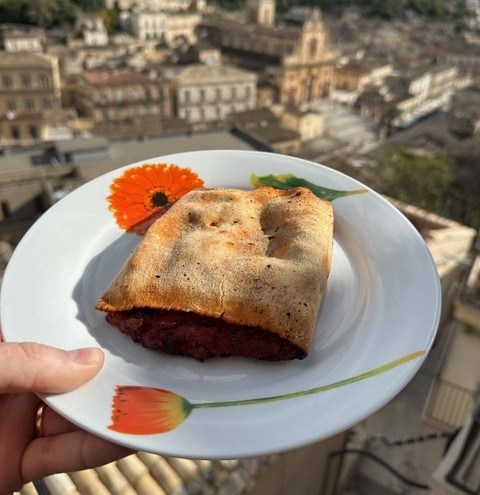
Some foods find you. Others you have to hunt for. Scaccia belonged firmly in the second camp.
I first came across it years ago in an online newspaper article. It mentioned this strange folded bread from the Ragusa area of Sicily; part pizza, part focaccia, part something entirely its own. Nobody I knew had ever heard of it. Even in my native UK, where Italian food is incredibly popular and well represented, scaccia might as well not exist.
That only made it more intriguing. When a dish is that local, that unknown, my curiosity goes into overdrive.
So, I did what any food obsessive would do: fell down a rabbit hole of half-translated recipes, blog posts and fragmentary instructions. I ended up stitching together my own version, equal parts instinct and detective work. It tasted good, but I always wondered how close I’d come to the real thing.
Finding Scaccia
And then, there I am, in Ragusa, finally meeting the dish on its own turf. No substitutions, no approximations, no British flour masquerading as Sicilian.
I park our car on an uncomfortably narrow side street. We walk around the corner and into the unassuming Panificio Giummarra, a place I’d scoped out as one of the best in town for scaccia.
My eyes lock onto it. It is sitting there in the counter display, directly opposite the door. If reading the newspaper article all those years ago was metaphorical love at first sight, this was the real deal.
Scaccia, you must understand, is no looker. It sits there at the bottom of the display resembling a messy, crumpled duvet. There’s little grace to its appearance.
Still, I wait impatiently for my turn to order, ready to bring this weird dream of mine to life.
Suddenly, it’s our turn and we opt for the tomato and caciocavallo scaccia. It is unceremoniously wrapped in tin foil, weighed and handed over in exchange for a few euros.
I hurry us back to the car and we decide to wait just a few minutes more, saving that first bite for the slightly more salubrious surroundings of a car park beside picturesque Ragusa Ibla.
Yet, as with most things in Italy, patience is a virtue. As we leave, a car appears from the opposite direction and I’m forced into a quick, panicked three-point turn, which may have been closer to a seventeen-point turn, to avoid a stand-off with the Fiat Panda directly facing me on this dead-end street.
I have to work for that scaccia just a little more, obviously.
We park up and the scaccia is whipped out of the tin foil before the handbrake has had much time to settle.
The first bite brings a rush of deeply concentrated passata. The sharp, salty caciocavallo cuts through the richness before the delicate layers of dough gently remind me that this is, indeed, bread.
Holding a slice warm from the oven feels like closing the loop on an obsession that’s followed me for five years.
Compared with the one I’d made at home, the dough was lighter and more delicate; the filling more generous and richer than I’d imagined from my recipe research.
Can't get enough of Sicily? Explore more of our stories from across the island.
A few miles away
But there’s a twist: it wasn’t quite my first encounter. We had been staying in nearby Modica and, although it was only a 15-minute drive away, the town had its own version: slightly thinner dough and a less generous filling. The distinction wasn’t in the name. Scaccia being singular and scacce, plural in both places. It was in what each town did with it.
What struck me while travelling through this part of Sicily was how scaccia isn’t an outlier. It belongs to a whole landscape of baked goods that are so local they sometimes don’t even travel to the next town. Scaccia itself a fitting visual metaphor for hyperlocal Italian cuisine.
To make one, a thin sheet of semolina dough is spread with filling and folded back on itself several times. The result is a seemingly complicated but fundamentally simple web of dough and filling. It can be made in a multitude of ways and include different fillings while still remaining recognisably the same thing.
Another example I encountered in Modica was the impanata. One bakery sold a small breaded parcel labelled Siciliana impanata, filled with prosciutto, tomato and mozzarella. Elsewhere, the counters displayed rectangular focacce and schiacciate with their own combinations of fillings. Ten minutes over a hill and the display changes entirely: different shapes, different fillings, different vocabulary.
It’s one of the clearest reminders of how tribal Italian food really is. Outside Italy we often talk about “Italian cuisine” as if it’s one unified thing, but here the borders are drawn at the nearest ridge. A bakery in Ragusa folds its dough differently to one in Modica. A tomato filling that’s standard in one town is unthinkable in another. Even the way loaves are knotted or scored seems inherited, more family tradition than written recipe.
Scaccia sits right at the heart of that. A dish that’s pretty unknown outside this corner of Sicily, somehow finding me anyway and now, finally, letting me come to it. In my quest, I unearthed a whole other collection of wonderful baked goods to taste and, one day, recreate myself.
My journey with scaccia taught me that the internet can be a wonderful place to discover things hidden in plain sight. But the real knowledge came from attempting my own pieced-together version and finally being fortunate enough to seek out the real thing, encountering a few unexpectedly pleasing twists along the way.
Back in the kitchen
Our trip to Sicily was followed by months of travelling outside Europe. It’s only now, in the summer of the following year, with the travelling over and a kitchen of our own again, that I’m able to put what I learned into practice. To tweak my original recipe. To try to recreate the specific flavours and textures of the real thing and its nearby relatives.
My original recipe heavily annotated with notes from Sicily, I am ready to give it another go.
“Be more generous with the filling.”
“Take time to really concentrate the tomato sauce.”
“Make the dough thinner than you think it needs to be.”
I put on my apron and the feeling of intense pressure returns, just like on that narrow one-way street in Ragusa nine months ago. I hope it’ll be worth the wait.
Love discovering Italy one bite at a time? Subscribe to the free Appetito newsletter for the latest in Italian food, travel and favorite recipes.