
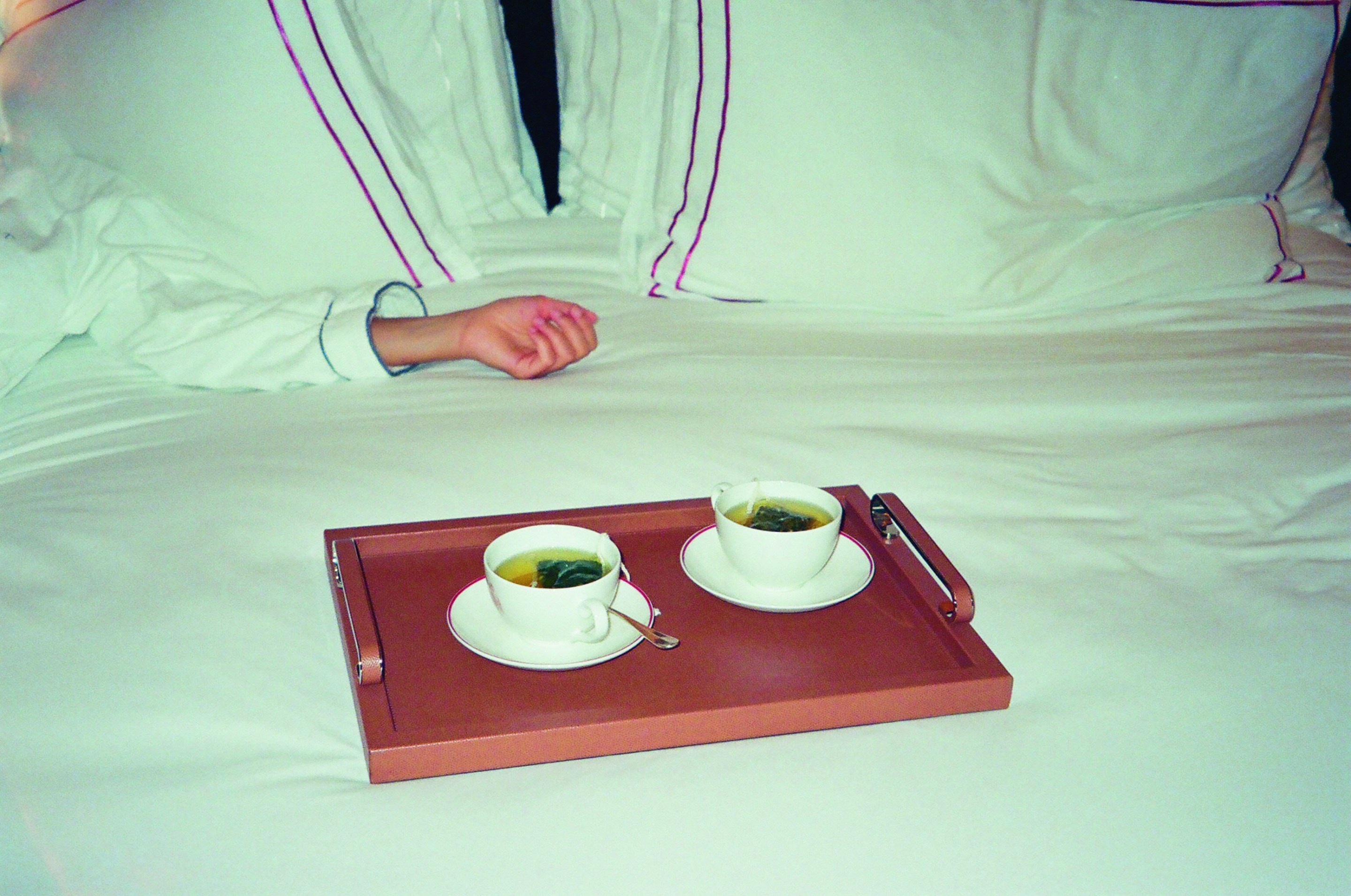
Given that Italy is a country more famous for its coffee than its tea, I am always pleasantly surprised to see how the experience of tea in the Italian countryside translates seamlessly to the fashion capital of Milan. While the coffee menus at most places are the same (espresso, macchiato, latte), at Milan’s tea parlors I found teas from the world over, whether grown in Japan or China, or tisanes from neighboring Germany and from Italy itself.
I also find Milan to offer a different perspective on tea. Whereas in some cities the allure of tea is the beverage or the teahouses, this isn’t necessarily the case in Milan—though there are beautiful tea shops. In some ways, Milan is a subtle city. It doesn’t have the decadent architecture and design of Rome or Florence, but more of an industrial history and infrastructure. The beauty lies in the intricate details of the building entryways, the houses, the furniture, and in the search for those details. When I focus on tea in culture, I look for the design of a city inspiring its inhabitants to live with tea, and search for specific teas and accoutrements that speak to the city itself. I look for it in movies, books, and paintings about a place. This search makes Milan, at its core a design city, extraordinary.
I first discovered Villa Necchi by watching Tilda Swinton in I Am Love (and, later, the villa was featured in House of Gucci). Visiting it for the first time in person, amid the meticulously designed rooms, I was delighted to discover the remnants of a family of tea drinkers. There are tea sets in gold, porcelain, and silver; teacups in the paintings on the wall; and perhaps my favorite of all, a plastic red tea set on an unassuming tray in the staff area. In a home-turned-museum, where you can’t help but contemplate how a family lived, you can immediately picture them gathering in the garden room, gossiping around cups of tea. Even in I Am Love, there’s a brief tea scene where Tilda Swinton sits on a couch with her mother-in-law while, in the foreground, one of their maids in a pink dress pours tea from a white porcelain tea set with little pink flowers on it.
This perspective on Milan, of focusing on design and looking for tea culture outside of the teahouse, can be applied to countless cities around the world, though in Milan it takes on a modern, colorful sophistication.