
There is a version of this story where I planned everything. Where I set out deliberately to bridge two of the world’s great culinary traditions in a single bowl. That version is cleaner, more impressive. It is also not true.
The real version: I had made a batch of makhani sauce at home — the recipe I learned at Rasoi by Vineet, the Michelin-starred Indian restaurant at Mandarin Oriental in Geneva — and I didn’t want rice or naan. I stood in my kitchen in New York, looked at the sauce, looked at my pantry, and thought: why not spaghetti?
What followed was not a revelation so much as a confirmation of something I had suspected for a long time. Makhani sauce and a great Italian butter-tomato sauce are not opposites. They are cousins who grew up on different continents and never knew each other.
The Same Architecture
Both sauces begin with tomatoes cooked down in butter, built slowly on low heat. The precise Italian parallel is not a generic pomodoro — it is Marcella Hazan’s three-ingredient tomato sauce: San Marzano tomatoes, butter, onion, nothing else. That sauce and a makhani base share the same architecture before the cream enters. Where they diverge is the aromatics: Italian tradition is spare — the tomato and the fat speak for themselves. Makhani reaches for cardamom, ginger, roasted cashew, and smoke.
The cream in this dish belongs entirely to the makhani tradition, which is Mughal in origin — a technique of enriching and rounding a spiced sauce that has no direct equivalent in classical Italian cooking. The closest Italian bridge is vodka sauce, where tomato and cream meet in the same way. Two traditions, arriving at the same enrichment from different directions, for different reasons.
The version I make uses San Marzano tomatoes instead of the Roma tomatoes traditional to makhani. This was not an accident. I learned at Rasoi by Vineet that great cooking is about understanding why an ingredient works, not simply that it does. Roma tomatoes bring acidity and body. San Marzano brings the same body with lower acidity, a natural sweetness, and a fleshy depth that holds up to two hours of slow cooking without turning bitter. The Campania volcanic soil that makes San Marzano essential to Neapolitan cooking makes it equally at home in a Mughal-derived sauce.
When I realized this, it felt like the entire argument in miniature. Two cuisines, separated by geography and history, arriving at the same tomato for the same reason — through the same instinct, without knowing about each other at all.
New York as the Testing Ground
New York is the only city in the world where this dish makes complete sense as a conversation. Everyone here knows butter chicken. Everyone knows spaghetti. The city is fluent in both languages. But that fluency comes with a kind of possessiveness — people know what these dishes are supposed to taste like, and they do not welcome the unexpected.
When I made this for my colleagues, no one believed it would work. The concept was met with polite skepticism at best. An Indian sauce on Italian pasta. The question hanging in the air was simple: why?
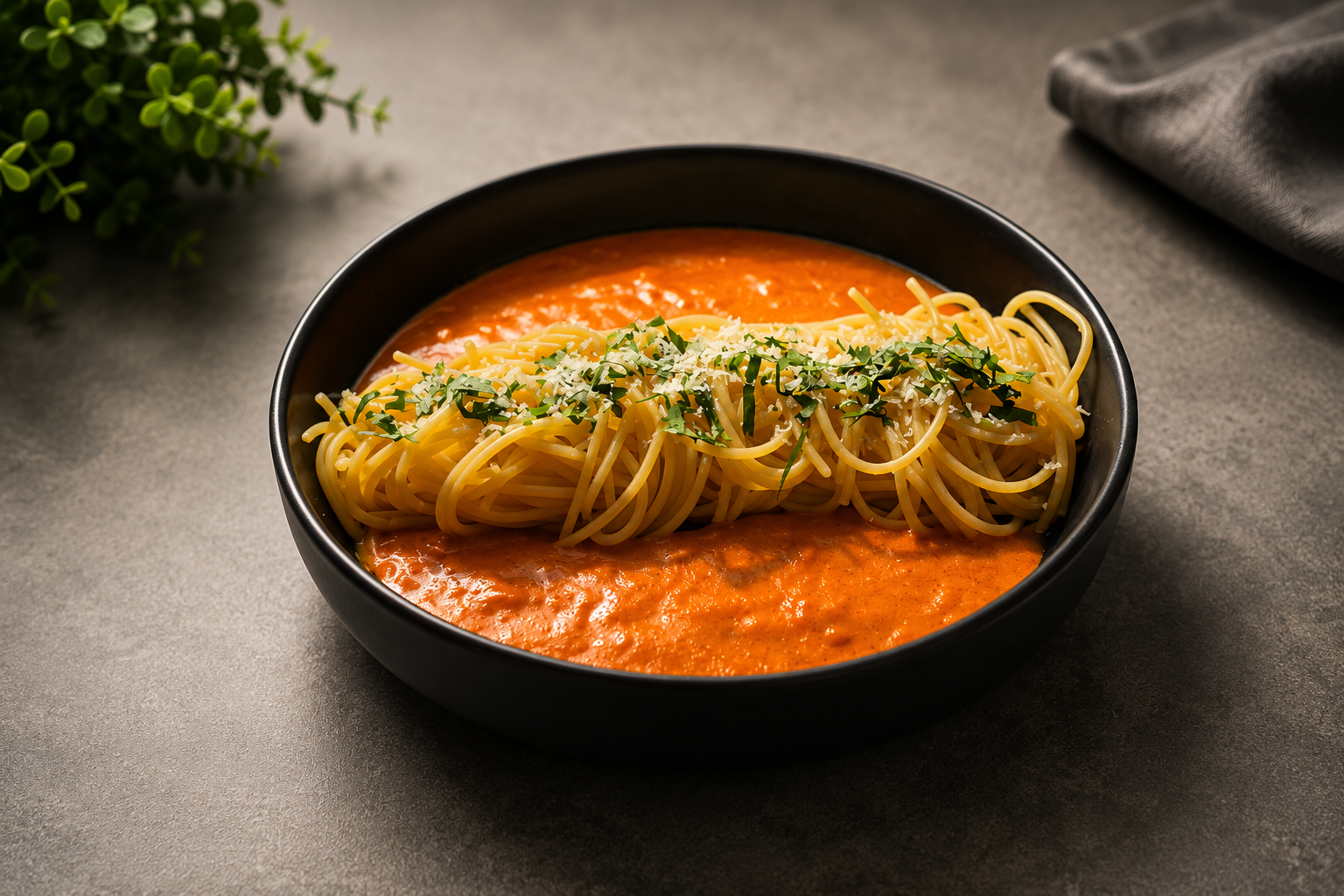
The answer is in the bowl. When the sauce — slow-cooked for two hours, finished with heavy cream, stirred through al dente spaghetti, and finished with Parmigiano-Reggiano and fresh cilantro — lands in front of you, the question disappears. The confusion remains, but it becomes the good kind. The kind that makes you lean forward.
What a Michelin Kitchen Taught Me
At Rasoi by Vineet, the kitchen was in Geneva. The ingredients were local — Swiss cream, European butter, continental produce. But the food tasted Indian. Deeply, specifically, regionally Indian. The technique and the spice logic were from one world; the raw materials were from another. And it worked, because the chef understood that great flavor does not require geographic purity. It requires structural integrity.
That principle is the foundation of this dish. The makhani is Indian in structure — the spice sequence, the slow reduction, the cashew-enriched base. The pasta is Italian in construction — finished al dente, coated rather than drowned. The Parmigiano-Reggiano at the end is not decoration. It is a salt and umami note doing exactly what it would do in a cacio e pepe.
Neither tradition is compromised. Both are honored. The dish sits at the intersection where they were already pointing toward each other — waiting.
In New York, that intersection has a table set for two. See the recipe below.