

In Italian, food is rarely just food. It organizes time, relationships, and expectations. This column explores Italian sayings and proverbs as ways of thinking shaped at the table.
These expressions preserve that knowledge in compact form. Read literally, they speak about eating. Read more closely, they offer insight into how experience, pleasure, and social life are understood.
The aim is simple: to treat language as another ingredient—handled with care, tasted slowly, and shared. No prior appetite required. It tends to arrive along the way.
Mangia, Mangia
Literal translation: Eat, eat!
Meaning: Mangia, mangia! is an insistent invitation to eat. As an Italian noun, un mangia mangia describes a scramble for personal gain, often at public expense.
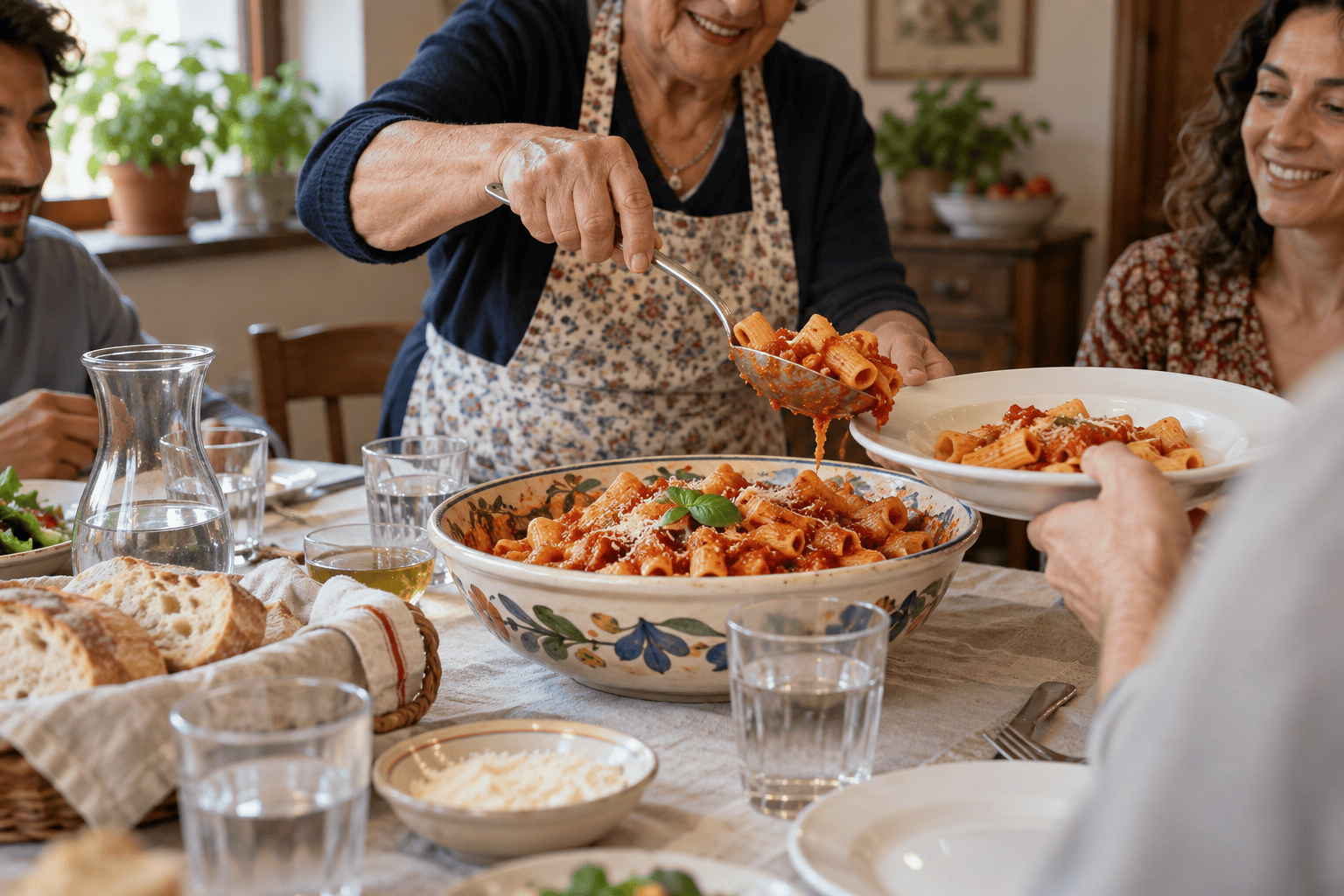
A parent or grandparent keeps urging a child to take another helping; a host wants to see the food enjoyed. In an Italian American family that remembers having had less, the sight of someone eating well may carry particular satisfaction. The repeated mangia, mangia! expresses both the pleasure of offering food and the reassurance of knowing there is enough. You may have said you were full, but the person holding the serving spoon is apparently unconvinced.
Even without an Italian background, you probably recognize the expression. It has traveled beyond Italian American households: on a restaurant sign, Mangia Mangia addresses anyone who walks through the door, promising generous portions and an enthusiastic welcome. No translation is needed to understand what the establishment hopes you will do.
The invitation remains familiar in Italy. But if mangia mangia meant only “eat, eat,” there would be little more to say about it. As we have seen throughout this series, Italian expressions built around food often speak about much more than meals. This one is no exception. In its figurative use, the repeated verb has become a noun: un mangia mangia. Nobody is being offered dinner.
Today, it is one of the most familiar ways Italians describe a political or institutional setting in which everyone seems to be after a share. È tutto un mangia mangia—“It’s a feeding frenzy”—suggests favors exchanged, money diverted, or public resources treated as though they were a private buffet. The expression does not require every person involved to have committed a crime. It conveys the suspicion that too many people have arrived with an appetite and too few intend to pay.
That political use was already in print in 1894. In Federico De Roberto’s novel I Viceré, men take part in “il mangia-mangia” amid political upheaval and, after a failed Sicilian revolution, hurry back to honor the restored authorities. Their loyalties change rather faster than their appetite. The noun now has an entry of its own in Italian dictionaries, sometimes written as a single word: mangiamangia. The diners have even managed to squeeze together on the page.
The doubled word gives the scene its momentum: one person eats, another joins in, and soon everyone is helping themselves. What began as a generous invitation has become a picture of greed. There is always room for another helping when it belongs to someone else.
Fortunately for American restaurants called Mangia Mangia, customers are unlikely to read the sign as an accusation of political corruption. They can concentrate on the menu—and assume the only thing being taken from them is their order.
Get a taste of Italy in your inbox. Subscribe to Appetito’s newsletter for Italian recipes, food stories and travel inspiration.