

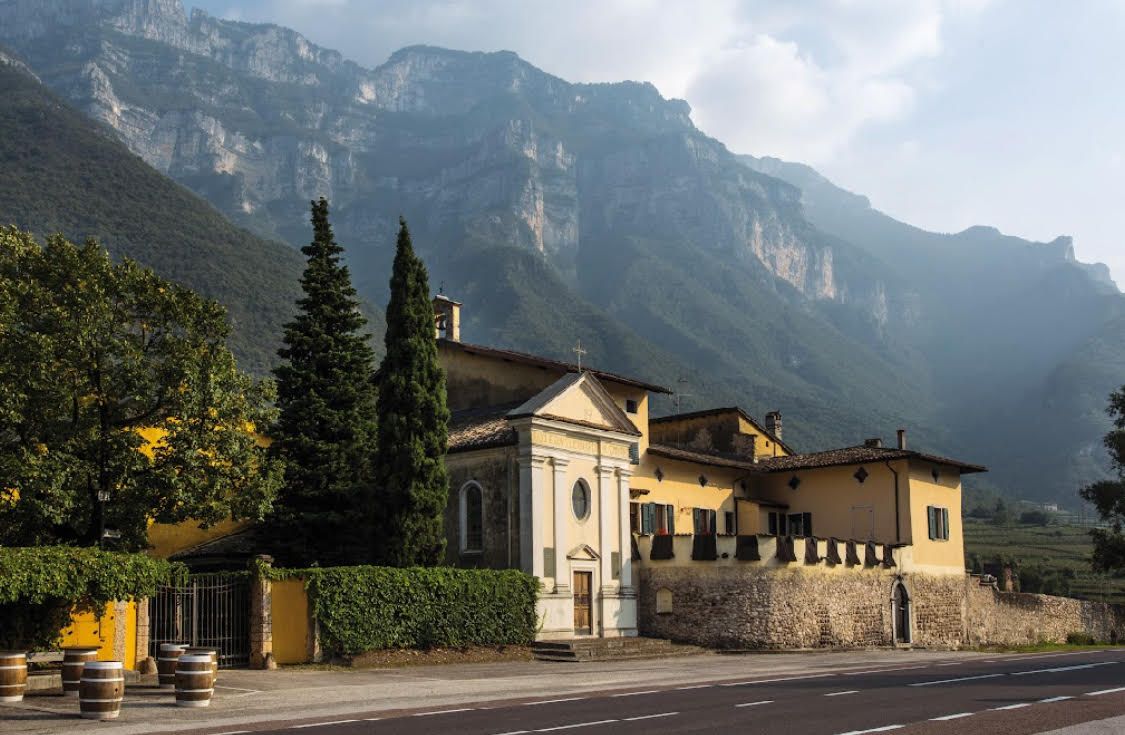
I recently had the pleasure of visiting Tenuta San Leonardo in Avio, the southernmost part of Trentino (near the Veneto border). Nestled between Monte Baldo and the Lessini mountains, the estate is an oasis within the valley, filled with both native and exotic flora. I happened to visit on a rainy day in August, which surprisingly framed the wine tasting quite nicely.
The vibrant gardens and vineyards, color-blocked against the bloated gray clouds lounging on the surrounding rock, gave way to a stunning setting, curated over many years by the Guerrieri Gonzaga family. It also served as a nice visual aid to the wine styles: Bordeaux and Tuscan inspired wines shaped within a distinctly Alpine setting. Our tour guide, Elena, explained that this year faced unusually hot and dry weather that had been encroaching on the estate, making the current rain a massive welcome relief for the plants.
During our tour with Elena, we spoke about San Leonardo’s extensive history. More than 1,000 years ago, the property was a monastery; for over three centuries, it has been home to the Marchesi Guerrieri Gonzaga family. The winery owes much of its identity to Marchese Carlo Guerrieri Gonzaga, who studied oenology in Lausanne before looking to Bordeaux for inspiration. In Tuscany, he learned blending from Mario Incisa della Rocchetta at Tenuta San Guido, home of Sassicaia, before planting Cabernet Sauvignon at San Leonardo in 1978. Four years later, the flagship wine was born.
Later, Marchese Anselmo Guerrieri Gonzaga, the estate’s current CEO, came out to chat with us. His background in business and wine - spanning Rome, London and South Africa - now informs his work growing San Leonardo’s presence internationally. His warmth and easy hospitality reinforced that San Leonardo remains very much a living, working family estate.
Our tasting began with Cuvée Pietra, a 100% Chardonnay Trentodoc Blanc de Blancs Extra Brut. Its high acidity and rocky, mineral quality, complemented by white peach and lemon peel aromas, made for a fresh expression of Chardonnay. The 2025 Vette, made from Sauvignon Blanc, was incredibly green and held onto its varietal pureness, while the 2023 Gemma, a Lagrein rosé, was all juicy red fruits and a floral bouquet, pleasurable and perfect for an aperitivo.
San Leonardo is best known for its reds, so we happily approached the second half with warmed palates and heightened curiosity.
I was quite impressed by the 2021 Villa Gresti, the underdog beside the flagship San Leonardo and varietal Carmenère, but a showstopper, nonetheless. A blend of 70% Cabernet Sauvignon, 20% Merlot and 10% Carmenère, it was promising on the nose and fulfilling on the palate, with each of the three grape varieties holding distinction in the blend. Out of the three reds, this most gave the feel of an easy and classic Bordeaux-style wine, that could be opened with a light conscious. On the palate danced aromas of black fruit, vanilla, clove smoke and spice.
The flagship 2020 San Leonardo slightly reversed the balance of Villa Gresti: 70% Cabernet Sauvignon, 20% Carmenère and 10% Merlot. The greater presence of Carmenère, drawn from some of the estate’s oldest vines, brought a more concentrated intensity, with fresh black fruit alongside deeper, cooked-fruit notes, red and black currant, baking spices and the grape’s distinctive black pepper. Savory notes of meat and tobacco followed, softened by subtle hints of violet and lavender. The tannins were ever-present but never overbearing, and the Cabernet Sauvignon and Merlot surely helped to give the wine its full-body and totally velvety texture. Ever so elegant.
To put it plainly: while the 2021 Villa Gresti was immensely satisfying, the 2020 San Leonardo was simply exquisite.
The 2020 Carmenère was exactly what one hopes for from a pure, concentrated expression of the grape. Sourced from some of the estate’s oldest vines, it gave dark chocolate and herbal freshness, followed by layers of pepper, clove and even charred wood. As we tasted, Elena explained that opinions within San Leonardo are divided almost evenly between those who favor the flagship wine and those who prefer the varietal Carmenère. I understood the dilemma: choosing between the two could be no easy task – but luckily, I didn’t have to!
It should be noted too that the varietal Carmenère is not produced every year, but only when the vintage yields fruit with the quantity and quality the estate needs to produce all three of its reds.
A recurring thought in wine circles is that were San Leonardo located in a more internationally recognized region for red wine, such as Tuscany, Piedmont or Veneto, its reds might command far greater global demand. Yet its location is not a disadvantage; the fact that it exists where it does and already has quite the recognition only proves its reputation.
The estate’s history, landscape and hospitality give context to everything poured into the glass. It fits naturally into a journey around Lake Garda or toward the nearby Alps, although calling it a stop along the way feels insufficient. For me, San Leonardo was reason enough to make the journey.