

Read episode one of the Regional Italian Series.
There are dishes you grow up eating—and then there are dishes that stay with you.
At Alessandro’s in Manhasset, Chef Alessandro Acquista takes one of Sicily’s most nostalgic, celebratory pastas—timballo di anelletti al forno—and reimagines it with a level of refinement that feels both deeply personal and quietly striking. It’s the kind of cooking that doesn’t try too hard, but lands with intention.
Anelletti, those tiny ring-shaped pastas that define the dish, are folded into a rich, slow-cooked ragù layered with beef, pork, and veal, simmered with passata, red wine, and a classic mirepoix. Fresh herbs like rosemary, sage and thyme bring depth, while English peas add a gentle sweetness that keeps everything in balance. It’s unmistakably Sicilian, rooted in tradition.
But what sets Alessandro apart is how he tells that story on the plate.
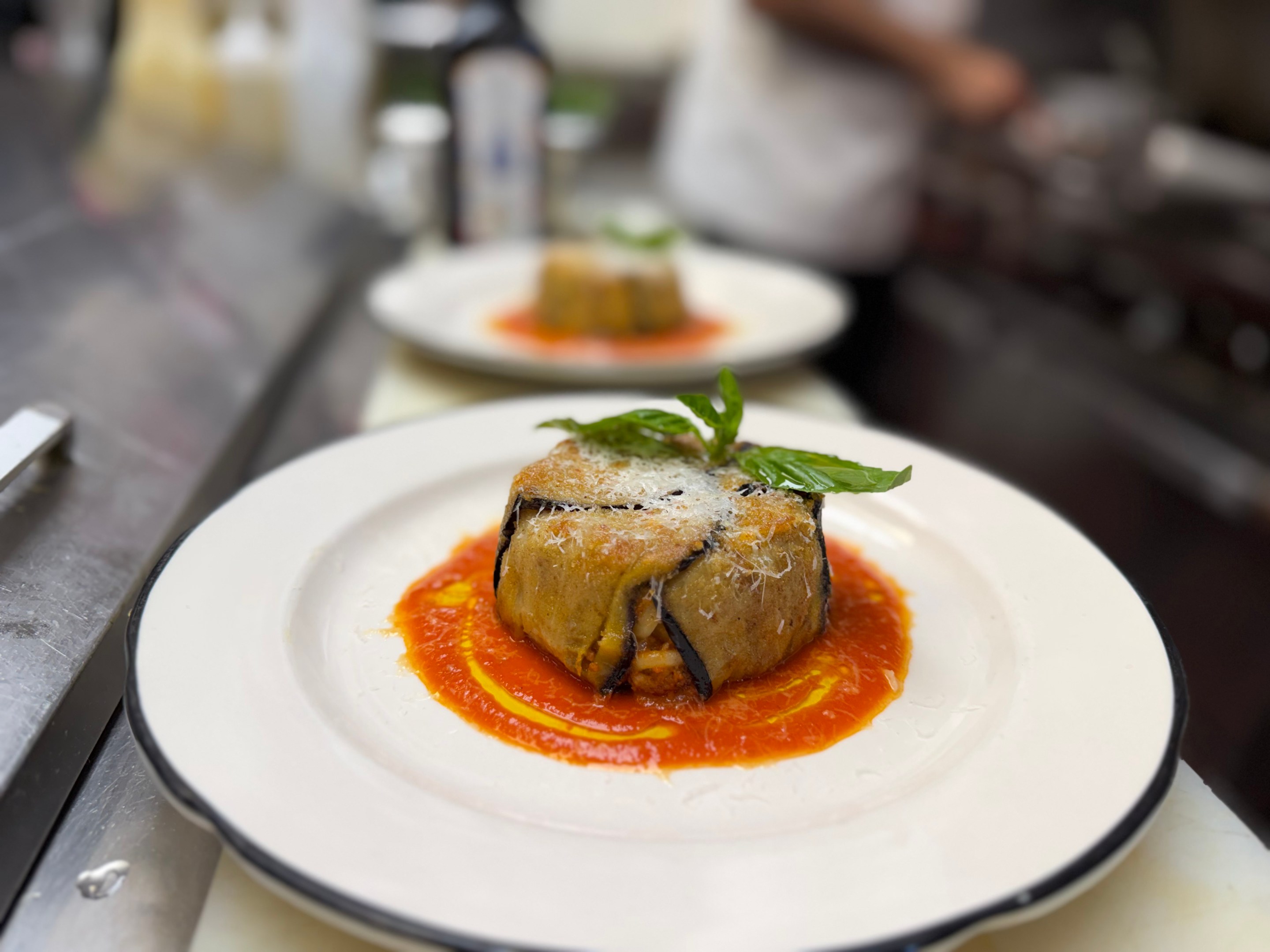
Instead of the large trays meant for family gatherings—the way his mother made it—he builds each timballo individually. Ramekins are brushed with olive oil, dusted with breadcrumbs and pecorino, then carefully lined with thin slices of eggplant, fried in extra virgin olive oil and finished simply with sea salt. Inside, layers of anelletti and ragù are punctuated with grated caciocavallo, then folded in and baked until set. Once inverted, the timballo is briefly finished under the broiler, creating a crisp, golden exterior that contrasts with the softness within.
Be the first to know about Italian food events, restaurant openings and culinary travel. Subscribe to the Appetito weekly newsletter.
It’s plated over a delicate, carrot-enriched tomato sauce that is silky, light, and understated, before being finished with more pecorino, Sicilian olive oil, and fresh basil. The result is something that tastes like home, but arrives with precision.
What makes the dish feel even more personal is where it all begins.
Alessandro is a first-generation Italian-American, born and raised here, but shaped by a very specific corner of Sicily—Castrofilippo—coincidentally, the very same town my father comes from. It’s the kind of connection that immediately grounds everything. There’s a familiarity to it, an unspoken understanding of how food functions in that part of the world—not as something curated, but as something lived. In his home, Sicilian dialect was his first language, and the kitchen was constant. The timballo di anelletti al forno he makes today traces directly back to that upbringing, to trays his mother would prepare for family gatherings, layered generously, topped with fried eggplant, and meant to be shared among many.
But what Alessandro does now is not simply replication.
His foundation in the kitchen is as rooted in tradition as it is in discipline. He trained at the Italian Culinary Academy—then part of the French Culinary Institute—before continuing his studies in Italy at ALMA - The School of Italian Culinary Arts, just outside Parma. There, under the mentorship and legacy of Gualtiero Marchesi—the first chef in Italy to earn three Michelin stars and widely regarded as a defining figure in modern Italian cuisine—he developed a philosophy grounded in precision, restraint, and clarity of flavor. It’s a way of cooking that doesn’t overwork a dish, but instead allows each element to hold its place with intention.
Before fully committing to the kitchen, Alessandro was also a competitive soccer player. It was an experience that brought him across Italy and exposed him to the country’s deeply regional culinary language beyond Sicily. That perspective is evident in his food. There’s a quiet confidence to it and an understanding of balance, of when to elevate and when to hold back.
Encouraged by his wife to pursue cooking professionally, he ultimately found himself exactly where he was meant to be. And that sense of purpose carries through everything—from the precision of his plating to the feeling in the room. Spend even a short amount of time in his kitchen, and it’s clear this is more than a restaurant. It’s a team built on familiarity and trust—many of whom he’s known since his early days working alongside his father. There’s a rhythm to it, almost like a sport, where everyone understands their role, moving together with a shared focus.
The result is something rare: food that feels deeply rooted, thoughtfully elevated, and unmistakably personal.
In a series rooted in place, this stop feels especially personal. Sicily has always been about contrast—bold yet restrained, rustic yet deeply intentional—and at Alessandro’s, that duality comes through in a way that feels both grounded and elevated. Alessandro isn’t reinventing these dishes so much as revealing them, stripping them back to their essence, then rebuilding them with care, technique, and a clear point of view. It’s food that carries memory, shaped by where he comes from and where he’s been, but presented with a quiet confidence that lets it stand on its own. And in that way, this version of Sicily—personal, precise, and deeply felt—becomes something you don’t just taste, but recognize.