

Pythagoras—that ancient philosopher, mystic, and unabashed triangle fetishist—kept a famously ascetic diet. His biographers insist he swore off meat, dairy, and even legumes in his pursuit of spiritual purity. Yet on languid afternoons in his garden in southern Italy—basking in honeyed sunshine, a perfumed breeze, and the adoration of his starry-eyed disciples—even the venerated old sage couldn’t refuse a little wine. One whiff of an aged Nero d’Avola—Sicilian nectar redolent of fruit orchards and sea spray—and who could blame him?
With more than 70 distinct grape varietals, Sicily is Italy’s most biodiverse wine region. Phoenician sailors planted the first vineyards nearly three thousand years ago, and in the centuries that followed, Greeks, Romans, Arabs, Normans, Spanish, and countless others introduced new grapes, training systems, and vinification styles. Like its cooking, Sicilian winemaking is a living fossil of the island’s kaleidoscopic history.
A landmass roughly the size of Maryland, Sicily encompasses an astonishing range of terroirs. Drive from Agrigento to Mount Etna and you’ll watch deserts give way to snow-dusted volcanic slopes. In the interior, grapes rooted in clay-rich hills ripen under balmy sunshine, while along the coasts, sea winds lash trellises planted just feet from the surf. After millennia of tinkering, Sicilian winemakers have learned to pair vine and soil with the precision of a Palermo fisherman reading the moods of the Mediterranean.
No producer celebrates the island’s magnificent viticultural range quite like Donnafugata, a family-run estate with vineyards scattered across Sicily. Over a glass of his Floramundi—a voluptuous, garnet-hued Cerasuolo di Vittoria DOCG—I sat down with Antonio Rallo, the estate’s head vintner, to discuss the hallmarks of Sicily’s great wine regions.
Etna
Mount Etna is an active, snow-capped volcano on Sicily’s eastern edge. Surrounded by walls hewn from hardened lava, Etna’s vineyards see intense sunlight at elevations approaching 1,000 meters. Sciarre—the crumbled remains of ancient lava flows—make up the sandy, mineral-rich soils.
The prince of Etna’s reds is Nerello Mascalese, a grape brought to Sicily by the ancient Hellenic colonists of Magna Graecia. Often compared to Pinot Noir, Nerello Mascalese shimmers with aromas of candied cherry, rose petal, and violets. As for whites, Etna is rightfully famous for Carricante. Sul Vulcano Etna Bianco, Donnafugata’s Carricante, features notes of white blossoms and fresh peach—spring in Sicily captured in glass.
Marsala
Founded by Phoenician merchants nearly 2,400 years ago, Marsala anchors Sicily’s far western corner. The terroir here is inseparable from the sea, with vines buffeted by briny gusts and soils shaped by Jurassic seabeds.
Marsala is synonymous with fortified wine, a style engineered in the 18th century to withstand long sea voyages, but its traditional wines are equally commendable. Look for whites like Grillo, Inzolia, or Catarratto—wines that brim with floral and saline aromas.
Spend a glorious afternoon savoring pours from across Donnafugata’s portfolio at their historic Marsala cellars. Built in 1851, the estate is as regal as a Roman aristocrat’s pleasure palace. After relishing a glass or three in the leafy courtyard, saunter over to the dining room for a traditional Sicilian dinner. (Note: Reservations are required for dining.)
Pantelleria
Pantelleria is a volcanic shard rising out of the Mediterranean deep, an island closer to Tunisia than to mainland Sicily. Fierce winds and scorching heat make the island hostile to most varietals, but Zibibbo—a Muscat grape originally from North Africa—is a glorious exception.
Teetotaling Muslim traders ostensibly planted Zibibbo on Pantelleria for jams and raisins, but it didn’t take long for oenophilic Sicilians to realize that sun-drying those golden berries before fermentation transformed them into an ambrosial sweet wine.
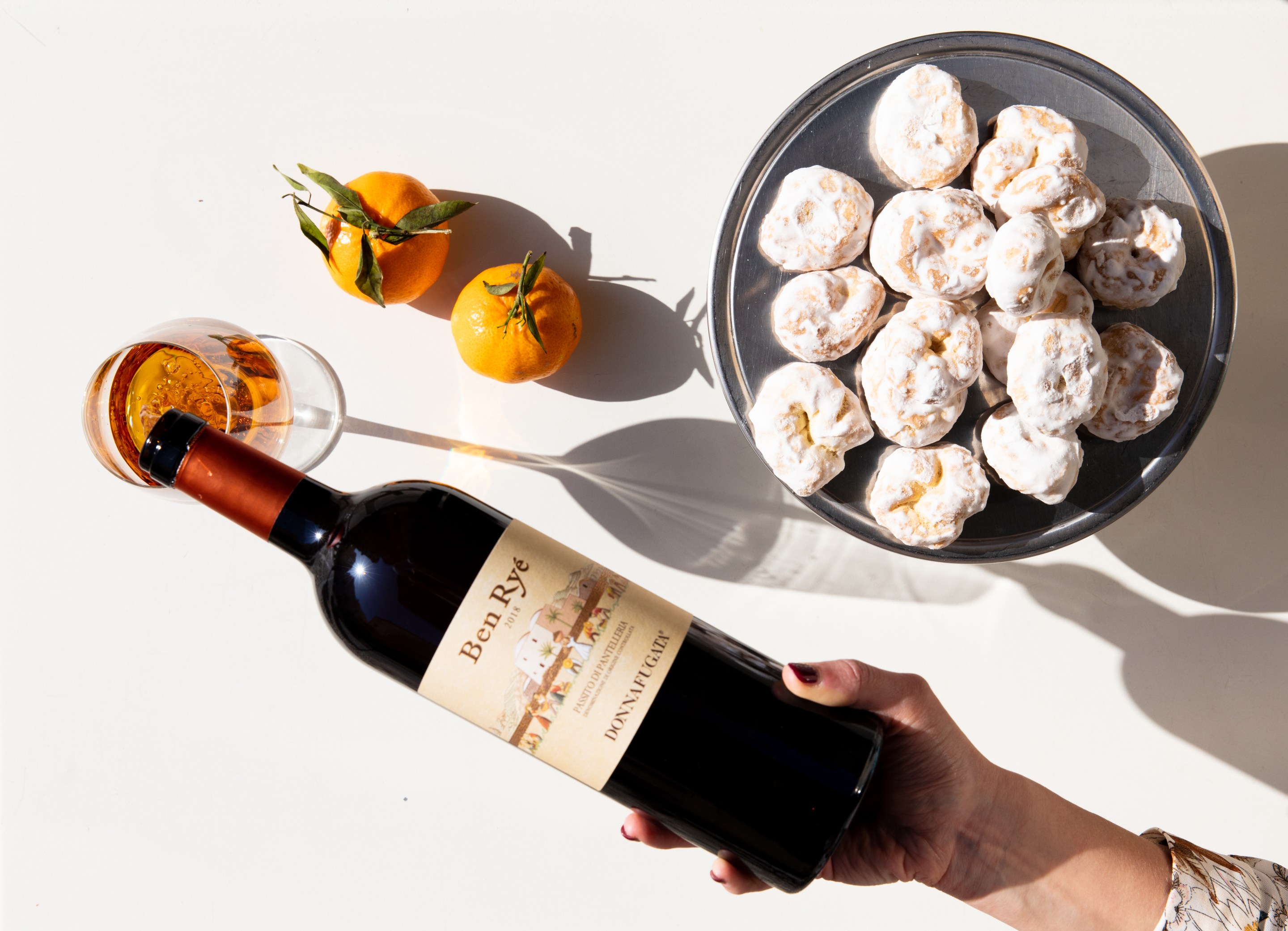
Pantelleria’s relentless gales force vintners to grow Zibibbo vines inside hand-dug hollows, a painstaking vine-training method recognized by UNESCO. “Pantelleria is one of the few places left where humans do not dominate nature but engage in a constant dialogue with it,” Rallo told me. “Ben Ryé, our expression of Passito di Pantelleria DOC, requires three times the labor of other wines.” When you taste it, you understand why Rallo perseveres: the silky elixir smells like a basket of gardenias, dried apricots, and candied citrus.
Vittoria
A land of soft, rolling hills, Vittoria is home to Sicily’s only DOCG, Cerasuolo di Vittoria, a blend of Nero d’Avola and Frappato. “The magic lies in the marriage of the two varietals,” Rallo said. “The power and dark fruit of Nero d’Avola is softened by the freshness of Frappato.”
Donnafugata sources grapes from three districts in Vittoria to craft Floramundi, its Cerasuolo di Vittoria DOCG. Ruby red in the glass, it’s a symphony of red and dark fruit, with cherry and wild strawberry embellishing deeper notes of plum and blackberry.
Contessa Entellina
In the forested inland reaches of western Sicily, Contessa Entellina sees sultry summers and rain-kissed winters—a climate that faciliates grapes with both power and freshness in its grapes.
Here, Donnafugata experiments with more than nineteen varietals, from heritage Sicilian grapes to international heavyweights like Cabernet Sauvignon and Merlot. “Contessa Entellina is our creative laboratory,” Rallo explained. “The patchwork of soil types makes it ideal for experimenting with a wide range of grapes.”
Mille e Una Notte exemplifies Rallo’s blending whimsy at its highest register. Nero d’Avola forms the backbone, while Petit Verdot and Syrah add velvet mouthfeel and a peppery zip. As it stretches out in the glass, a procession of dark flavors unfurls—blackberry, mulberry, even a hint of aged balsamic. It’s a showstopper with hearty fare like roasted lamb, pappardelle with pork ragù, or a marbled ribeye.