

In Italian, food is rarely just food. It organizes time, relationships, and expectations. This column explores Italian sayings and proverbs as ways of thinking shaped at the table.
These expressions preserve that knowledge in compact form. Read literally, they speak about eating. Read more closely, they offer insight into how experience, pleasure, and social life are understood.
The aim is simple: to treat language as another ingredient—handled with care, tasted slowly, and shared. No prior appetite required. It tends to arrive along the way.
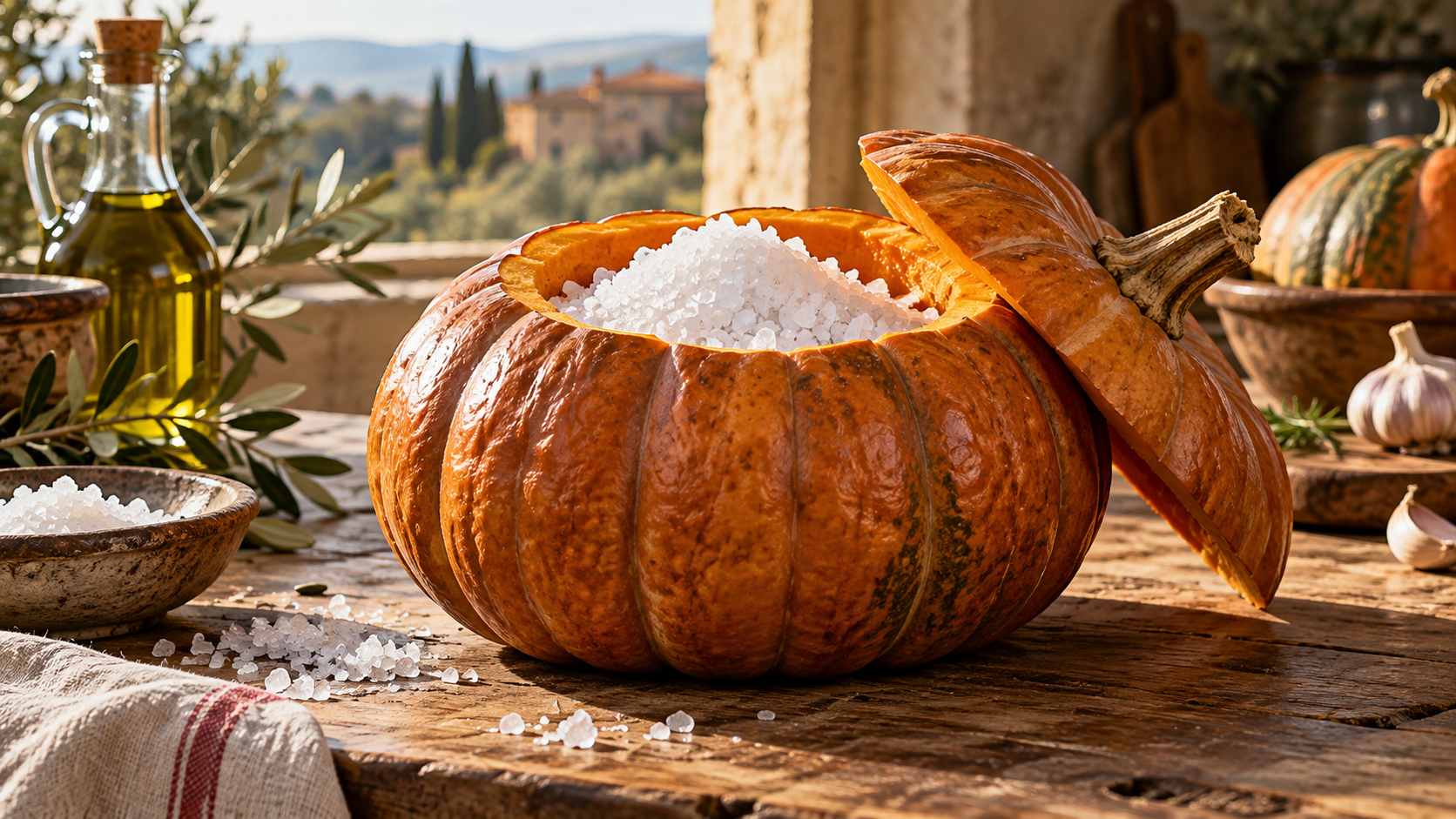
Avere sale in zucca
Literal translation: To have salt in one’s pumpkin.
Meaning: To possess intelligence, practical wisdom, or good sense.
Intelligence comes in many forms. It can be measured, cultivated, inherited or demonstrated. In Italy, it can also be seasoned.
Someone who ha sale in zucca (“has salt in their pumpkin”) possesses enough good sense to understand a situation and avoid making it worse. The expression does not necessarily describe a scholar, an intellectual, or even someone of exceptional brilliance. It suggests something more useful: sound judgment, mental alertness and enough practical intelligence to navigate everyday life without unnecessary disasters.
The pumpkin, needless to say, is the head. Its round shape made zucca a natural and often unflattering substitute for the human skull. An Italian can have a zucca vuota, an empty pumpkin, or be called a zuccone, a large and particularly resistant pumpkin—someone stupid, stubborn, or both. The vegetable provides the container. What matters is whether anything worthwhile has been placed inside it.
That is where the salt comes in.
Love discovering Italy one bite at a time? Subscribe to the free Appetito newsletter for the latest in Italian food, travel and favorite recipes.
Long before refrigeration, salt preserved food, enhanced flavor, and possessed considerable economic value. The figurative connection follows the same logic: as salt gives food flavor and protects it from decay, wit and judgment keep the mind from becoming dull or easily deceived. Latin makes this connection explicit: sal could mean wit or cleverness, while insulsus could describe either something tasteless or someone foolish. Without salt, the mind is therefore, in every sense of the word, unsalted.
The expression itself is remarkably old. In the fourteenth century, Giovanni Boccaccio used it in the Decameron to describe Madonna Lisetta, a vain and gullible Venetian woman. She naively believes Friar Alberto, a fraudulent friar intent on sleeping with her, when he claims that the Angel Gabriel has fallen in love with her and will visit her in the friar’s body. The deception succeeds because Lisetta has, to use Boccaccio’s words, poco sale in zucca.
The Accademia della Crusca later recorded aver poco sale in zucca as a proverb meaning to be deficient in judgment. The negative or diminutive form remains common: non avere sale in zucca and avere poco sale in zucca describe someone foolish or lacking common sense. The positive form, avere sale in zucca, reverses the judgment and becomes a compliment.
Some modern dictionaries connect the expression to the former practice of using hollowed and dried gourds as containers. Whether this custom actually gave rise to the expression is beside the point. Its figurative logic requires no legend. The pumpkin resembles a head; salt supplies both flavor and sense.
Of course, quantity matters. But no one demands genius. A little salt will do—provided the pumpkin is not completely empty.