

It’s common knowledge that the greatest tomatoes come from Europe. It’s also widely accepted, especially among food experts, that among those aforementioned tomatoes, the ones from Italy are the most impressive. And it was with noted knowledge in place that I embarked on a press tour, aptly named the “Greatest Tomatoes From Europe” hosted by ANICAV, the Italian Association of Canned Vegetable Industries. My intention wasn’t to acknowledge the greatness of the tomatoes of Italy in particular and Europe in general but to find out the reasons for their superiority. So, off to Naples I went to follow tomatoes from the fields of Campania to the facilities where they are cleaned, peeled, canned and distributed worldwide.
The tomato fields of Campania differ aesthetically from the curated, vertical vines of household gardens. They spread across the surface of the soil in swarms, from where they are collected by machines and carted off in crates. It ain’t pretty, but the dominant terroir is evident: standing there in the fields, surrounded by an abundance of tomatoes, Mt. Vesuvius in the distance, the hot sun of southern Italy overhead in the blue summer sky, the rich mineral smell emanating from the soil informed by centuries of volcanic ash. These are advantages that no other micro-region in the world enjoys. Imagine picking a ripe tomato from under your feet, wiping it clean and taking a vigorous bite as if it were an apple, the firm texture informed by sweetness with a hint of acid. I ate the whole thing without any concern over synthetic pesticides, herbicides or fertilizers. And then I ate another.
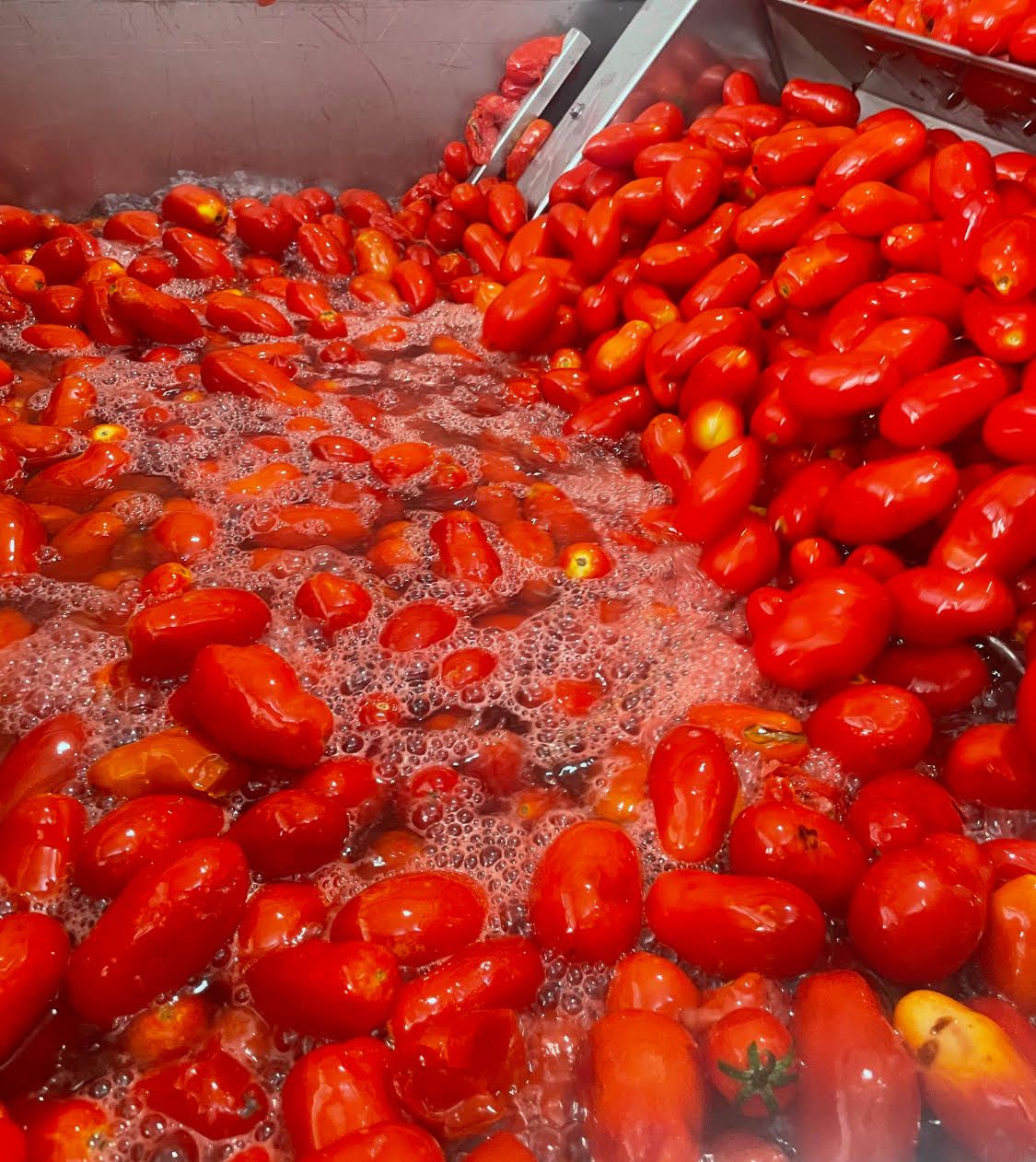
From the fields, we followed the route taken by the trucks loaded with crates of just-harvested, perfectly-ripe tomatoes to the production facilities throughout the provinces of Campania where they will be delivered for processing. We visited four such facilities over two days. They varied somewhat in size, but the process was always the same with regard to the utmost quality: sorting and sorting and sorting; washing and washing and washing; more sorting; steam peeling the skins; canning or jarring (mostly canning) in the most sterilized containers ever. Along the way, ample samples are taken to in-house laboratories for inspection through an integrated, state-of-the-art control system.
What further connects the facilities we visited, and I imagine those we did not, is that they are all family-run operations that date back generations. These businesses have been united by ANICAV since 1945, which brings the aforementioned quality standards, but they operate autonomously on a day-to-day level as family-run businesses. As a result, there is a tremendous amount of pride that flows from the top down that positively informs the commitment of every employee, whether year-round or seasonal, as the family ethos extends throughout each operation.
From the tomato fields to the processing facilities was a masterclass in European excellence. Yes, they have, especially in Italy, what I refer to as a “homefield advantage” with regard to the elements for growing superior products, but the dedication of those involved with their commitment to the myriad aspects of culture is what elevates that advantage and makes, for example, the tomatoes of Europe the greatest in the world.