

A few years ago, during a virtual interview with actor Stanley Tucci for a commercial collaboration, our conversation drifted from the planned talking points to something far more interesting: pasta. As we talked, Tucci spoke affectionately about pizzoccheri, the rustic buckwheat pasta of Italy’s Valtellina Valley. He painted a picture of short, thick ribbons tossed with winter greens, potatoes, Alpine cheese and generous amounts of garlic infused butter. It was a dish that sounded nothing like the Italian food I had grown up eating. I was used to fresh tomatoes, basil and hearty red sauces. There was none of that here. Rather, this was a dish shaped by cold winters and by the ingredients people could grow, store or preserve through the long months when little else was available.
The interview ended, the laptop screen went dark, and yet Tucci’s words stayed with me. For the next two years, pizzoccheri was always in the back of my mind. I had never tasted it, but I knew that if I ever found myself in northern Italy, I wanted to seek this pasta dish out.
A pasta from the Valtellina
Pizzoccheri originates in the Valtellina, an Alpine valley northeast of Lake Como, shaped by the Adda River and framed by the mountains along the Swiss border. For centuries, the area's mountainous terrain and harsh climate made farming difficult, so communities relied on crops that could withstand those conditions. Buckwheat, known in Italian as grano saraceno, thrived where other crops struggled and thus became an important part of the local diet.
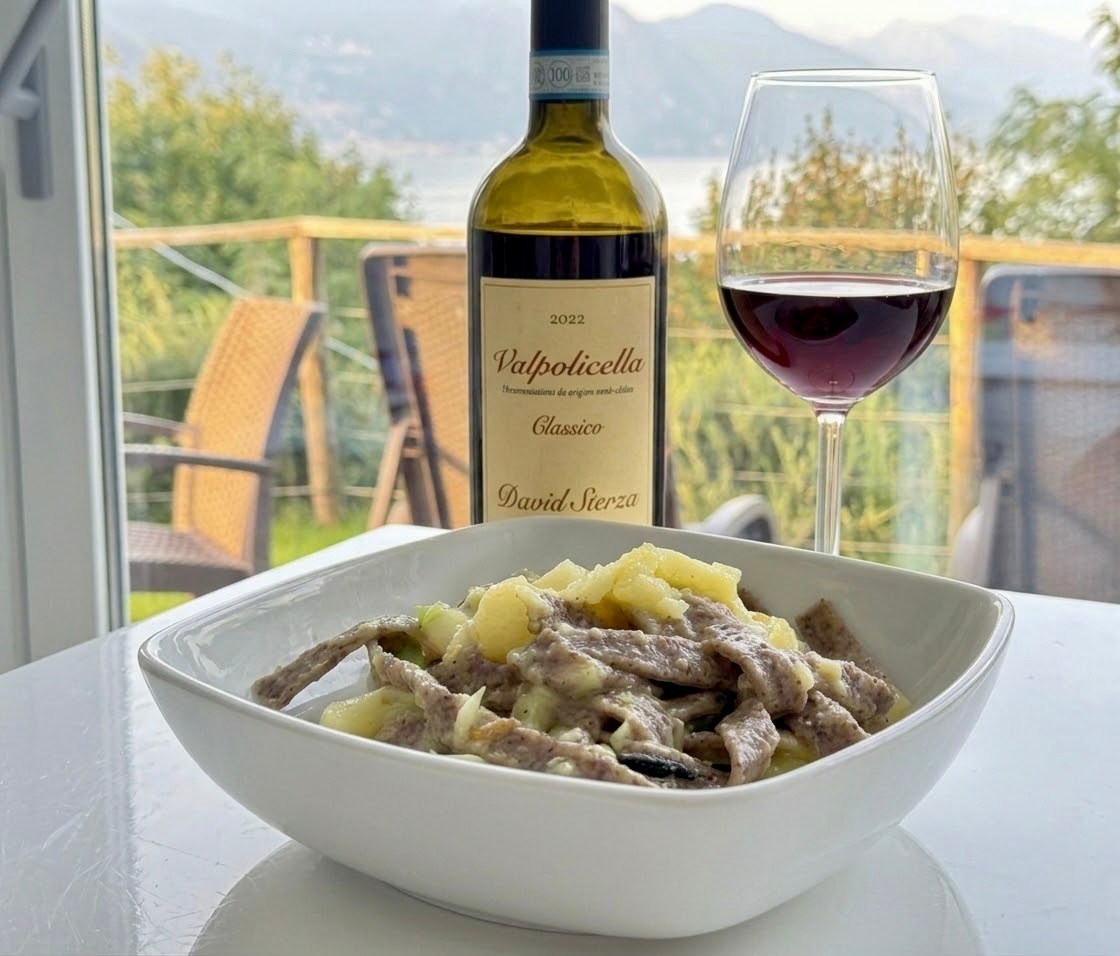
It’s that humble grain that gives pizzoccheri its dark color and earthy flavor. A combination of buckwheat and whole wheat flour is used to form a dough, which is rolled flat, cut into short, wide noodles, and paired with Savoy cabbage and potatoes. The dish also incorporates dairy products central to Valtellina’s cuisine, including butter and Valtellina Casera DOP, a semi-hard cow’s-milk cheese. The ingredients are simple, but together they make a surprisingly substantial meal. Nothing about pizzoccheri is delicate or ornamental. It’s the kind of food that makes sense when you imagine long winters, mountain villages and kitchens where a meal needed to be both comforting and sustaining.
Craving more? Explore our collection of Italian pasta recipes for your next memorable meal.
The opportunity to taste pizzoccheri arrived early one October, when my husband and I traveled to northern Italy and settled into an apartment in San Giovanni, a quiet hamlet just south of Bellagio's historic center. By then, the idea of finding pizzoccheri had become one of those small goals that quietly shaped our trip. We weren't traveling solely for the dish, of course, but knowing it was somewhere in the region made the journey feel a little more personal for me.
The locale offered narrow stone alleys, a peaceful lakeside path and a slower rhythm far removed from the midday ferry crowds in the heart of town. The apartment was enchanting, though its kitchen left quite a bit to be desired in terms of modern convenience. There was a small two-burner cooktop, almost no counter space, and a collection of mismatched pots and utensils. Still, the floor-to-ceiling windows looking straight out over Lake Como and the mountains made it easy to forgive the cramped quarters.
Finding everything we needed to recreate pizzoccheri turned out to be much easier than I expected. A leisurely walk through town brought us to Latteria Bellagio, a local dairy and specialty shop. Inside, the cool air carried the rich perfume of aging cheese. Shelves and glass cases proudly displayed the region's heritage: wheels of Taleggio, prized Bitto, Grana Padano and dense slabs of pale-straw Valtellina Casera, the exact cheese needed for making pizzoccheri. Along with the various cheeses, we found packages of buckwheat pasta displayed on the counter. Seeing them lined up waiting to be purchased was strangely satisfying, and I knew in an instant I was finally going to taste the pasta dish I had been secretly keeping in the back of my mind.
Want to be the first to know about Italian food events, restaurant openings and culinary travel? Subscribe to the Appetito weekly newsletter.
Cooking pizzoccheri near Lake Como
After a quick stop at the nearby alimentari, the neighborhood grocery, and I was able to complete the haul. I found a crisp head of Savoy cabbage, firm potatoes, butter, garlic and a fresh bunch of sage. Back in our apartment, the process of making pizzoccheri unfolded with deliberate choreography as my husband and I worked side by side in the tiny kitchen. First came the prep work: peeling and cubing the potatoes into bite-size pieces and slicing the cabbage into broad strips. Once everything was ready, the potatoes went into the only stockpot we could find, filled with water. After boiling for a few minutes, the cabbage was added to the pot, where it quickly softened. Finally, once the water returned to a boil, the pasta was added, and it all finished cooking together.
On the second burner, we set a small skillet over low heat and added generous cubes of butter. Once melted, thinly sliced garlic and fresh sage leaves were added. Almost immediately, the sage began to soften, and its savory aroma drifted through the tiny room. To finish, we poured the sizzling butter, sage and garlic over the pasta, cabbage and potatoes, letting the butter seep through and bring the flavors together.
When we finally sat down to eat, the dish tasted different from what I had imagined it would. The buckwheat pasta was hearty and slightly nutty, the potatoes soft and comforting, and the cabbage tender enough to almost disappear into the dish. Then there was the garlic butter, coating everything in a richness that made each bite feel deeply satisfying. It was rustic, filling food, but somehow it didn't feel heavy.
As we ate, I found myself thinking less about the recipe than about everything that had shaped it. I know from experience that food can be recreated nearly anywhere. Ingredients can be imported, and techniques can be studied and repeated. Yet some dishes reveal their fullest expression only when experienced in the places that gave rise to them. I believe that pizzoccheri is one of those meals. The ingredients themselves weren't exotic, and the preparation wasn't particularly complicated. What made the experience memorable was everything surrounding it: the landscape, the season, the small kitchen, the local ingredients and the fact that I had arrived at this meal because of a conversation that had taken place years earlier.
I still think about that conversation with Stanley Tucci and the unexpected detour that led me to an unforgettable meal. During that virtual interview, pizzoccheri was simply the name of a dish I had never heard of. A few years later, I found myself sitting down to that very dish in the region where generations of cooks had been making it long before I ever knew its name. I never would have gone looking for it if Tucci hadn't mentioned pizzoccheri that day. But that is often how travel works. A passing recommendation can plant a seed of curiosity, and sometimes, following it leads you somewhere you never expected to go and introduces you to meals you never expected to eat.