

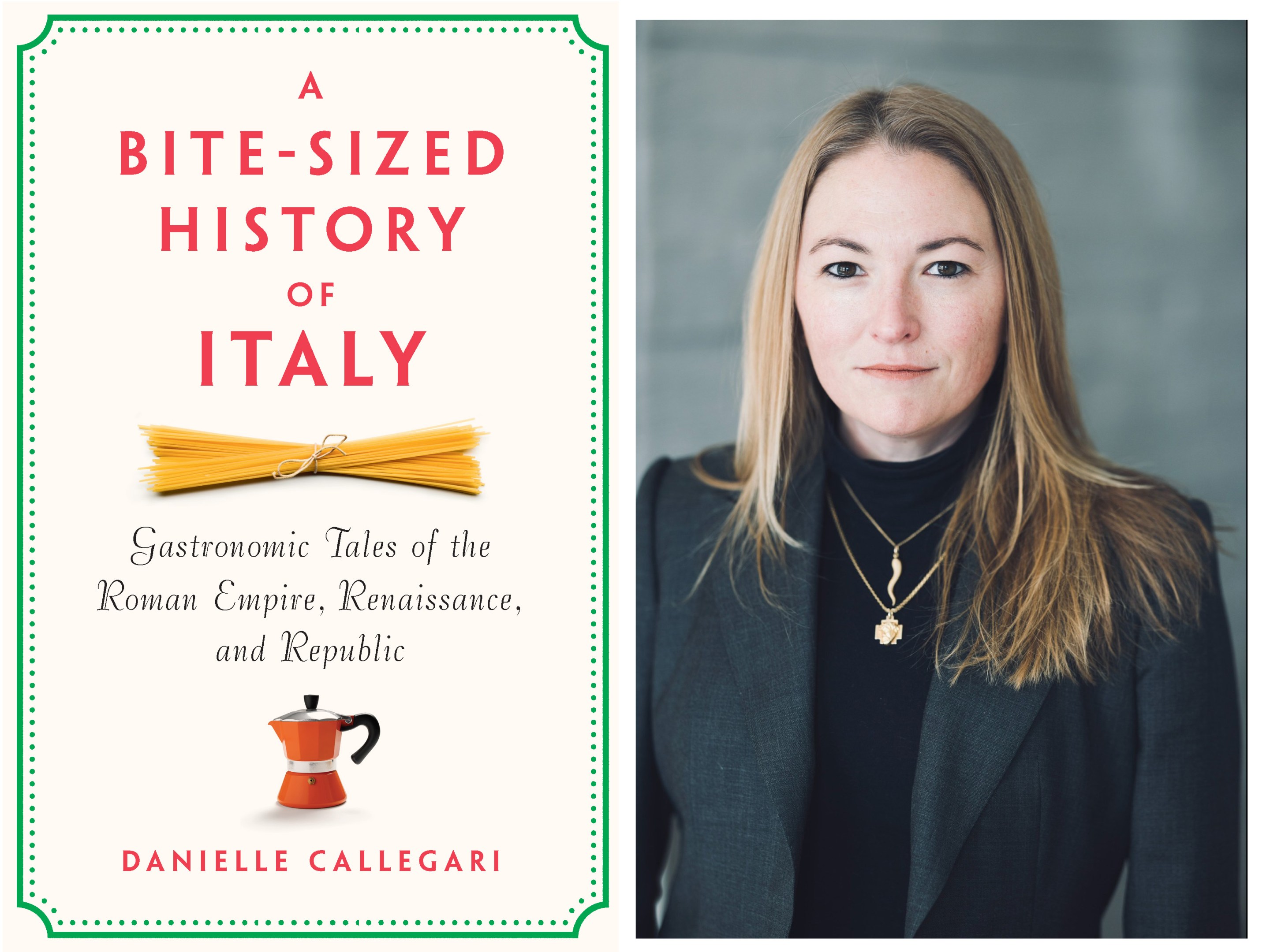
Danielle Callegari argues in her latest book, A Bite-Sized History of Italy, that gastronomy unifies Italy’s fractured political history. Culinary culture came first and the politics followed. Her new book tackles the story of Italian cuisine beginning in the Roman Empire and leading to the modern era. She is an associate professor at Dartmouth College where she specializes in Italian literature and trans-historical food and beverage studies. We spoke with Callegari over Zoom about the evolution of Italian culinary history and the ideas behind her new book.
One line that really struck me was: “Rome survived because it had food; it flourished because it had gastronomy.” Do you think that's a legacy that holds through all of Italian history?
Italy did not have another unifying principle for most of its history. As Italy is conceived as an idea and a cultural space, and then moves up into eventually becoming a political reality, it needs to find another kind of magnet to operate around. If we compare it to France, the difference is that in France there was a centralized government, a monarchy for most of early modern into modern history, followed by the creation of nation states. And Italy didn't have that. Italy was really a disparate place from 500 to 1850. It had a need that really charges the food that it produces.
In the Renaissance era, Eleonora Medici uses her Boboli Garden experimental plants. What what kind of innovations came from that garden and did they end up entering into Italian cuisine?
Boboli Gardens were really a space for experimentation and often ostentation. It was less for the real practical purpose of cultivation and scale, and much more for the purpose of finding new things and to have exotics. Eleonora di Toledo had great fashion. She was considered an influential individual in all senses. She studied and wrote things herself. The things that she got up to in her garden or elsewhere were things that other people followed, initially in the elite, but then of course, all of that starts to circulate more broadly.
Some of her innovations did end up in the aristocracy's gardens. They basically always become diplomatic tools in some ways. They are used as gifts. But a lot of times it's just for the crazy weirdness of it. And then other these things ended up taking off for real. The tomato, of course, is a great example of that.
Want to be the first to know about Italian food events, restaurant openings and culinary travel? Subscribe to the Appetito weekly newsletter.
When the fascists come to power, they pushed back against Italians eating pasta. Why do you think that failed so spectacularly?
Italy leaned harder than most places on its culinary identity because it didn't have a strong political point of reference. Mussolini had a solid, two-decade throttle hold on the government and on culture. There are significant changes that become rooted in that time and space. But that being said, that's pushing back against close to 2000 years, or a little bit less, 1500 years, of people having used their food to create their community and the boundaries of their identity.
So even with an iron fist that becomes surprisingly more challenging to undermine. And then there's just the practical side of it, which is that Italy isn't really suited to have any single crop become a monolith. It doesn't work.
In the modern era, Italian is really committed to Denominazione d'Origine Protetta and protected categories, but a lot of the designations are modern inventions. How do we reconcile this idea of preservation with a sort of a false authenticity in the face of these things being only a few years old?
I am trying to argue constantly that there's a special relationship between Italians and their cuisine, because it is their anchoring principle for identity. But then the result of that is there's an incredible, fierce battle over what those items are. You're then anchored to them. The main problem is right now that none of those things can ever be extricated from a very specific economic gain that everybody has a play there.
We look at when they solidify a recipe. For pesto, if we want to use that one, because it was one that exploded into real violence. In a lot of ways, when you name a product on the list of things that has to be in that now — that region, that sub-region, that town, the people who produce all those things are suddenly guaranteed a certain return on their investment while everyone adjacent to it is not necessarily part of that party.
If we want to come at it from the abstract, academic point of view, the key would be to understand that there are philosophies and values and ideas that are coherent and that follow through, but the individual items themselves are flexible. And, in fact, that's why this can have such a trans-historical relevance. We're obviously not, even if we limit ourselves to the city of Rome, from the ancient moment to the contemporary, not the same when it comes to day-to-day consumption.
But there are things that do follow through. If we think of ancient Rome wine consumption, it's not that they're drinking the same wine, but they actually were using the same grapes and they were mostly using the same techniques and they were talking about it in the same way. In the sense, they were caring about vintage and they wanted certain flavor profiles and characteristics. So there are many things that are controls for the experiment.
I’m curious how you perceive the Italian-American cuisine of the 20th century. Do you see that as stuck in time or as its own sort of unique thing?
I think in a best-case scenario, the hyphenated foods of this world are our best calling cards there and the best sign of humanity. It's like: I came here, I didn't know stuff, but I shared what I did know with you and you understood me better because I had a thing that you could engage with that didn't require a lot of effort. Food is the one universal.
Everybody has to eat, everybody has feelings about food. When I try to work on wine education I try to start with food because when you say: what do you know, how do you feel about wine? People say: I don't know about wine. They freak out the second you bring it up.
But if you say: what do you think about this food? People don't have a problem expressing an opinion. They don't say: Oh, I haven't taken a course on this. Food is a really important calling card and point of entry for all people.
We need to be able to use it to talk to each other. Italian American cuisine is how Italians became a part of America and how Americans became a better part of Italy. Also, the massive influx of tourists that continues in Italy is difficult for the country to manage. But it's somewhat less difficult [because] there are these layers of different kinds of people who are engaged in different ways and who will make a special trip to go someplace, like a place where Katie Parla and I might recommend.
We say to people: Hey, we know you're going to do your grand tour — Rome, Florence, Venice — but while you do, why not make a quick deviation and stop at this other place and learn about a new thing and throw some money at people who could use it.
I think those are the ways that we get to have a more nuanced conversation when we start at a lowest common denominator in the first place.