

In Italian, food is rarely just food. It organizes time, relationships, and expectations. This column explores Italian sayings and proverbs as ways of thinking shaped at the table.
These expressions preserve that knowledge in compact form. Read literally, they speak about eating. Read more closely, they offer insight into how experience, pleasure, and social life are understood.
The aim is simple: to treat language as another ingredient—handled with care, tasted slowly, and shared. No prior appetite required. It tends to arrive along the way.
Literal translation: To dress like an onion
Meaning: To wear several layers of clothing that can be added or removed as the temperature changes
To anyone learning Italian, the image is wonderfully perplexing.
Dress... like an onion?
Not in an onion costume, of course. Like the onion itself.
The expression simply means dressing in layers, so clothes can be added or removed as the day unfolds. Imagine a cool autumn morning: an undershirt, a T-shirt, a shirt, a sweater, and finally a light jacket before stepping outside. By lunchtime the jacket is over your arm. Later the sweater disappears as well. By evening, when the air turns cool again, they quietly find their way back on. The weather changes; your clothes change with it.
English describes the process with admirable efficiency: "dress in layers." Italian, as usual, prefers to take a small detour through the kitchen.
But here's the surprising part.
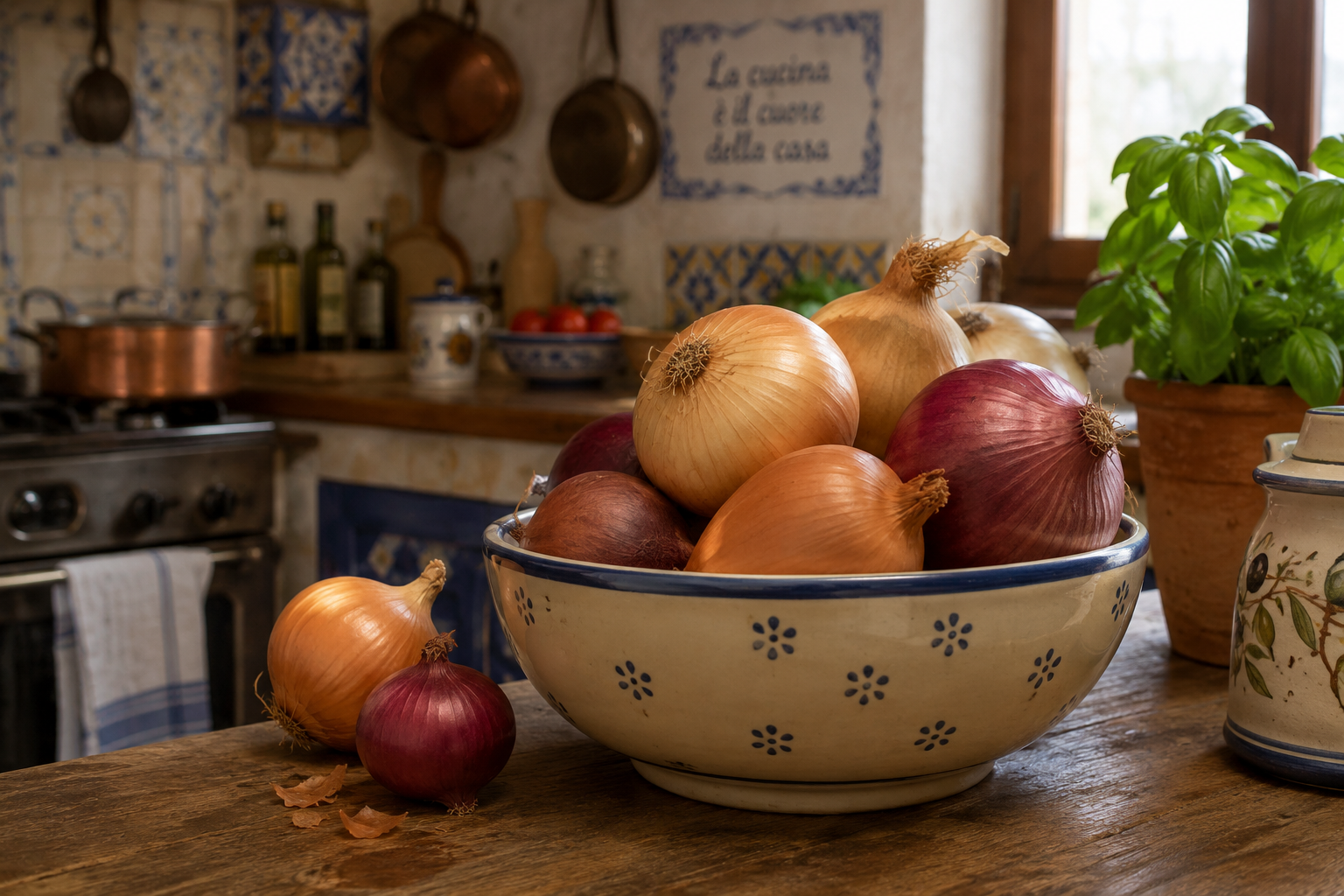
Unlike so many Italian food expressions, vestirsi a cipolla does not arise directly from cooking or eating. Nobody is chopping onions. Nobody is preparing dinner. The vegetable never makes it into the pan.
Instead, the expression begins with observation. It grows out of a world in which food is so familiar, so constantly present, that even an ordinary vegetable becomes a natural way of understanding everyday life. Once you begin to see things this way, the image feels so natural, so perfectly appropriate, that it is difficult to imagine a better one.
Hungry yet? Discover some of our favorite and unexpected ways to use onions in recipes from Appetito.
Italian Potato, String Bean & Onion Salad Recipe
Tortellini in Charred Onion & Carrot Brodo
Zucchini and Onion Frittata
And so, an ordinary onion quietly became Italy's most unlikely expert on getting dressed.
Curiously, the expression itself appears to be much younger than many of the famous Italian food idioms we've explored in this series. It is absent from the major historical dictionaries of the Italian language, suggesting that it became established only relatively recently. That, however, has done nothing to slow its success.
Yet in the middle of an Italian summer, when the pavement shimmers, the cicadas drown out almost every other sound, and the only sensible goal is simply to make it to sunset, dressing like an onion sounds almost absurd. After all, there comes a point when there are simply no more layers left to remove.
Wait until late September—or even October.
If you're in Italy, you won't just hear the expression. You'll see it everywhere: jackets draped over shoulders, sweaters tied around waists, scarves appearing as the evening air begins to cool, only to disappear again the following afternoon.
And no, it won't be Halloween.
It will simply be autumn, Italian style.