

In Italian, food is rarely just food. It organizes time, relationships, and expectations. This column explores Italian sayings and proverbs as ways of thinking shaped at the table.
These expressions preserve that knowledge in compact form. Read literally, they speak about eating. Read more closely, they offer insight into how experience, pleasure, and social life are understood.
The aim is simple: to treat language as another ingredient—handled with care, tasted slowly, and shared. No prior appetite required. It tends to arrive along the way.
Spirito di patata
Literal translation: Potato spirit
Meaning: A lame, unfunny, or awkward sense of humor
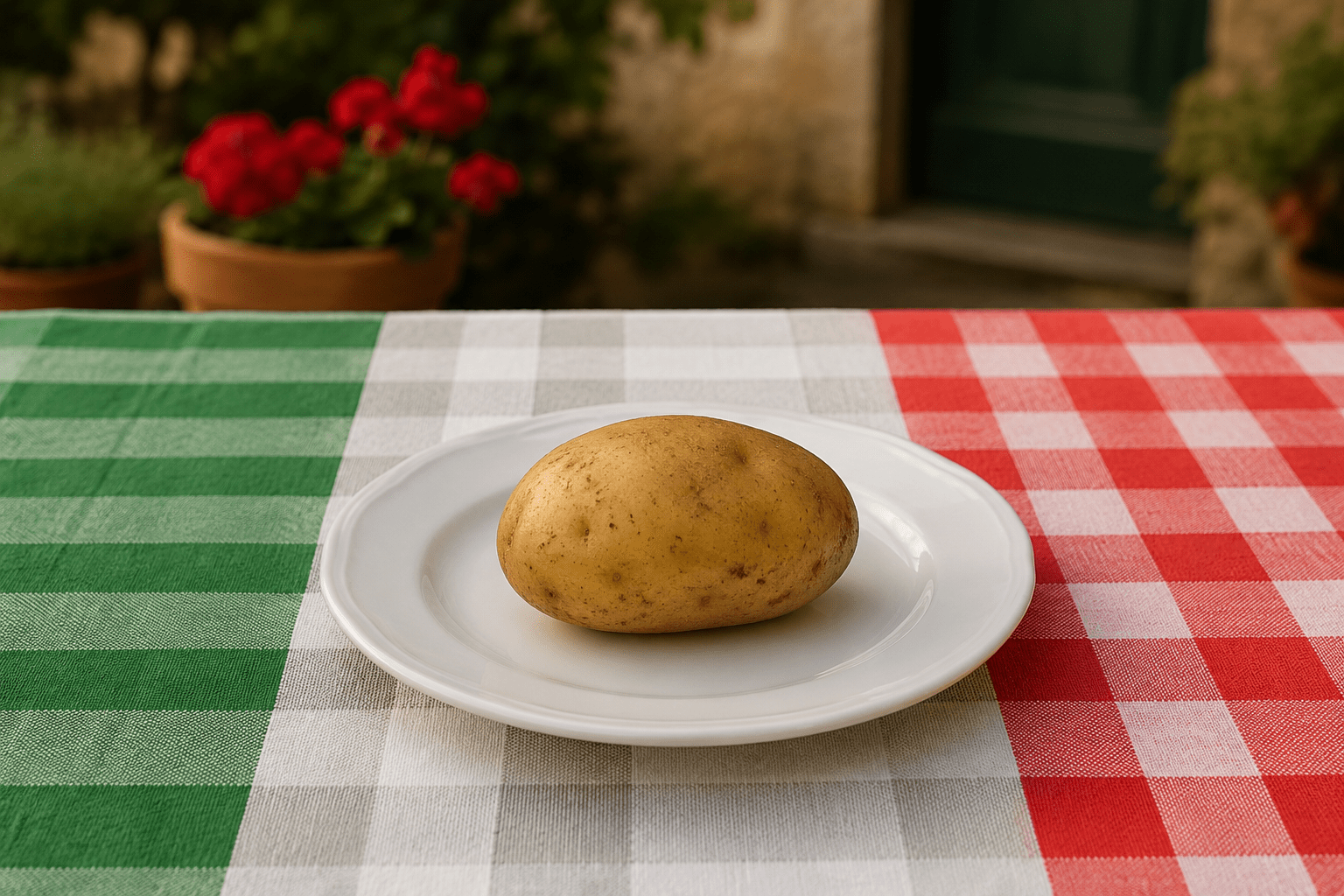
The potato occupies a curious place in Italian culture. Today it is an indispensable ingredient, found in countless regional dishes and loved throughout the country. Yet unlike many of the foods that helped shape the peninsula's agricultural and cultural identity, it was a relative newcomer. Introduced from the Americas, it spread gradually and earned its place at the Italian table through sheer usefulness.
Valued for its versatility, affordability, and ability to feed large numbers of people—especially in times of hardship—the potato became a staple of everyday life. Bread, wine, and olive oil entered Italian culture carrying centuries of religious symbolism, literary associations, and historical memory. The potato arrived later. It won gratitude, even affection. Prestige was another matter.
The contrast is striking. Few ingredients became so deeply embedded in everyday Italian cooking while remaining so modest in the cultural imagination. The potato was appreciated and relied upon, but it was rarely associated with refinement, celebration, or distinction. It belonged to the world of necessity rather than aspiration. That distinction would prove important not only in the kitchen but also in the language Italians developed around it.
That peculiar combination of importance and modest status may help explain the expression spirito di patata. Italians use it to describe jokes that fall flat, comments that aim at wit but miss the mark, and humor that rarely receives the reaction its author was hoping for.
Want to be the first to know about Italian food events, restaurant openings and culinary travel? Subscribe to the Appetito weekly newsletter.
The idiom seems to draw upon the broader cultural associations of the potato itself. Familiar, practical, and decidedly unpretentious, the tuber lends itself more naturally to images of ordinariness than brilliance. A joke described as spirito di patata is not necessarily offensive or malicious. It is simply unremarkable: humor that arrives confidently and leaves quietly.
There may also be another way of understanding the expression. In Italian—just as in English—spirito refers not only to wit or humor but also to distilled alcohol. For this reason, the phrase is often linked to potato-based spirits, an interpretation reflected in major Italian dictionaries.
In a country shaped by wine culture, however, potato spirits occupied a far humbler position than those derived from grapes, grains, or aromatic plants. If the expression did emerge from the world of distillation, the metaphor would have been immediately intelligible. After all, poets have spent centuries celebrating wine. Potato spirits have inspired rather less literature.
Hungry for more? Browse Samuel Ghelli's collection of Italian food idiom articles.
Whether the phrase originated from the potato itself or from potato-based spirits, the metaphor points in the same direction. In both cases, the image evokes something useful, familiar, and decidedly unglamorous.
The potato appears in a surprising number of Italian expressions, suggesting that its linguistic career extends far beyond the kitchen. Those stories are best left for another time. For now, it is enough to note that when Italians accuse someone of having spirito di patata, they are not complimenting their comedic talent.
If someone has spirito di patata, they are trying to be funny. The problem is that nobody else is laughing.
Or at least not for the reasons they intended.