

Long before his own name appeared above a restaurant door, Raffaele “Lello” Arpaia was a young Neapolitan immigrant who had come to America at 19 with little money and little English, taking three and four jobs to make his way. He entered the business in 1960 as a busboy at Alfredo’s while still in college.
In those years, a newcomer’s introductions came through family, through the block, through fellow Campani—and the campani knew Oscar Tucci kept a door open for young Italians willing to work. That is how Lello came to 56 Beaver Street. Oscar saw that he was going to be a star. He also saw a fellow Italian immigrant. Oscar had been one himself, and he admired that. Oscar and his son Mario took him in, and the bond held for life. At Delmonico’s, Lello quickly rose through the dining room to captain of the Palm Room. Restaurant work paid his way, and Delmonico’s became his education. “As I worked,” he said, “I watched and learned.”
During one service, Lello came flying down the back stairs. His heel caught on a step. He slid toward the kitchen carrying a tray of Richard Ginori china and somehow saved every piece. My aunt Mary Tucci—the iron fist of Delmonico’s—was watching. “Good job,” she said. “You didn’t break anything.”
I loved hearing Lello tell stories like that. Each one brought my family back to me. Lello recounted memories of my grandfather Oscar Tucci, who ran the room; of my father Mario and my aunt Mary, who inspected the waiters’ fingernails and haircuts, and checked that the gold frog buttons on each Mandarin-collar jacket had been polished to a gleam. In that room, Lello—a captain—knew the menu and the cellar, read every table, and kept his balance even after losing it on the stairs.
Lello once called me and said, “I have to tell you a story about your father.” A waiter had said vaffanculo to Mario Tucci in the middle of the main dining room. My father slapped him. The next day, the union supervisor arrived with a $5,000 fine. Mario lined up the dining-room staff, looked directly at the supervisor, and said, “If anyone says vaffanculo to me again, fine me twice—$10,000—because I’ll slap him twice.” I’m not defending the slap. What stayed with me was the world it revealed: the severity of my father’s authority and the uncompromising culture that formed Lello’s own standards.
From that dining room, Lello absorbed the whole production: flowers, linen, silver, wine, food, and service moving together. Most of all, he learned to make the person at the table feel important.
Raffaele “Lello” Arpaia died on July 18, 2026, in Coral Gables, Florida, from complications of pneumonia following a fall seven months earlier. He had turned 85 exactly one month before. He belongs in New York restaurant history, and it is time we said so.
Lello came through Delmonico’s alongside Sirio Maccioni and Tony May, part of a generation of Italian immigrants who mastered New York fine dining and went on to change it. Sirio rose to captain of the Roman Room—serving King Umberto, Elizabeth Taylor, and Jacqueline Kennedy—then built Le Cirque. Tony ran the Rainbow Room and built San Domenico. Lello built La Tavernetta, Lello, Scarlatti, and Fiorini. Their restaurants were different, but the training showed.
My mother, Gina Tucci, told me: “Lello was one of Oscar’s favorites. I always admired how Lello operated his restaurants. He kept discipline and order like Delmonico’s. I remember going with your father to Scarlatti—it was elegant, and the service was impeccable. That was Lello.”
A few years ago, at a dinner I hosted at Il Posto Accanto (in the East Village), Lello told Marisa May, Tony’s daughter, that he had worked with her father at Delmonico’s and that Tony was one of his trainers. “My father truly inspired him,” Marisa recalled. By her account, he carried some of Tony’s lessons into the restaurants he later opened and remained grateful for the time Tony gave him.
From Naples to Delmonico’s
Lello was born in Naples on June 18, 1941. He learned English on the subway, yet carried himself like a Neapolitan prince. Lello loved beauty before he could afford it.
By the mid-1960s, he was earning $600 to $800 a week as a captain in the Palm Room—an astonishing sum at the time. He did more than serve the stockbrokers who came in for lunch; he listened to them, followed some of their advice, and invested wisely. Between his wages, his tips, and those investments, he accumulated $27,000 ($232,000 in 2026 dollars)—enough to make the transition from captain to proprietor. At the end of 1970, when he was 29, he purchased the Woodmere restaurant that would become La Tavernetta. It opened the following year in Long Island’s Five Towns and remained in business for 45 years.
His clientele in the Five Towns was largely Jewish, and he learned the room quickly. La Tavernetta’s early menu moved comfortably from fettuccine Alfredo and filet mignon flambéed with Cognac to cannelloni, pesto, and saltimbocca. He knew how far to lead a customer and when to let pleasure do the persuading.
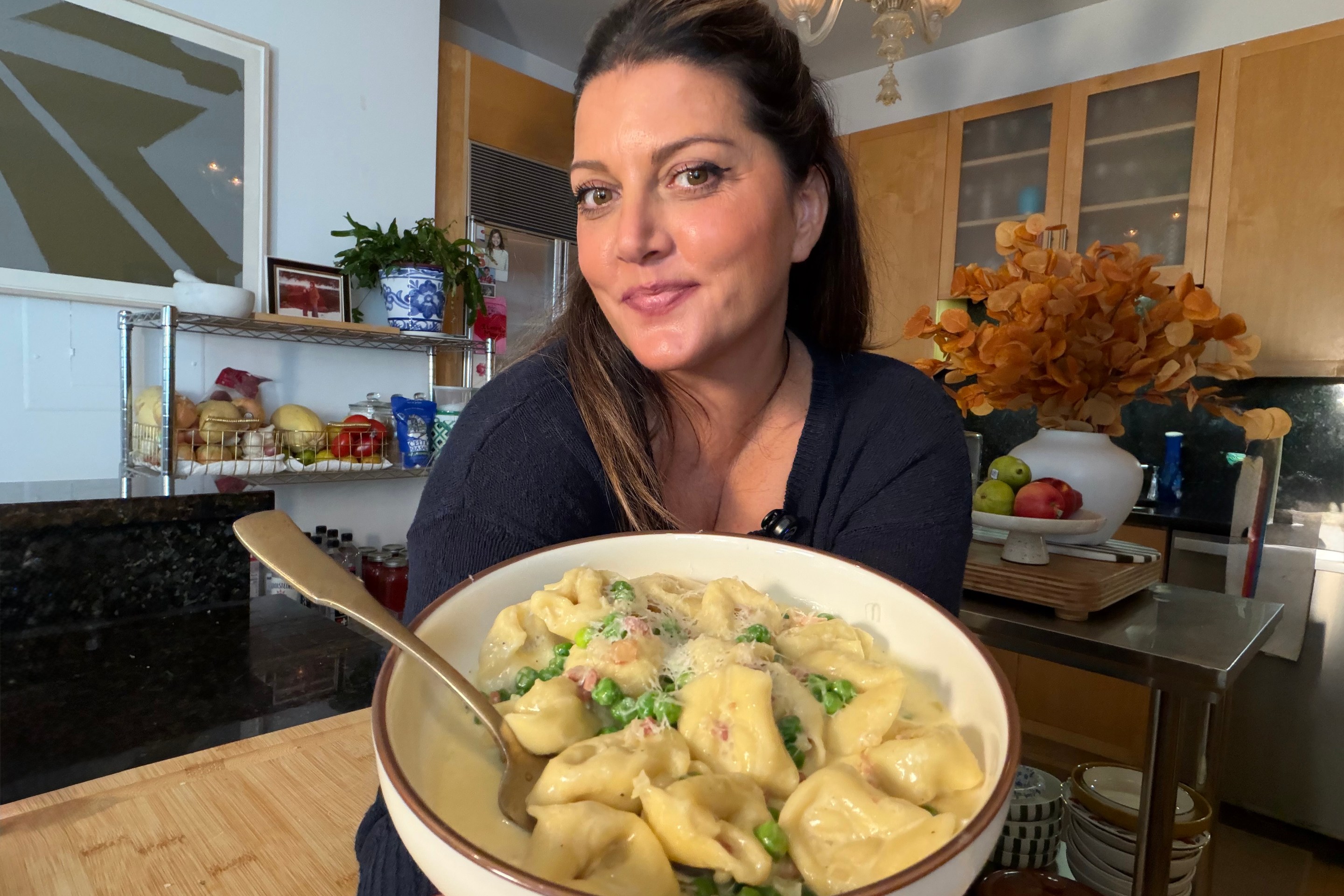
The whole family went to work. Lello Arpaia’s mother brought this ricotta cheesecake recipe from Naples and baked it at the family’s La Tavernetta restaurant on Long Island. Olympia's granddaughter Chef Donatella Arpaia still makes it today. His brother Enzo joined the kitchen. His wife, Maria, welcomed the guests. Donatella’s crib sat beside the dishwasher, where the steady hum put her to sleep.
Lello gave the Five Towns Roman Nights, live piano, tableside Caesar salad, and fresh flowers. Dinner was an occasion because he decided it would be. More than 50 years ago, he hired Black gay pianists, German women behind the bar, newly arrived Italian immigrants, and anyone else whose talent he recognized. As Donatella said in her eulogy, “He did not need anyone to explain diversity to him.”
He was also his own contractor. Unable to close La Tavernetta long enough to level the dining-room floor, he did it after service. Exhausted, he fell asleep in a corner and woke to find his shoes completely set into the concrete. Rather than tear up the floor, he stepped out of them, poured the rest of the floor over them, dressed for work, and opened the restaurant.
The corner table above “Lello’s shoes” became the most requested in the house among regulars who knew the story. Leave it to Lello to turn a construction mishap into a reservation.
No checkered tablecloths
Lello bristled at the idea that Italian dining meant red sauce, checkered tablecloths, and movie stereotypes. Italy’s regional cooking, he believed, deserved the wine, ceremony, service, and critical attention then reserved mostly for French restaurants.
American Express had already featured him in its “Do you know me?” restaurant radio campaign of 1977 and 1978. He brought that conviction, and that name, to Manhattan with Lello in 1980. Mimi Sheraton awarded it two stars in The New York Times. Lello, naturally, believed he had been robbed. New York magazine’s wine-and-spirits insert saw it his way, handing Lello its Silver Jigger Award in late 1983.
Four years after Lello opened Scarlatti: grand, chandeliered, peach-upholstered, and priced with confidence. Gael Greene recorded the opening frenzy in New York magazine—crowds outside, a television crew inside, the staff trained to be of service. The press took notice. A 1985 profile, “No Checkered Tablecloths for Lello Arpaia,” reported that Lello and Scarlatti were expected to gross a combined $6 million that year.
Five years on, a 1990 dining guide found the room undimmed: an army of dining-room staff in silk suits and gold braid, and a signature Tritico that combined three homemade pastas with three different sauces. The maître d’ greeting guests was Ernesto Cavalli. He had been the longtime maître d’ at Mario’s Villa Borghese when Lello took over that restaurant—that is how they met. Ernesto knew everyone and was very handsome, which mattered: Lello was a snob about looks according to his daughter. He hired him to open Lello and, when Scarlatti opened, took him along. More than four decades later, at Lello’s own age, Cavalli still works a door—maitre d’ at Due on the Upper East Side. “What can I say?” he told Donatella. “Your dad was my inspiration and is a legend.”
In 1993, the Scotto family later took over Scarlatti’s former space for Fresco by Scotto. Rosanna Scotto told me:
“What began as a business connection grew into a friendship with Lello and his family that we treasured over the years. Lello was a true New York restaurateur—warm, passionate, and larger than life—and he understood that a great restaurant is about so much more than food; it’s about family, hospitality, and making people feel at home. We will always be grateful that our paths crossed and that, in a way, Lello will forever be part of the Fresco story. Our hearts are with his family.”
Lello was never ashamed of the food that sustained Italian neighborhoods. He simply refused to accept it as the boundary of Italian cooking in America. At Fiorini, his last Manhattan restaurant, he made the case with exquisite service, serious wine, and no interest in chasing the trends.
The late Regis Philbin was a regular. Oprah Winfrey, Dolly Parton, Sylvester Stallone, Andrea Bocelli, Pelé, politicians, financiers — and, yes, members of the mob. All of them passed through his dining rooms. Some of those men arrived expecting to own the place. They never owned Lello.
A restaurant owner in that New York had to decide early what kind of man he was. Lello decided.
Dino remembers the night at Lello when a Mafia figure dining in the alcove questioned the check, loudly, accusing his father of cheating him. Lello’s honor was everything to him. He tore the check up in front of the man’s face. “Since you don’t believe I’m honest, then dinner is on me—but you are never allowed in my restaurant again.” Later, the man waited for him in the parking lot on 52nd Street and pulled a gun. Lello didn’t engage. He got into his car with his 17-year-old son and drove home. The man stayed banned.
Another night at Lello, a member of a different family put a gun on the table in the middle of a busy dinner service and told Lello he wanted his chef—and made clear what refusing would mean. Lello refused. He kept his chef.
And there was the night at Scarlatti—the story he told Donatella when she was a girl. The house had a strict jackets-required policy, a rule Lello had learned in Oscar and Mario Tucci’s Delmonico’s; she still has the sign. A Mafia figure kept pulling his blazer off and hanging it on the chair, and as the drinks went down, his table got louder and meaner, while, as she remembers it, men from another family watched from the corner. Lello asked him, politely, again and again, to put the jacket back on. He was not carrying a gun. He had no protection around him. He refused to be intimidated. “There are no men today,” he used to say. To Lello, being a man meant defending your principles no matter who was standing in front of you.
He gave Donatella the code years later, when she opened Bellini and some of the same men from her father’s stories began coming in. She didn’t want to serve them. Her father told her: be gracious to every customer—police commissioners and cops, politicians, celebrities, the press, the Mafia. Be respectful. Treat them well. Never get too close. And never, ever go into business with them, because then they would own you. That was how he ran his own rooms: cordial with men from different families, generous as a host, and never once at the expense of his rules. It was the way my aunt Mary ran Delmonico’s—iron fist, eagle eye—and nothing slipped past either of them. He raised Donatella the same way: same fist, same eye, her own rooms. Bellini was old-school chic and still had one of the old pay phones on the wall; Donatella was years from understanding why certain men liked the place so much.
The people he built
After Lello died, people who had worked for him 30 and 40 years earlier called his children in tears. One former busser said Lello taught him construction; he later built a successful company. Lello’s dining rooms were schools, whether anyone had enrolled or not.
He held his children to the same standard. Dino started at Lello as a busser and dishwasher, never as the owner’s son. In 1994, his father helped him build Cellini in Lello’s former space, where he is chef and owner to this day—the busser who became the chef in his father’s old room. Lello wanted his daughters educated and out of the business, and insisted they become attorneys—though both worked summers at Scarlatti as hostesses and cashiers. Annamaria still practices law today. Donatella left it after six months to open her first restaurant, Bellini. She went on to build a formidable career, opening ten restaurants and becoming a television food personality, best known as a head judge on Iron Chef America.
When Bellini began to succeed, Donatella waited for her father’s praise. Lello asked why she had not opened five more. Behind her back, she later learned, he carried her articles and showed them to anyone willing to look.
According to Donatella, he loved each child differently, but asked the same things of all three: work, education, loyalty, and the confidence to know who they were. When Maria became ill, he stepped away from the business and cared for his wife for seven years. For all his swagger, Lello’s quietest act said the most about him: he stayed.
Riccardo Spadola—the son of Renata Greinert Spadola, the German barmaid Lello had hired half a century earlier—grew up around the family and volunteers as a firefighter in Atlantic Beach. When the emergency call came in after Lello’s fall, he recognized the address. He was among the first to reach him, and he helped arrange the helicopter that lifted him out. The crew could not believe the man they were carrying was in his mid-80s.
Steve Cuozzo of the New York Post put it plainly: “Lello was not only a great restaurateur who inspired several generations of Italian-venue owners and chefs. He was that rarest brand of human in an unforgiving business: a true gentleman. Lello conducted himself with unfailing grace through the rough-and-tumble. We won’t see the likes of him again.”
I am grateful I had the chance to tell Lello what he meant to me while he could hear it. At my Rizzoli signing for "The Delmonico Way," he came to support me. During my conversation with the great Pamela Fiori, former editor of Town & Country, I paused the program and asked Mr. Arpaia to stand.
“Thank you for every story you shared with me about my family,” I told him. “You brought me closer to them. My father, my grandfather, my aunt, and my mother all adored you. Thank you for being present in my life. You are a true gentleman.”
The audience applauded. In his face, and especially in his eyes, I could see what that acknowledgment meant to him. The message was simple: my grandfather's motto—I see you. I hear you. You matter.
After his death, Dino, Annamaria, and Donatella gathered in their parents’ home among 50 years of menus, photographs, antiques, and objects Lello had tried to repair with caulk. At first, they argued about the sheer volume of it all. Then they cooked, ate, laughed, and remembered.
“Even in death,” Donatella said, “Dad brought us back to the table.”
That is how I will remember Lello: presiding over a beautiful room, noticing everything, expecting more, and making certain the family came back to the table. His shoes are still in the foundation. He is in New York restaurant history, where he always belonged. Grazie, Signor Lello.
Love discovering Italy one bite at a time? Subscribe to the free Appetito newsletter for the latest in food, travel, recipes, and Italian culture stories.