

In a narrow street in Bari Vecchia, women still sit outside their homes making orecchiette by hand, just as previous generations did. Tourists gather to watch, cameras in hand, but for the women rolling, cutting and shaping tiny pieces of dough, it's just another day.
Watching them work changed the way I thought about one of Italy's simplest pasta dishes.
Before I even booked my flights to Puglia, I'd already decided what I was going to eat.
Orecchiette.
Looking back, choosing a destination because of a pasta shape probably sounds a little ridiculous. But after twenty years working as a chef, including five years leading the kitchen of a Mediterranean restaurant, I'd become fascinated by these little ear-shaped pieces of pasta. I wanted to watch them being made by hand, eat them where they originated and discover whether they really tasted different in the region that had made them famous.
It turned out I was asking the right question.
Orecchiette in Bari Vecchia
Standing in Arco Basso, better known as Pasta Alley, I realised I hadn't travelled to Puglia simply because I loved pasta. I wanted to understand why this little pasta shape mattered so much to the people who made it.
The women chatted to one another as they worked, barely looking down as years of practice guided each movement. Long ropes of dough became perfectly formed orecchiette with a quick flick of a knife and thumb. I could see how much skill sat behind something that looked so effortless. This wasn't a demonstration put on for tourists. It was simply everyday life.
Later that evening, I wandered back after the crowds had disappeared. The women had gone indoors, but their tables were still outside, lined with bags of homemade pasta and taralli. There was no orecchiette to be seen - it had all sold out during the day. Somehow, that made me smile. If you wanted to buy anything else, you simply knocked on the front door, and someone came out to help you.
There was no gift shop, no market stall and no performance. Just neighbours making and selling pasta as they always had.
That was the first clue. Orecchiette wasn't simply something people ate in Puglia. It was woven into everyday life.
Eating Orecchiette across Puglia
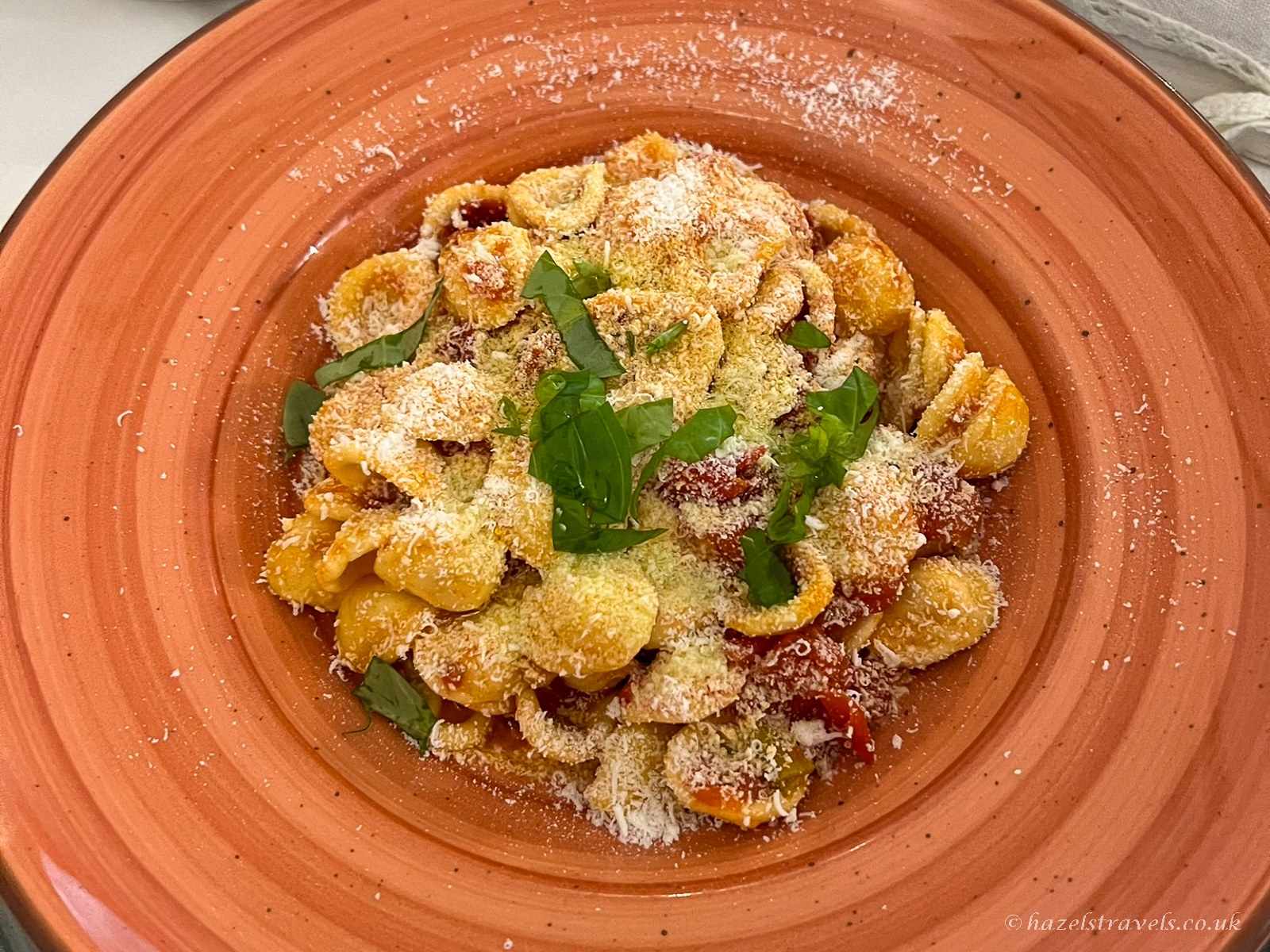
By the second day, I'd developed a habit. Every time I opened a menu, my eyes went straight to the orecchiette. If there was a version on offer, I ordered it. Rich tomato sauce? Yes please. Cime di rapa? I'd never heard of it, but I hadn't travelled all the way to Puglia to ignore the regional speciality. Before long, I wasn't comparing restaurants anymore - I was comparing how each kitchen interpreted the same pasta.
The first bowl arrived with cime di rapa, an ingredient I'd never encountered before. If I'm honest, I wasn't entirely convinced after the first mouthful. Its pleasantly bitter flavour was unlike anything I'd cooked with before. Yet by the end of the week, I'd started looking for it on menus. By then, I'd become a convert.
What surprised me most was how different each bowl could be. Although orecchiette is best known with cime di rapa, I also found it served with fresh tomato and ricotta in Bari, pork ragù in Salento, anchovies and breadcrumbs in Lecce, and even spicy dried peppers across
the border in Basilicata. In Cisternino, the local version was larger and more deeply ridged, usually served with rabbit ragù. The idea remained the same, but every town seemed to leave its own fingerprint on the dish.
That's when I realised something else. Orecchiette isn't really defined by one recipe at all. Instead, it becomes a showcase for whatever each part of Puglia produces best.
The more I travelled through Puglia, the more I realized the same connection between food and place was everywhere. An olive oil tasting in the Itria Valley reinforced it perfectly. I'd cooked with excellent olive oil throughout my career, but tasting it where it was produced, surrounded by centuries-old groves, gave me a completely different appreciation of the ingredient that tied so many Puglian dishes together.
One final bowl in Alberobello
By the time I reached Alberobello, I'd eaten more bowls of orecchiette than I could count. Each one had been slightly different, which only made me more curious. One restaurant kept appearing during my research: Ristorante L'Aratro. Known for its traditional Puglian cooking, it kept appearing whenever I searched for the best orecchiette in Puglia. By the time I reached Alberobello, it seemed like the perfect place for one final bowl.
Dreaming of your own Italian escape? Explore Appetito’s Italy travel guides and start plotting your next adventure.
By early evening, Alberobello had become relatively peaceful. Most of the daytrippers had disappeared, leaving the trulli streets almost empty.
Inside the restaurant, only a handful of tables were occupied. A display of cured meats, local cheeses and fresh burrata greeted diners near the entrance, alongside an old Berkel meat slicer that seemed perfectly at home in a restaurant devoted to traditional Puglian cooking. Moments later, I was shown to my table inside one of Alberobello's iconic trulli.
The four-course meal was excellent from beginning to end, but the orecchiette was still the plate I found myself thinking about afterwards. The pasta had just the right amount of bite, the tomato sauce celebrated rather than overwhelmed the ingredients, and everything on the plate felt as though it belonged there. After spending a week eating different versions across the region, this one somehow brought everything together.
Before visiting Puglia, I'd probably have said that great cooking is about knowing what to add and when to add it. More flavours, more techniques, more components. But spending time in Puglia reminded me that knowing when to stop can be just as important. The confidence to let outstanding ingredients do the talking is a skill in itself.
Before flying home, I bought a few bags of locally made orecchiette. Since then, I've managed to recreate the tomato-based versions reasonably well, but the version with cime di rapa has always defeated me. Partly because it's not easy to find cime di rapa in Britain. But mostly because the best ingredient was never just the pasta.
It was the women chatting as they shaped it in Bari Vecchia. The olive groves stretching across the Itria Valley. The changing seasons. The pride in local ingredients. The generations of tradition behind every bowl.
Looking back, choosing a destination because of a pasta shape no longer seems ridiculous at all. I travelled to Puglia because I wanted to eat orecchiette. I came home understanding how one simple pasta tells the story of an entire region.
Love discovering Italy one bite at a time? Subscribe to the free Appetito newsletter for the latest in food, travel, recipes, and Italian culture stories.