
For the latest installment of my Regional Italian series, I found myself back in Sicily—but this time, on the sweeter side of the island.
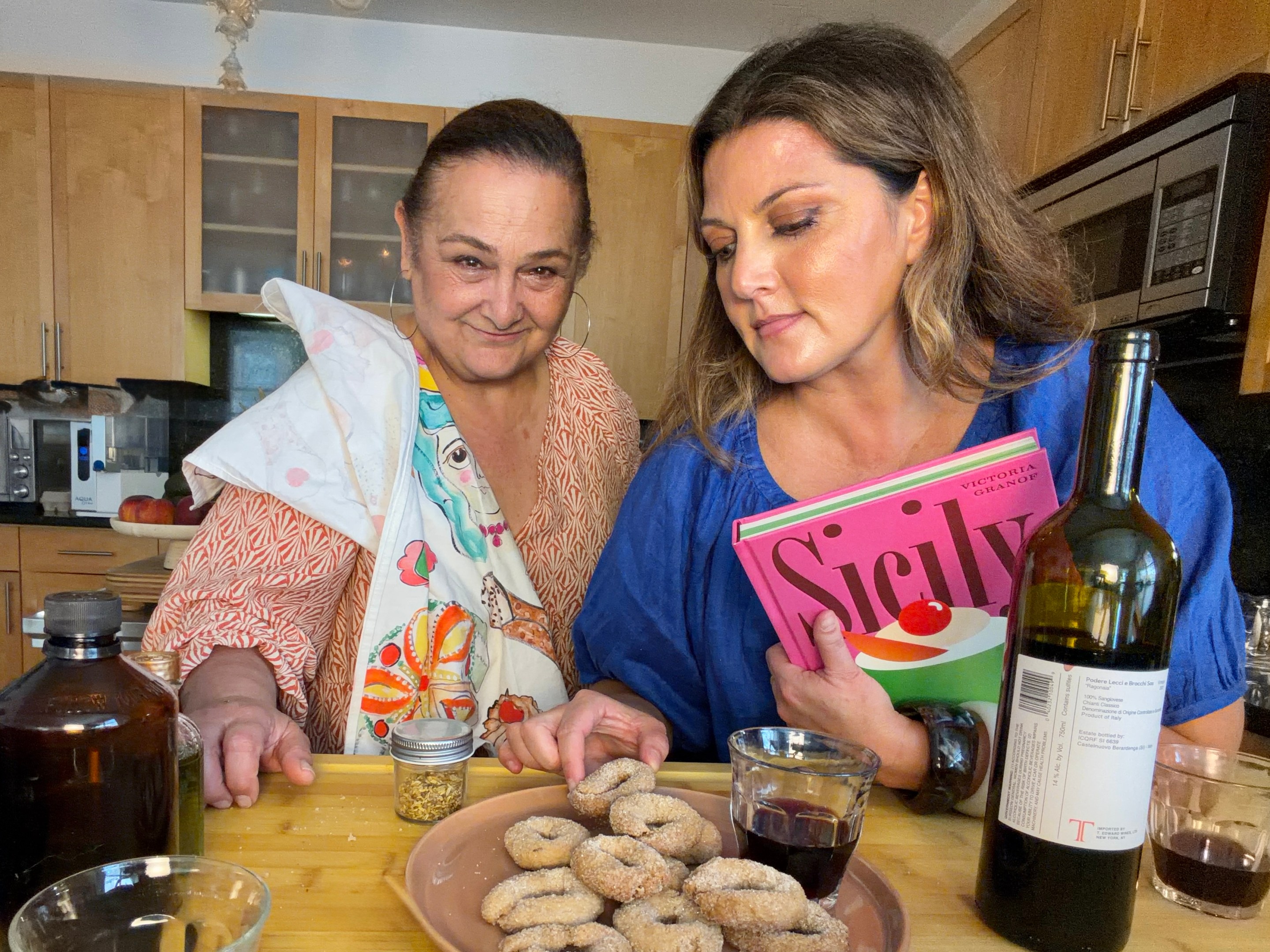
Joining me in my kitchen was cookbook author, food stylist, pastry chef, creative director, James Beard Award finalist, and Le Cordon Bleu graduate Victoria Granof, whose work has shaped the way many of us think about food. Through her writing, styling, recipes, and storytelling, she has a remarkable ability to transport readers beyond the plate and into the places, people, and traditions behind a dish.
To say I felt a little starstruck would be an understatement.
I have tremendous admiration for Victoria's work, particularly her beautiful cookbook, Sicily, My Sweet. More than a cookbook, it feels like a love letter to the island—part recipe collection, part history, part memoir. It's one of those rare books that is as visually stunning as it is informative, filled with recipes, stories, and cultural insights that stay with you long after you've turned the final page.
Victoria arrived bearing gifts, including a copy of her cookbook, her liqueur alle erbe, and a packet of wild Sicilian fennel seeds she had foraged during recent travels through Sicily. There were also her watercolor tea towels, each one feeling like a small work of art.
Her liqueur alle erbe was particularly memorable. Made with fennel, fresh mint, basil, and other botanicals, it was intensely aromatic, herbaceous, and beautifully balanced. Served alongside the biscotti al vino we were about to make, it felt like the perfect accompaniment.
Naturally, one of the first things I asked was whether the recipe appeared in Sicily, My Sweet.
"Of course not," she replied. "How linear would that be?"
I laughed immediately.
The answer was quintessentially Victoria—clever, unexpected, and entirely her own.
Instead, she explained that the recipe came from dear friends who own a permaculture farm in Sicily, where the biscotti are often served to guests as a simple dessert at the end of a meal. The recipe itself could not have been more humble: olive oil, red wine, sugar, flour, and wild fennel seed.
When I asked about the role of wine in the recipe, she smiled.
"Red wine in it, dipping it in red wine—red wine all around."
As we baked, I found myself watching the way Victoria moved around the kitchen. There was a confidence to it, but not the performative kind. It was the ease of someone who has spent a lifetime cooking, observing, researching, and collecting stories. Every step seemed attached to a memory, every ingredient connected to a place or a person.
As she measured sugar into a cup, she told me about an old silver spoon that had belonged to her grandmother, a beautifully worn piece that her grandmother had received as a wedding gift many years ago. It was one of many moments that revealed something essential about Victoria: food is never just food. Every ingredient, every utensil, every recipe carries a story.
Standing beside her and listening to those stories was as memorable as the biscotti themselves.
Our conversation drifted from Sicily's pastry traditions to the island's layered history. Victoria spoke about her mother's Sephardic Jewish Sicilian roots and her father's family from northern Italy. Yet it is Sicily that seems to have captured her heart most deeply.
As she shared stories from her travels and research, it became clear that her connection to Sicily goes far beyond recipes. In speaking about Sicily, My Sweet, Victoria has described arriving on the island and feeling an immediate sense of familiarity. The aromas, ingredients, and flavors felt like something she already knew, as though they had been living quietly in her memory long before she ever stepped foot there. What began as a search to better understand her family's Sephardic Jewish roots eventually grew into a much deeper exploration of Sicily itself and the many cultures that have shaped its food traditions.
Listening to Victoria speak about Sicily was fascinating. What resonates with me most about Sicilian food is exactly what she has spent years exploring: the way history, migration, culture, and geography all reveal themselves through ingredients and recipes. From wild fennel and citrus to almonds, pistachios, sesame, and spices, Sicily's culinary identity tells the story of the many people and civilizations that have shaped the island over centuries.
We laughed a lot. We talked about ingredients, traditions, memories, and the people who pass recipes down through generations. At one point, our conversation turned to the ingredients that grow abundantly across Sicily but don't always find their way into traditional cooking. Victoria spoke about pomegranates, cacti, and other ingredients that thrive on the island, and how fascinating she finds the tension between abundance and tradition.
While Sicilian food is deeply rooted in history, she noted that traditions can also create boundaries around what is commonly used. She spoke about friends who creatively incorporate some of these overlooked ingredients into their cooking, finding new ways to celebrate what the landscape provides. For Victoria, part of Sicily's endless fascination lies in that possibility—the idea that there are still ingredients, stories, and flavors waiting to be discovered, even in one of the world's most storied culinary traditions.
The biscotti eventually emerged from the oven, fragrant with wine and fennel, ready to be dipped into a glass of red wine or enjoyed alongside Victoria's liqueur alle erbe.
But what I'll remember most isn't the recipe itself. It's the opportunity to spend an afternoon with Victoria Granof, whose work continues to illuminate Sicily's rich culinary history through food, storytelling, and a deep appreciation for the people and traditions behind every dish.
Want to be the first to know about Italian food events, restaurant openings and culinary travel? Subscribe to the Appetito weekly newsletter.
30
minutesIngredients
3/4 cup 3/4 extra virgin olive oil
3/4 cup 3/4 red wine
3/4 cup 3/4 sugar
4 cups 4 all-purpose flour
2 tsp. 2 baking powder
1 tbsp. 1 lightly crushed wild Sicilian fennel seed (or toasted fennel seed)
pinch of fine sea salt
Directions
- Preheat the oven to 350°F.
- In a large bowl, combine the olive oil, red wine, and sugar and stir until blended.
- Add the flour, baking powder, sea salt, and fennel seed. Mix until a dough forms.
- Pinch off small pieces of dough and roll into thin ropes.
- Shape each rope into a circle, overlapping the ends slightly. If desired, roll lightly in sugar before baking.
- Arrange on a parchment-lined baking sheet and bake for about 30 minutes, or until lightly golden.
- Turn the oven off and leave the biscotti inside until fully dried and crisp.
- Serve with a glass of red wine or alongside Victoria's liqueur alle erbe.
Did you make this recipe?
Tag @appetitomagazine on Instagram and hashtag it with #italianfoodanddrink
Like this recipe?
Follow @Appetitomagazine on Pinterest
Follow us on Facebook!
Follow us on Facebook
Want more stories from Sicily? Read our coverage of Sicily's food, wine, and travel traditions.