

In Italian, food is rarely just food. It organizes time, relationships, and expectations. This column explores Italian sayings and proverbs as ways of thinking shaped at the table.
These expressions preserve that knowledge in compact form. Read literally, they speak about eating. Read more closely, they offer insight into how experience, pleasure, and social life are understood.
The aim is simple: to treat language as another ingredient—handled with care, tasted slowly, and shared. No prior appetite required. It tends to arrive along the way.
A Fagiolo
Literal translation: To a bean
Meaning: Exactly right—whether in timing, suitability, usefulness, or personal appeal
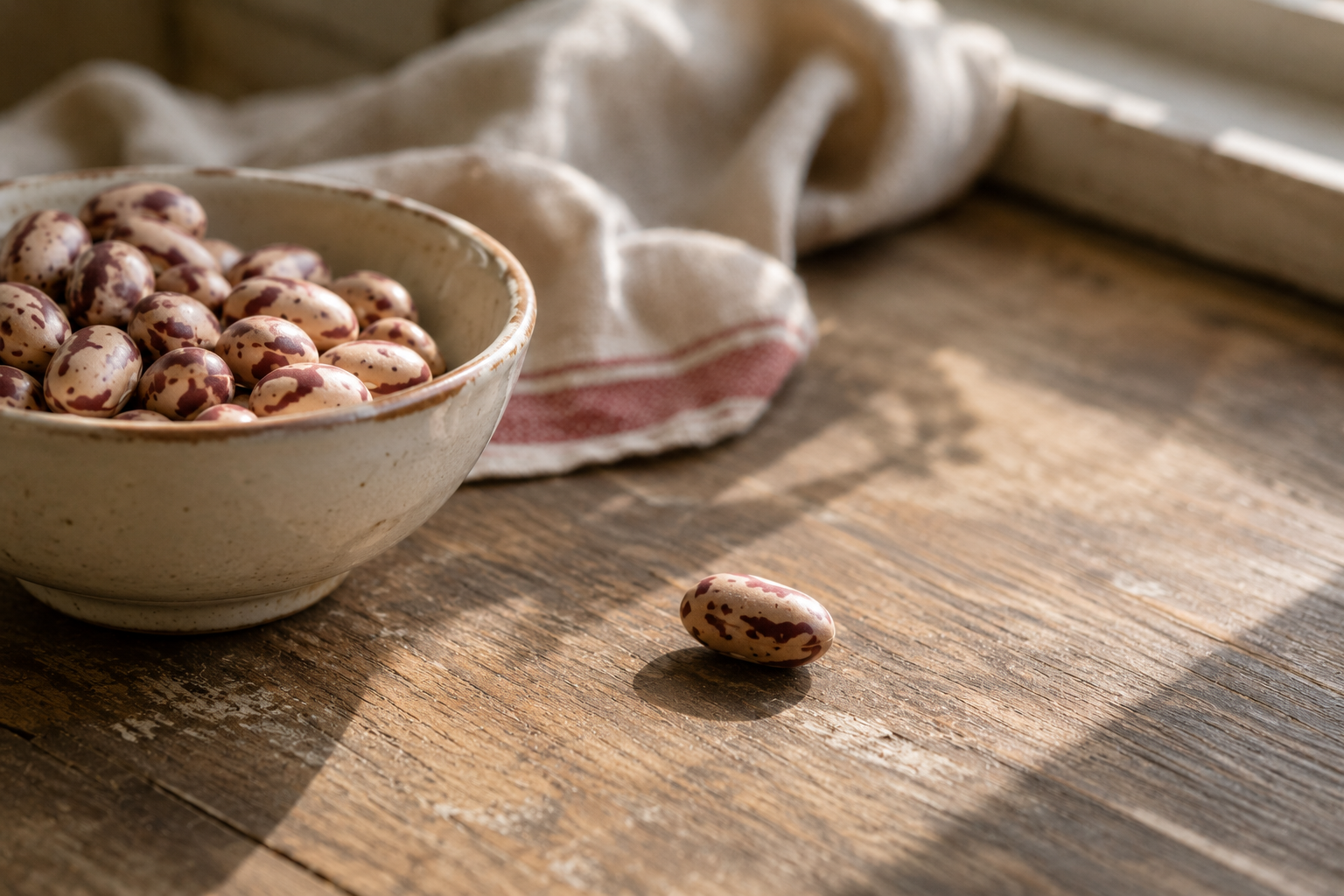
English has a different expression for each way things can fall perfectly into place. Italian dispenses with such distinctions and produces a bean.
The expression is a fagiolo, a small phrase with an unexpectedly large range. Something can capitare a fagiolo, cadere a fagiolo, venire a fagiolo, or andare a fagiolo. The bean remains unchanged; the verb specifies what kind of fortunate fit has occurred.
If a friend appears just as you are struggling to carry a table upstairs, the friend capita a fagiolo: he turns up providentially. If someone raises the very subject you wanted to discuss, the remark cade a fagiolo: it lands at precisely the right moment. If an unexpected day off allows you to finish a neglected project, the free time viene a fagiolo: it proves particularly useful.
These uses share more than good fortune: in each, circumstances seem not merely favorable but uncannily well matched to the person, purpose, or desire at hand.
Hungry yet? Discover unexpected ways to use beans in some of Appetito's favorite recipes.
Italian Potato, String Bean & Onion Salad Recipe
Pici Pasta with Potatoes and Beans
“Ceci Ceci” Chickpea Bean Salad
Andare a fagiolo, however, deserves particular attention. It is the earliest documented form of the expression and already contains the semantic core preserved in its later uses. The Accademia della Crusca illustrates it with a teasing line from an anonymous fifteenth-century Florentine carnival song: every woman is invited to pair herself “with the bird that most le va a fagiolo.” In a genre famous for erotic double meanings, the choice of bird was probably not innocent. But beneath the joke lies the idea that would endure: a perfect match between what is offered and the person to whom it appeals. The erotic suggestion faded, while the sense of something pleasing, fitting, and eventually arriving at just the right moment remained.
Why a bean should possess this remarkable power is less certain.
In the nineteenth century, the lexicographer Niccolò Tommaseo cautiously suggested that the expression might reflect the well-known fondness of Florentines for beans. Another theory connected it with the use of beans in voting. Neither explanation has been proved. The historical examples document the expression’s long life and changing uses, but they do not reveal how the bean first acquired its figurative talent.
That uncertainty is important. A fagiolo does not necessarily describe a bean falling into the pot at the perfect instant, nor can its origin be confidently traced to a particular recipe or custom. Its durability may depend precisely on the fact that its original image can no longer be recovered. What remains is the peculiar linguistic certainty that a bean can represent something welcome, suitable, and exactly where it ought to be.
Perhaps that is the most Italian feature of the expression. A clock can identify the right moment, but not the peculiar satisfaction of something that is also useful, welcome, and exactly right.
For that, apparently, you need a bean.
Love discovering Italy one bite at a time? Subscribe to the free Appetito newsletter for the latest in food, travel, recipes, and Italian culture stories.