
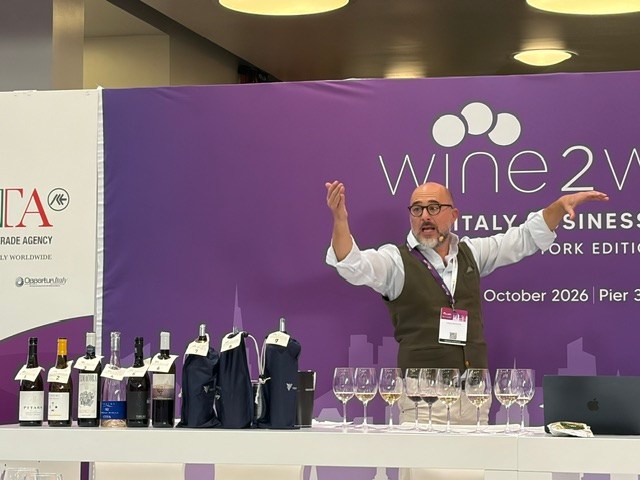
Anywhere the sun strikes Italian ground, the soil seems to give forth a different bounty; in fact, Italy has more indigenous grape varietals than any other wine-growing country, and all 20 of its regions, from the Alpine heights of Piedmont to the volcanic island of Sicily, bottle their own inimitable grape.
Each of these regions is represented here at Vinitaly, the preeminent and largest wine expo of our day. (You may think of Vinitaly as the wine version of Oktoberfest, with double-breasted suits replacing the lederhosen, and without the sing-alongs.)
I had my wine education, so far as it goes, not from wine primers and encyclopedias, but by traversing northern Italy with a rucksack and a pen, from village to village, tasting the local draughts, which are, more often than not, not for export. It was while crossing the Veneto at the right time—I was staying near Lake Garda, Catullus’ old digs—that I first attended Vinitaly, in Verona.
This event returned this week for its third outing in America, and the first to be held in New York City. Pier 36 is the site chosen for the great affair, and Chianti sippers are treated to a view not of the Ponte Vecchio, but of the Manhattan Bridge.
Buyers, distributors, merchants, importers, sommeliers, magazine editors, “personalities” and professionals—all smartly outfitted from suede shoe to silk foulard—converge on one plot of ground for two days (in Verona it is nearly a week) of information exchange, consorting and networking.
And between all the hobnobbing and business card swapping comes, naturally, the tasting. On arrival, each attendee is handed a radiantly clean glass, the same to be used throughout the day (this seldom happens).
Italy’s roughly 116,000 square miles are condensed into a level 125,000 square feet, and with but a few paces one can descend from the Dolomites to the lagoon floor of Venice, ski down the Alpine slopes of Valle d’Aosta to the coastal plains of Abruzzo, and in one leap step from frost-covered Piedmont into volcanic Sicily; and you needn’t charter a boat to take you from the Campania coast to the paradisiacal shores of Sardinia.
Besides the tasting booths—some 300 vintners present their labels (with a lone limoncello stand)—the program includes panels and podcasts, lectures and master classes. To give just some of the bylines will give a sense of the days’ topical variety:
“Sardegna: An Island Apart”; “From River Stones to Ancient Grapes: The Many Faces of Friuli Venezia Giulia”; “The Future of Wine Tourism in Italy”; “Can You Taste Italy Blind?”; “The Mario Soldati Experience: Why Great Wine Needs a Great Story”; “From Importer to Shelf: How America’s Three-Tier System Really Moves Wine”; “Your AI Assistant: Planning and Executing a US Marketing Plan for Italian Wine”; “The Science of Drinking Well: Wine, Health & the Mediterranean Way of Life." (I hadn’t a need of a lecture to convince me of the verity of this last; while I instinctively shiver with horror at the very insalubrious diet of AI and wine.)
All this is well and fine. But—nothing being so evocative as taste and smell—savoring the Metodo Classico of the Oltrepò [booth H3], the nebbiolo of the Langhe [E9], the Chianti of Toscana [E26], the Valpollicella of the Veneto [I6] and the Cesanese of Piglio [G2], I was brought back to my Byronic wine-wanderings and reflected that what is in the bottle is ultimately affected by what is without. This nappy blue baize carpet is not the verdant topsoil of Siena, and this corrugated steel roof is not the Savoy-blue sky over Verona. I maintain that one glass, full and cold, of vermentino or pecorino in its place of origin is better, more intimate and satisfactory than this infinity of infinitesimal sips.
But, at bottom, this is a trade event; and invitees are here to talk shop, taste shop, and move on. Still, I maintain that, despite all the display and pedantic explanation, wine cannot, whether for purposes of business or pleasure, be properly “assessed” in this way.
The two-day event began early, 9 a.m., and I set out for Pier 36 with the intention of doing my best not to topple into the East River. I was quickly apprised of the cumulative potency of those little tasters—I was almost brought to understand (almost) the barbarous and uncivilized modern habit—unsightly as well as unsoundly—of spitting one’s wine. Some of these ferments are too noble to be treated as mouthwash and cascaded into a spittoon, the wine equivalent of a pissoir. That said, Vinitaly is nearest I can approach in sympathy the mouth-micturators. Still, I cannot bring myself to dispense with a Barolo or Brunello, and as a result I spent the first day, well, spent, and tried to space myself more wisely the morrow.
It is now the second day, and I am sitting in the private upstairs lounge occupied by cannoli-crunching, espresso-supping grandees. (This article was dashed off on three cannoli and innumerable orders of “un caffè," with no Piedmontese DOCG as of yet.) Now, I must bid you arrivederci, for there remains but two hours until the closing ceremony, and I have a whole country to tramp across.
Like knowing where to eat before everyone else does? Subscribe to the Appetito newsletter and let us keep you in the know.