


I was raised at a table where the glass, the plate, the wine, the olive oil, the risotto and the welcome all carried rich Italian heritage. A family name was present in the details: the polished silver, the folded pressed linen, the food placed before a guest, the story told while the wine was poured — all in the spirit of the Delmonico way.
My grandfather Oscar Tucci brought that etiquette and discipline into a public room at Delmonico’s. He understood hospitality as action and carried the house through a revival during prohibition and into a new era of New York dining with elegance and devotion. He taught my father, who then taught me, that inheritance is protected in the doing: how the door is opened, how the guest is received, how the table is set, and how the meal is remembered.
I recognized that same inherited Italian dedication in my friend Giorgio Pozzi and his family’s centuries-old rice company, Pozzi rice, Pozzi rice.
Pozzi rice comes from fields in Northern Italy, pure water, inherited patience, Italian ancestry, and a family name of grace and substance. Giorgio Pozzi carries the Pozzi name with a seriousness that I understand. Although his rice arrives in a box, inside that box is more than rice: it is Italy, Landriano, Cascina Cirano, the agricultural memory of the Pavese, and the discipline of a family that has stayed committed to the grain.
I know Giorgio as a friend, and I know his rice from the dish. But I wanted to know more. I wanted to have a conversation about ancestry, friendship, rice, wine, olive oil, and the table.
I sat down to speak with Giorgio about the story inside the grain: the land, water, harvest, rice, and the responsibility of carrying his family name forward with dignity.
Giorgio, I am so happy to sit down with you and have this conversation, it is long overdue. You know I love your rice, and I adore you. I want to know all about Pozzi. And Cascina Cirano. Especially Cascina Cirano, a historic Italian agricultural estate located in Landriano. When you stand at Cascina Cirano, what do you feel first: land, ancestry, or the future?
All three at once. They are inseparable at Cascina Cirano. But if I must choose a starting point, I feel the land first. It is beneath your feet, it is in the air, and it holds everything that came before and everything still to come. The land is our truth.
First the region, then the estate. Teach us about Landriano. What does the region give to the grain that nowhere else can?
Landriano sits in the heart of the Po Valley, where the soil is deep and rich, fed by glacial waters from the Alps. What this land gives the grain is slow growth, mineral depth, and a starch structure that cannot be replicated anywhere else. The fog in winter, the heat in summer, the water that has run through these fields for centuries — all of it becomes the rice.
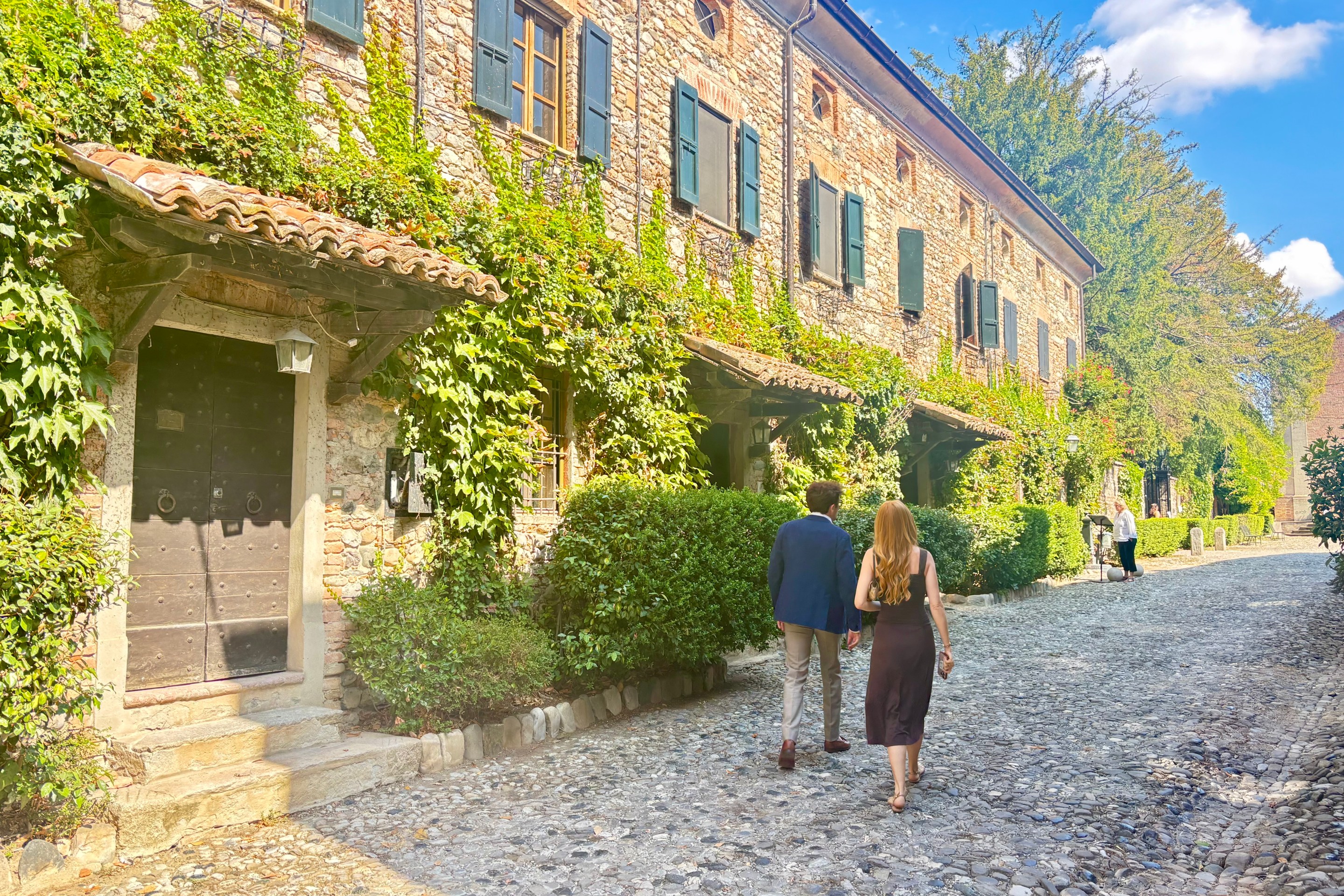
At 204 years old, Cascina Cirano (which is older than Delmonico’s by five years,) carries deep agricultural heritage. For those still becoming familiar, Cascina Cirano is a historic Italian agricultural estate located in Landriano, in the province of Pavia, Lombardy, and is renowned as a cradle of traditional Italian rice cultivation.
Established more than two centuries ago, it earned a place in agricultural history as the home of Italy’s first rice huller, the pila da riso, erected on May 25, 1822.
Today, the estate is synonymous with Riso Pozzi, a premium brand run by the Pozzi family, who have been cultivating elite varieties of Italian risotto rice across three generations.
With that said, how does this history guide the way your family works today?
It keeps us humble and rigorous. In 1822, the first rice huller was built in Italy on this land. It solved a problem with precision and dedication. That is still how we work, today. History does not make us nostalgic. It makes us responsible.
What is one ancestral lesson passed down to you that remains within your heart in the field, the mill, or the season?
“Never rush the rice!” It sounds simple, but it means everything. In cultivation, in milling, and in cooking, the moment you try to save time, you lose quality. The rice will tell you when it is ready. You just have to know how to listen.
When you explain true Italian rice to someone for the first time, where do you begin?
I begin with the water. Rice is born in water, grows in water, and is transformed by water. Before you even speak of variety or origin, you must understand that Italian rice is a living product of a very specific hydrological world. Once people understand that, everything else follows.
Pozzi rice is 100% Italian and 100% authentic: from the soil, seed, water, ancestry, and family. What makes Pozzi rice different before it ever reaches the stove?
The seed is ours. The field is ours. The milling is ours. There is no step in the process that we have handed to someone else. Most rice, even rice that calls itself Italian, passes through many hands before it arrives in your hands. Ours does not. That chain of custody is everything.
In addition, our Pozzi rice begins with documented, certified seed — a guarantee that what you are cooking is true Italian rice, not something uncertain or anonymous that has drifted over generations. In Italy, many rices are sold under familiar names, but the variety, origin, and handling can change over time. That is what makes Pozzi different before it reaches the stove: not just where it comes from, but the certainty of what it is.
For a chef reader, what should a proper grain of rice do in the pan?
It should resist, then yield. A good grain holds its structure through the heat and the stirring, absorbs the broth gradually without collapsing, and releases its starch slowly and evenly. When it yields at the right moment, that is the grain doing its job.
Do you think Italian rice is still underestimated outside of Italy?
Enormously. People know Italian rice, but they do not always know it well. There are many varieties, and each one has a different personality in the pot. The education is still happening. That is actually why I am here.
What does harvest season feel like at Cascina Cirano?
It feels like holding your breath and exhaling at the same time. The fields turn gold, the air smells of earth and water, and the machines move slowly through the rows. It is the moment when all the decisions of the year — every irrigation choice, every weather gamble — become visible. It is both beautiful and terrifying.
I want to experience the fields turning gold.
Sustainability can become a fashionable word, but for families tied to the land, it is daily work. What does protecting the land mean to you in practical terms?
It means managing water with extreme care, using flood cycles that protect biodiversity and reduce the need for chemicals. It means rotating varieties to protect the soil. It means not extracting more than the land can give. For us, sustainability is not a marketing claim. It is how you make sure there is still a farm in another 200 years.
Rice begins with water. What do you think about water as both a resource and a responsibility?
Water is the foundation of everything we do. The flooded rice fields of the Po Valley are living ecosystems, home to migratory birds, fish, frogs, and an entire world that exists because of the way we manage our fields. So managing that water well is not only an agricultural decision. It is an ecological one.
What makes our water truly special is its origin. It comes from the melting glaciers high in the Alps, flowing down through the spring and summer months into the plains below. This is not ordinary irrigation water. It is pure, mineral-rich, and alive with the energy of the mountains. It is the same water that has fed these fields for generations, and it is one of the things that cannot be replicated elsewhere. You cannot import that glacial purity.
When I think about water as a responsibility, I think about that journey from glacier to grain, and the obligation we have to protect every step of it.
When you hold your rice in your hand, what do you see that most people might miss?
Most people see rice. I see a year of work. I see the water, the weather, the decisions made in the field at five in the morning. I see my father, my grandfather, and every generation that stood in that same field and made the same choices. I see tradition and history held in something no larger than a fingernail. And I also see myself as a child, playing in those fields.
Your family has received important recognition, but what kind of acknowledgment means the most to you?
When a chef calls me to say the rice behaved perfectly — that it gave them the onda [wave] they were looking for. That is not a prize or a certificate. That is the rice doing exactly what it was meant to do in someone else’s hands. That is a beautiful recognition that matters.
Italian products carry heritage. How important is it that people understand the place and ancestry behind Pozzi?
Essential. A product without a place is just a commodity. Pozzi rice is not a commodity. It is Landriano; it is the Po Valley; it is the specific bend of a river and the particular angle of Alpine light on a field in September. It is a single family’s commitment, across generations, to one thing done with absolute care.
When people understand that, something shifts. They cook differently. They treat the rice differently, with more attention, more patience, and more respect for what it took to arrive in their kitchen. That relationship is the difference between a good risotto and an extraordinary one.
As Pozzi reaches New York and beyond, what do you believe Americans understand about Italian rice, and what do we still need to learn?
Americans understand quality when they taste it. That instinct is strong here. What is still developing is the vocabulary — the ability to distinguish between varieties, origins, and the way rice behaves in the pan.
In America, one type of rice has often become the default. In Italy, we see it differently. Each rice has its place, and each grain has a purpose. Pozzi rice brings structure, control, and authority to the pan.
That said, everyone has a different taste, and there is nothing wrong with that. I am simply here to say: try Pozzi rice once, and then decide for yourself.
When I introduce someone to Pozzi rice, I feel I am introducing them to your family and your standards. Is that how you see it?
Completely. Every box that leaves Cascina Cirano carries our name in the most literal sense. It is not just a brand. It is an identity. So yes, when you hand someone Pozzi rice, you are making an introduction. I take that seriously, and I am grateful that you do too.
My mother Gina, “the Queen of Delmonico’s, the Queen of Risotto,” has taught me many secrets on preparing risotto. One of them is: never walk away. What is the most common mistake people make when cooking rice for risotto?
They add the broth all at once, or they add it cold. The rice needs to receive the liquid gradually, at a constant temperature, so the starch releases slowly and evenly. And your mother is right, the other great mistake is walking away. Risotto requires presence. You cannot negotiate with it from across the kitchen. You need to listen. Risotto speaks to you.
What risotto feels most like home to you?
Risotto in bianco: rice, butter, a little Parmigiano, almost nothing else. It is what my family made when the fields were quiet and the pantry was simple. It asks the rice to carry everything. When the rice is right, it is enough.
And finally, my mother, Mamma Gina, wants to know: what is the perfect texture for a risotto dish, and how do you create the ultimate onda, meaning “wave”?
Signora Gina, the onda is the moment the risotto moves like a slow wave: fluid but not liquid, creamy but not heavy, each grain distinct but bound to the others.
You create it by respecting three things: the right rice, the right broth temperature, always hot and never cold, and the final mantecatura, the vigorous folding of cold butter and Parmigiano off the heat.
If it moves like a gentle wave, you have done it right. If it stays still, cook it a little less next time. The rice will teach you.
Max Tucci shares his White Truffle and Mushroom Risotto, a recipe that highlights the texture, flavor and heritage behind every grain of Pozzi Rice: