

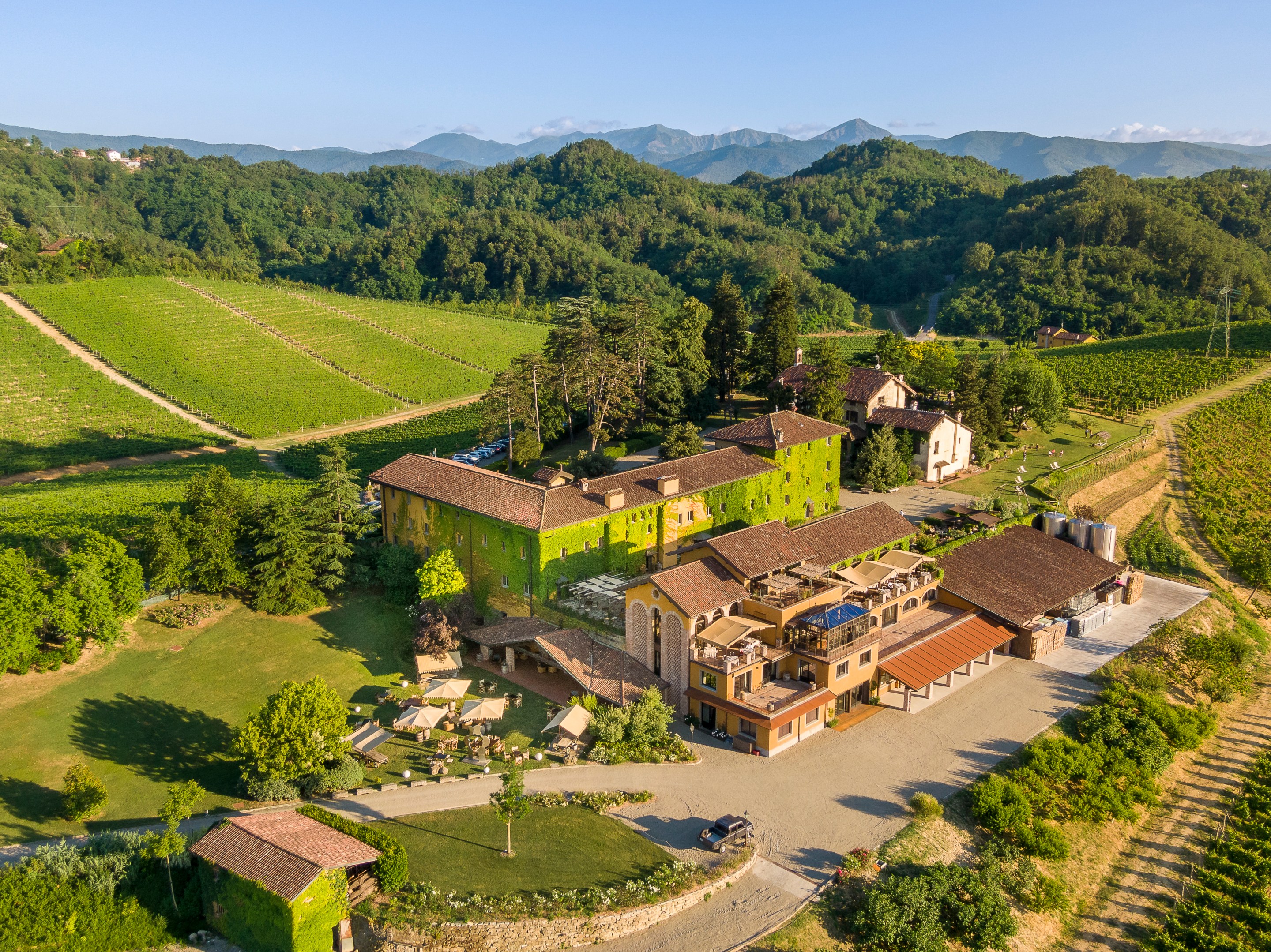
I almost missed the turn. A narrow road threads off into the Piedmontese hills in the region of Gavi, rising gently through rows of Cortese vines before the farmhouse complex of Villa Sparina appears, all ancient stone, golden light, and a stillness so complete it feels deliberate. By the time I had parked and stood in the courtyard, I already understood why a couple from Milan had driven out here in the early 1970s and simply decided not to leave.
How it all began
That couple was Mario Moccagatta and his wife Bruna. What they found here was an 18th-century farmhouse estate in the Monterotondo district, originally built by the Marchese Franzoni di Genova, with ancient cellars, hillside vineyards, and meadows that had never fully realized their potential.
Tiziana Moccagatta, one of Mario and Bruna's three children, who now runs the estate alongside her siblings, told me the story on a clear sunny morning as the light moved across the vineyards outside. Her parents saw what others had missed: the favorable hillside positioning, the cool Ligurian breezes drifting up from the coast, and the Cortese vines that seemed to belong to this particular patch of earth as though they had grown there forever.
They bought the estate, founded the Villa Sparina farm, and dedicated nearly 75% of the land to Cortese, the grape at the heart of Gavi wine. The watershed moment came in 1999, when their flagship wine, the single-vineyard Monterotondo, drawn from vines dating back to 1945, became the first Gavi ever to receive Tre Bicchieri award from Italy's authoritative Gambero Rosso guide. For a region still fighting for wider recognition, it was a huge breakthrough.
Turning a winery into a world
Stefano, Tiziana, and Massimo grew up among these vines and came to sense something the wine alone could not fully express: that this land deserved to be experienced, not merely tasted. In 2004, they opened L'Ostelliere, a four-star superior hotel, and La Gallina, a gourmet restaurant, effectively transforming Villa Sparina into a complete destination.
What they built required extraordinary care. Walking through the cellar with Tiziana, she explained how the restoration team lifted the original 18th-century stone floors, reinforced the structures beneath, then re-laid the very same floors, stone by stone, exactly as they had been. It was restoration rather than renovation, preserving the soul of the building while giving it the bones to last centuries more.
The ancient cellars, dating to the 1700s and still perfectly maintained, were also expanded, with a new wine cellar constructed to mirror the aesthetic of the historic originals, so seamlessly that it is nearly impossible to tell where the old ends and the new begins.
Love discovering Italy one bite at a time? Subscribe to the free Appetito newsletter for the latest in food, travel, recipes, and Italian culture stories.
The grounds are just as thoughtful. A dedicated wedding venue sits tucked away beneath the hotel, accommodating celebrations without disturbing other guests, a detail I noticed immediately and found impressive. Nearby, there is an outdoor bar surrounded by a lush garden, and it is exactly the kind of spot where an entire afternoon can easily melt away. Everywhere you turn, you find another perfect little corner: a cozy lounge, a rustic cellar room, a green clearing under a shady tree, or the bright kitchen with a view of the vineyards where they hold cooking classes. Across 100 hectares of vineyard, woodland, and meadow, there is a quiet elegance that makes you feel completely hidden away from the rest of the world.
My room was like nothing I have stayed in before. Each of the 33 rooms at L'Ostelliere is entirely unique, filled with original artworks and antique furniture the family has sourced at antique markets across Europe over the years. These are pieces chosen for their character rather than any desire for uniformity. Mine had the distinct feeling of a room decorated over time by someone with genuine taste, not a hotel designer working to a corporate brief.
Dinner at La Gallina
La Gallina takes its name from the hens that once roamed this farmyard, and their cheerful likenesses are a part of the restaurant's décor in a way that is charming and elegantly rustic. It occupies the converted ancient barn, with sweeping views over the vineyards that, at dusk, vie for attention with the beauty on the plate before you.
The kitchen is currently in the hands of chef Graziano Caccioppoli, who arrived in 2022 having just earned a Michelin star at the San Giorgio restaurant in Genoa. Originally from Vico Equense near Naples, Caccioppoli brings a remarkable range of influences to the table, blending the deep, rich tradition of Piedmontese cooking, the bright coastal energy of Campania, and a subtle Japanese precision absorbed during a 2016 residency at the kaiseki restaurant Mizuki in Japan.
The result is a menu that manages to feel both rooted and restless. Caccioppoli holds a Michelin star from his previous post in Genoa, and I wouldn’t be surprised to see one here soon. The wine list leans heavily and wisely on the estate's own Gavi, with Barolo and Barbaresco well represented alongside it. Their latest accolade is from Condé Nast Johansens as Best Dining Experience 2026.
The bottle with a story
Before I left, Tiziana showed me something I had been curious about since arriving: the Villa Sparina wine bottle, which is unlike any other on the market. Its silhouette is at once ancient and modern, soft but compact, elegant but sturdy, sitting somewhere between a vase and a classic vessel.
During the restoration works, an ancient amphora had been unearthed on the property, and the family commissioned Italian designer Giacomo Bersanetti to create a bottle inspired by that discovery. The golden tint of the glass, which both protects the wine from light and amplifies its warmth, is as recognizable as its unmistakable rounded shape. It has become entirely inseparable from Villa Sparina's identity, a bottle that, as the family put it, revives experiences of the past while looking to the future. It’s no wonder The Wine Enthusiast magazine awarded Villa Sparina as Best European Winery in 2021. Since then, their vintages have gone from strength to strength.
Family, legacy, and what comes next
Villa Sparina is run today entirely by Stefano, Tiziana, and Massimo. Stefano manages public relations and oversees the commercial side; Tiziana tends to events and guest experiences across the hotel, grounds, and gardens; Massimo holds the admin agricultural and investments of the winery together. They are each other's counterparts as much as colleagues, and it shows in the coherence of what they have built. The future, Tiziana told me, holds even more: deeper wine tourism experiences, further development of the resort, and a continued commitment to La Gallina's place among Piedmont's great tables.
Whatever comes next, the foundation Mario and Bruna laid here more than fifty years ago is secure. Villa Sparina is one of those rare places where wine, food, architecture, art, and hospitality coexist in a harmony that, once you have felt it, is not easily forgotten. My special memory is the tractor ride through the vines to a patch of forest where the chef served focaccia just out of the oven topped with their home cured salami and a glass of bubbles from the cantina.
I stayed an extra night, and still, it didn’t seem enough. So, it’s not goodbye, but definitely arrivederci, Villa Sparina.