

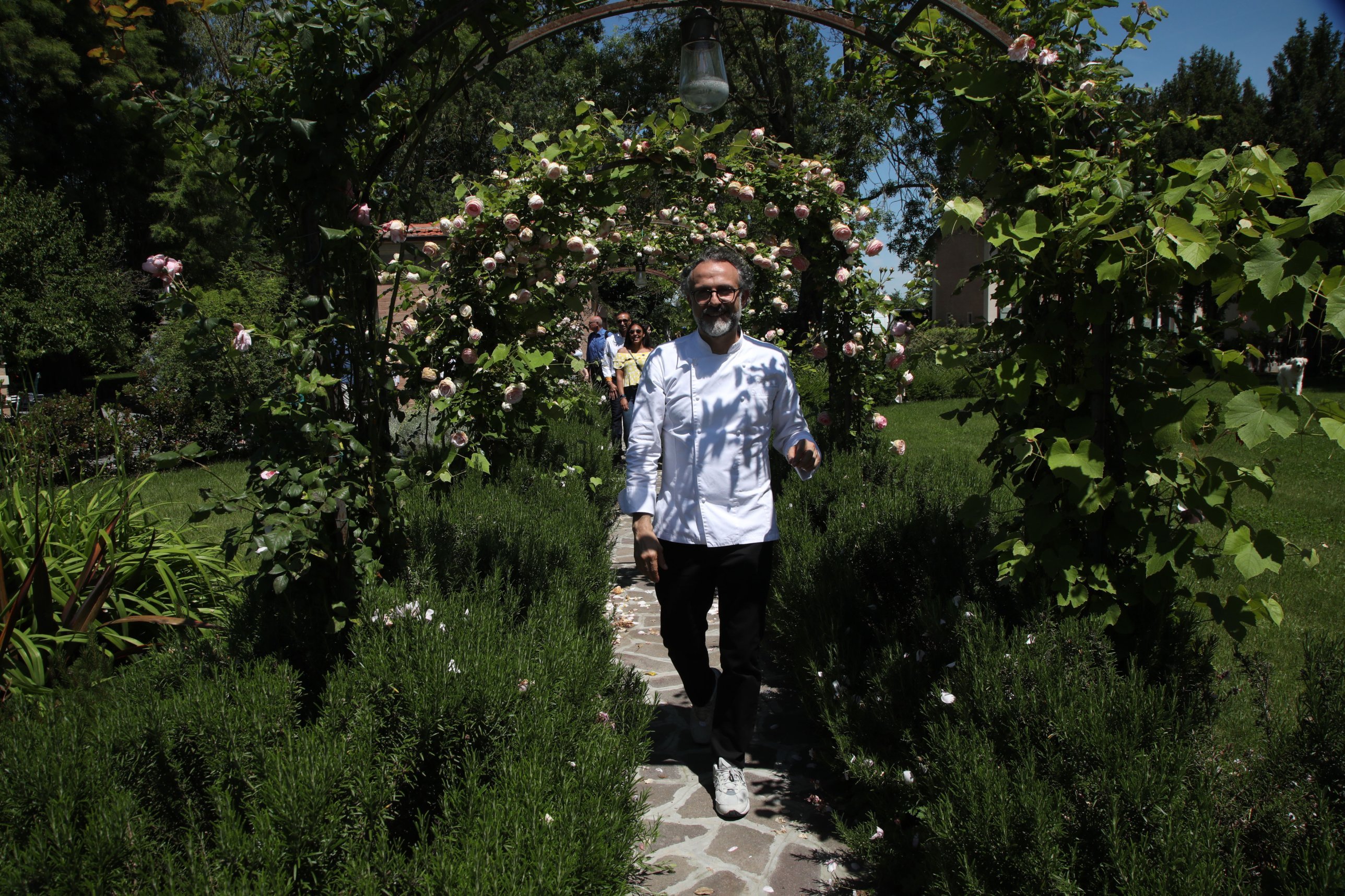
A few years ago, I spent a day at Casa Maria Luigia, the 17th-century country house outside Modena that Massimo Bottura named for his mother. I arrived late and rattled after a white-knuckle drive down the autostrada from Milan. Then I heard his voice.
In a carriage house turned demonstration kitchen, Bottura was already talking. Not about technique at first, but about art, music and a dish he calls "Autumn in New York." He described his work as folding the things he loves into something you can eat in a bite or two.
Later, away from the group, I asked him whether food is art. His answer surprised me. He is an artisan, he said, not an artist. Whatever he creates still has to be delicious. A guest may live down the street or fly halfway around the world to sit at his table. Either way, he owes them a meal worthy of that commitment, one they will remember. His way of honoring it is to remember the history of the Italian table and translate it, with art and with love.
I'm no artisan. I'm a home cook. But that afternoon he put words to something I had only half understood at my own stove. Everything you love shows in your food. If you cook with care, trying to please the people at your table, it shows. If you don't, that shows too.
Appetito's Editor in Chief, Andrew Cotto, has written about eating his way through three Bottura restaurants in 36 hours. My day was smaller and slower, and it ended with my hands in the food.
A sandwich, properly built
Lunch came in waves: tortellini, a chilled soup bright with herbs from the garden and a basket of gnocco fritto still hot from the fryer
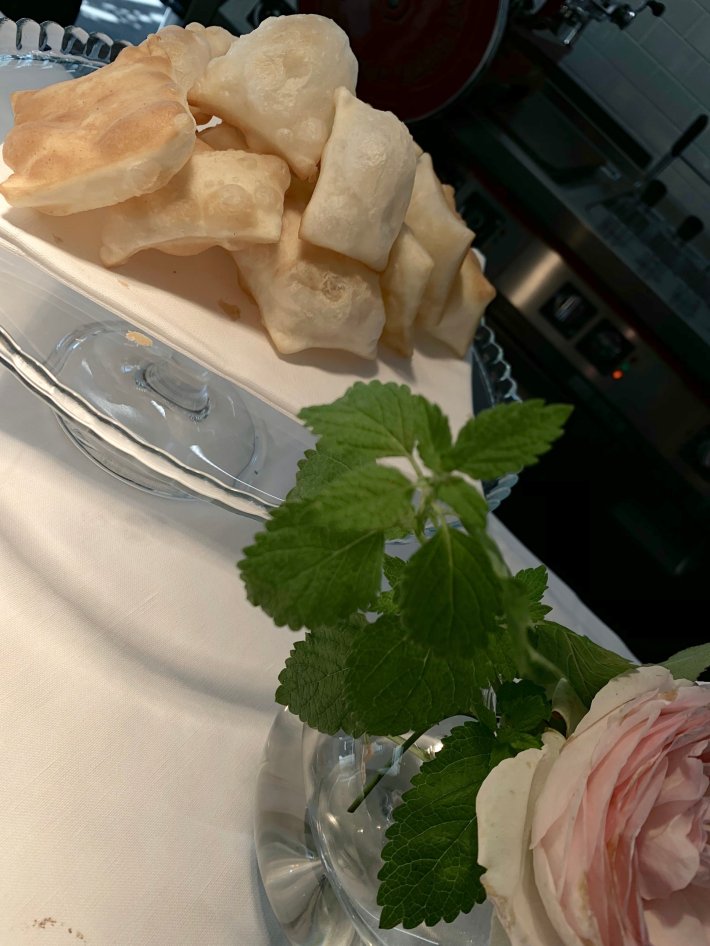
Gnocco fritto is the everyday bread of Modena and Reggio Emilia. It is a simple dough of flour, water, salt and lard, cut into diamonds and fried until it puffs up hollow. Locals tear it open and fill it with salumi, often in place of bread at the table.
Then Bottura showed me how someone from Modena builds a sandwich. Split a hot gnocco. Pile in mortadella and prosciutto, if there's room for both. Finish it generously with a balsamico aged for decades. When I hesitated using a portion of vinegar that likely cost more than my plane ticket, he shrugged. "Why not? You don't have to pay here."
Gnocco fritto, the fried bread of Modena. Photo by David Rodriguez.
That vinegar was nothing like the bottle in my pantry. True Aceto Balsamico Tradizionale di Modena DOP is made only from cooked grape must and aged at least 12 years in a series of wooden barrels. At 25 years, it earns the name extravecchio and a gold cap. It is sold only in a round-bellied 100-milliliter bottle designed by car stylist Giorgetto Giugiaro. Most supermarket "balsamic" is a different product that can be bottled after 60 days.
Until that day, I had never really liked balsamico. I had only known it far from home, poured from a supermarket bottle. In Modena, at its own table, it finally made sense. Nothing in that sandwich was complicated. Every part of it had simply been made by someone who cared.
Bringing it home
The idea followed me back to Reno, and it has not left.
I didn't set out to buy a pizza oven. The one that found its way to my back patio is far bigger than anything I would have chosen. But I suspect that sunny afternoon outside Bottura's house had something to do with it. He welcomed us, as if hospitality were the main course.
So I roast meatballs in red sauce and turn out pizzas by hand. Lately, I've started making dishes that remond my guests of home. When a friend from Chicago came to dinner, I made him an Italian beef pizza on a thin, tavern-style crust, topped with giardiniera. It was a little unconventional. But I wanted it to taste like home.
He took a bite and grinned. Short of an Old Style in his hand, he said, he was back on the South Side.
It changed how I eat for a living, too. I have reviewed restaurants across northern Nevada for more than 20 years. Care is visible on a plate, and so is its absence. You can taste a sauce someone stood over. You can taste a kitchen that has stopped paying attention.
The clearest proof I've found is not in Modena. It's in a stone cellar in Old Montreal, at Da Emma, the Roman restaurant Emma Risa and her husband, Lorenzo Aureli, opened in 1993. It has no 10-year waiting list and tops no global rankings. What it had, on every one of my visits, was Emma herself.
She stands barely 4 feet 6 inches tall and climbs a wooden stool to see into her pots of sauce. One night she invited me into her kitchen, handed me the wooden paddle and had me stir while she murmured to me in Italian. We didn't share a language. Her apron looked as if it had been with her for decades. I understood everything she was saying anyway.
It was the same thing Bottura told me in Modena. Behind every dish is respect and love.
And it is the thing I find myself passing on. I once told that story from Modena to Ruth, who runs a food truck here in Reno. She works full time as a housekeeper at a local hotel. On weekends, rather than rest, she loads her family into a faded orange truck and makes tacos, burritos and tortas in the style of Guadalajara, all by hand.
She listened, then said simply, "Sí, lo entiendo." Yes, I understand. What she meant was that she and Massimo are the same. She cooks because she loves to feed people, and I taste it in every bite.
It is as true at her truck as it was in that sunny garden in Modena. It's what I tell anyone who asks me where to eat and anyone I cook beside.
The same idea, at a larger table
Bottura practices this well beyond his own dining rooms. With his wife, Lara Gilmore, he founded Food for Soul, a nonprofit that grew out of a community kitchen he opened for Milan's 2015 World Expo. Its refettorios turn surplus ingredients into meals for people in need.
One of them, Refettorio Harlem, operates inside Emanuel AME Church on West 119th Street in New York. The premise is the one I heard in that carriage house. A meal cooked with care is a form of respect, whoever is at the table.
Ciao, Massimo
On summer nights, I still slice ripe strawberries and drizzle them with aged balsamico. It takes two minutes. It is hardly a recipe.
But for a moment I am back in a sunny garden in Modena, far from Reno, listening to a chef who reminded me that the love goes in first. Everyone at the table can taste it. And on the best nights, it feels possible to live a little more like a dream.
Ciao, Massimo.
Want to be the first to know about Italian food events, restaurant openings and culinary travel? Subscribe to the Appetito weekly newsletter.