



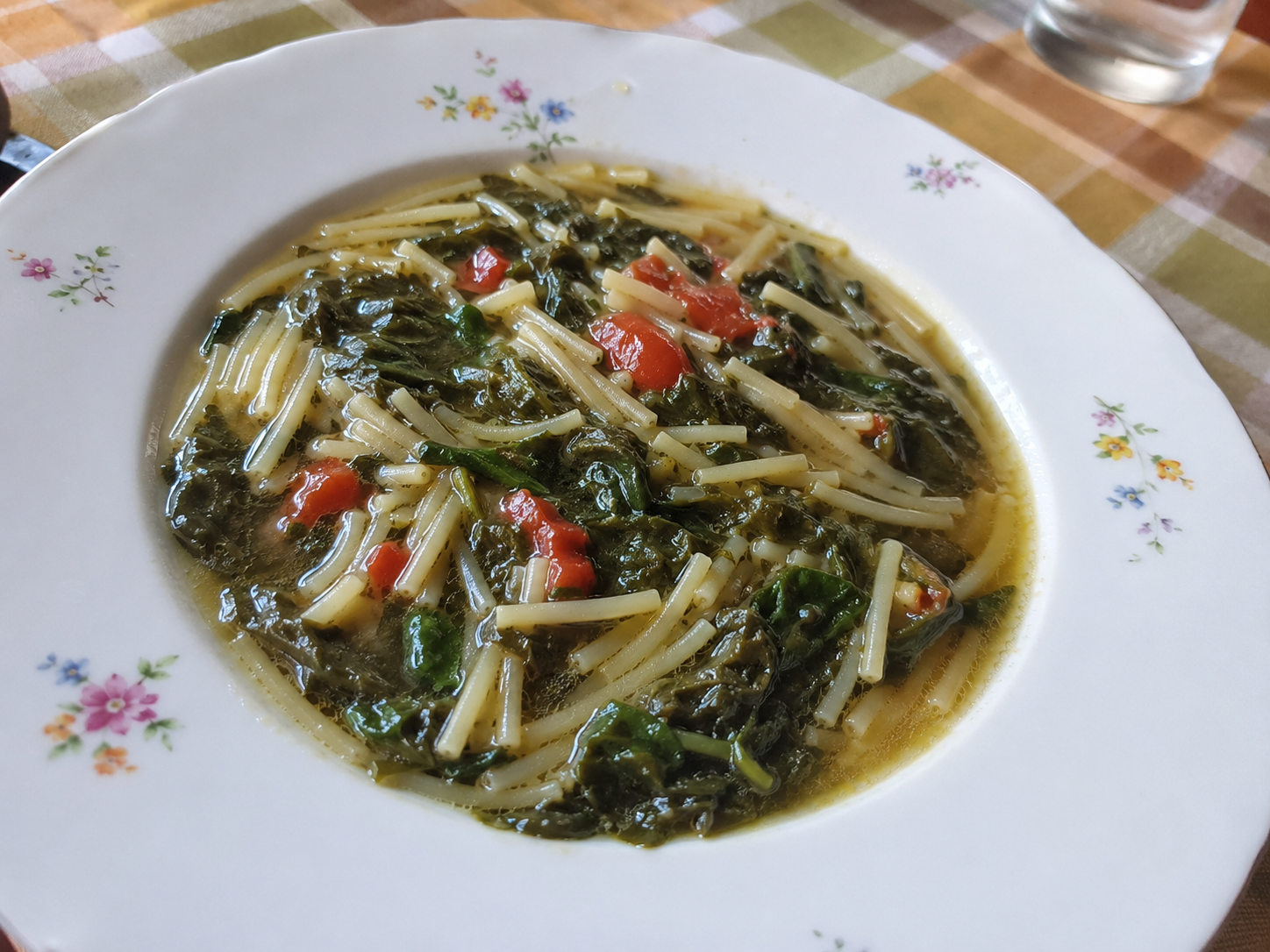
Every morning, my grandfather Tano would disappear into the garden. We never knew for how long, and we never knew what he would bring back. The menu of the house was decided by a silent negotiation between the soil, the season, and whatever his hands chose to pull from the earth. My grandmother Nuccia waited in the kitchen, the one who turned whatever he brought into lunch. This was how they spoke to each other, and the table was where we listened.
Their house stood in Pisano, on the lower slopes of Etna. I spent every summer there as a child. The table under the patio was always set with a sincerity I have spent my adult life trying to replicate.
One afternoon in July, Tano appeared from behind the fig trees carrying enormous bundles of bright green leaves, so large they obscured his face. In Catania, we call them tenerumi. In other parts of Sicily, they are called tenerezze. Tenderness.
Tenerumi are the youngest leaves and apical shoots of the cucuzza longa, the long white Sicilian squash, a plant so ancient that Pliny described it in the first century. It has been cultivated in Sicily for over two thousand years, and for most of that time, the leaves were considered more precious than the fruit. What other cultures throw away, Sicilians put at the center of the summer table.
Their scent is where this dish begins. Imagine the purest green you have ever smelled, the raw brightness of chlorophyll, and then layer beneath it something far deeper: dark earth after rain, a mineral vein, and at the very base, something almost animal, like worn leather in a church pew. What my grandfather grew in that volcanic soil had an aromatic power that I do not believe is nostalgia. It is a biological fact — lost.
The taste seems plain: slightly sweet, moderately bitter, profoundly umami. But an ingredient reveals itself through aroma long before it reaches the tongue. We possess only five tastes. We possess thousands of olfactory receptors. Tenerumi speak to the thousands.
Nuccia cooked them in the most humble way imaginable. She boiled the leaves for half an hour with chopped onion and fresh tomato, sometimes gently sauteed, sometimes simply surrendered to the water. No stock — just leaves, water, and time. In some households, people add cubes of the cucuzza fruit to sweeten the broth. In ours, never. It was tenerumi in absolute purity. When the water had turned into a dark, fragrant green broth, she broke spaghetti by hand and dropped them in. Just before serving, a few leaves of fresh basil, torn at the last moment, gave a last green note to a dish that belongs entirely to the earth.
She served it boiling hot in July. Under the Sicilian sun.
This will seem like madness. But my grandmother, like the Bedouins who drink scalding tea in the Sahara, was practicing a wisdom that science confirmed only in 2012. Researchers at the University of Ottawa demonstrated that ingesting a hot liquid in warm, dry conditions triggers a disproportionate sweat response through thermosensors in the stomach. The evaporation removes more heat from the body than the liquid added. The breezy Sicilian hillside is precisely the environment where this works.
Want to be the first to know about Italian food events, restaurant openings and culinary travel? Subscribe to the Appetito weekly newsletter.
But something else is at work. The warmth stimulates the vagus nerve, the longest cranial nerve in the body, the one that connects your gut directly to your brain. Heat activates vagal thermosensors lining the digestive tract, the signal travels to the brainstem, and your parasympathetic system takes over. The heart slows. The stomach opens. The enteric nervous system, what neuroscientists call the second brain, begins releasing serotonin. Ninety-five percent of the serotonin in your body is produced not in your head, but in your intestines.
Poetry, once explained, becomes science. Science, once felt, returns to poetry. My grandmother never read a study. She simply knew that a bowl of hot broth on a summer afternoon is not merely food. It is a recalibration.
Under that patio, on a table dressed in faded 1960s tablecloths, the steaming bowl would arrive and we had to wait. The first spoonful was always too hot. You blew on it, watched the steam dissolve against the afternoon light, and when you finally brought it to your lips, something inside you went quiet. No one ever ate a single plate. We always served ourselves again. The abundance of that broth gave a fulfillment that went beyond hunger, a reconciliation with the day, with the heat, with the life outside that garden wall.
Nourishment reaches us through channels we have not yet learned to measure. A bowl of tenerumi broth, prepared with patience and eaten in stillness, has the capacity to reorder something intimate and essential within us. Not through magic, but through the ancient precision of a nervous system that recognizes warmth and care.
In Western Sicily, many finish this dish with grated salted ricotta. We never did. We left the plant’s delicacy untouched. But if you wish, a whisper of aged pecorino will not offend it, alongside a generous pour of raw olive oil.
Since tenerumi are nearly impossible to find outside Sicily, I offer two paths. The first is my grandmother’s version, the soupy one that leads to silence. If you cannot find tenerumi, use the tender inner leaves of Swiss chard or young sweet potato leaves, which share a gentle bitterness and earthy depth. The second is drier, sauteed, perhaps more familiar to an American kitchen.
But I urge you to try the broth. Choose a hot day. Sit outside. Wait for the steam to clear. And take a spoonful.
We all need a little tenderness.
Explore more Sicilian stories from Chef Mario Traina.

Tenerumi Soup (Sicilian Squash Leaf Soup)
4
servings15
minutes30
minutesIngredients
2 large bunches 2 fresh tenerumi (approximately 1 lb.), washed and roughly chopped
1 small 1 white onion, finely chopped
2 medium 2 ripe tomatoes, peeled and chopped
12 oz. 12 spaghetti, broken by hand into 2-inch pieces
4 tbsp. 4 extra virgin oilive oil, plus more for serving
handful fresh basil leaves
sea salt, to taste
optional: a light dusting of salted ricotta or aged pecorino
Version one: In brodo (the authentic broth)
- In a large, heavy pot, bring 8 cups of water to a rolling boil and season generously with salt.
- Add the chopped tenerumi, onion, and tomatoes directly to the water.
- Lower the heat to a steady simmer and cook for 20 to 30 minutes, until the leaves are completely soft and the water has become a fragrant, dark green broth.
- Return the heat to high and, when the broth boils vigorously, drop in the broken spaghetti.
- Cook the pasta directly in the broth until al dente, stirring occasionally.
- Remove from heat, tear the fresh basil leaves over the surface, and let the pot rest for 5 minutes.
- Serve in deep bowls with plenty of broth, finishing each portion with a generous pour of raw olive oil and, if desired, a very small pinch of grated cheese.
- Version two: Asciutta (sauted)
- In a large pot of salted boiling water, blanch the chopped tenerumi for 10 minutes until tender, then drain, reserving the green cooking water
- In a wide, heavy pan, warm the olive oil over medium heat and saute the onion until translucent.
- Add the chopped tomatoes and cook for 5 minutes until they begin to collapse.
- Add the drained tenerumi, season with salt, and saute together for another 10 minutes, allowing the flavors to concentrate.
- Meanwhile, bring the reserved cooking water back to a boil and cook the broken spaghetti until al dente.
- Drain the pasta, reserving half a cup of the liquid, and add it to the pan with the greens.
- Toss vigorously over medium heat for 1 minute, adding a splash of the reserved liquid to bind the sauce.
- Remove from heat, tear the fresh basil over the top, and serve immediately with olive oil.
Notes
- If you cannot find tenerumi (the tender leaves of the Sicilian long squash), the best substitutes are the innermost leaves of Swiss chard or young sweet potato leaves. Seeds for cucuzza longa are available from heirloom seed suppliers in the United States and grow vigorously in warm climates.
Did you make this recipe?
Tag @appetitomagazine on Instagram and hashtag it with #italianfoodanddrink
Like this recipe?
Follow @Appetitomagazine on Pinterest
Follow us on Facebook!
Follow us on Facebook










)