

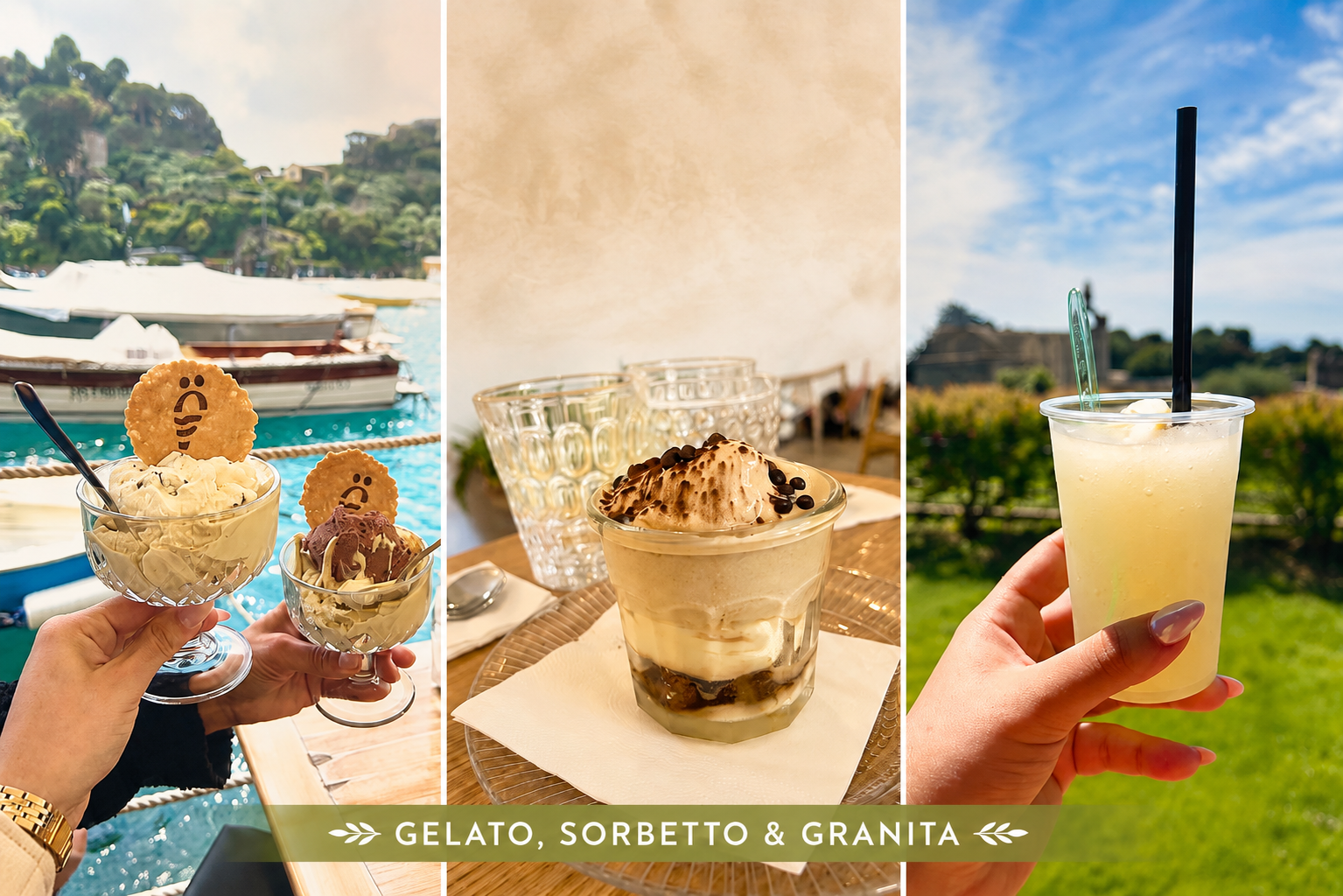
If you have ever been in Italy and looked around, you were probably looking at at least five different gelaterias. So how do you choose which one to go to? Do you choose the trendy shop with pops of pink and glitter in big cities like Rome or Turin, or do you go for the little hole in the wall with only five gelato flavors?
Italy has one of the most extraordinary frozen dessert cultures in the world. Gelato, sorbetto, and granita are three completely distinct formats, each with its own history, its own technique, and its own place in Italian culinary tradition. And yet most people outside of Italy have only scratched the surface of what each one actually is.
Gelato
Gelato is not ice cream. I say this with love, but also with complete seriousness.
Ice cream is made with heavy cream and no eggs, churned aggressively to incorporate large amounts of air. Up to 50% of the volume in a commercial ice cream can be air. The term we use is overrun. If someone says this is 50% overrun they are saying its volume is 50% air. So that air is what makes it light and fluffy but it also dilutes the flavor significantly.
Gelato is made with whole milk, not heavy cream. Italian law requires a minimum of 3.5% butterfat, or the fat found in the milk, though authentic artisanal gelato typically runs between 6 and 9%. Because there is less fat the gelato cannot hold as much air during churning, typically between 20 and 35% compared to ice cream's 50%. Less air means more density. More density means more flavor. And because gelato is served at a warmer temperature than ice cream, 20°F rather than 0°F, your palate is not numbed by the cold. You taste everything immediately and completely.
Dense but never heavy. That is the goal.
Sicilian gelato
Sicilian gelato is its own category entirely and one of the most unknown in all of Italian food culture. While traditional Italian gelato is made with egg yolks cooked into a custard, Sicilian gelato uses no eggs at all. Instead it is thickened with cornstarch, a technique rooted in Arab culinary influence dating back to the 9th and 10th centuries when Arab rulers introduced sugar, citrus, and starch-thickened sweets to the island.
The result is a brighter, lighter, almost velvety texture that lets the flavor of the ingredient come through more cleanly. It is also significantly more forgiving to make at home, no tempering, no risk of curdling, just milk, cornstarch, sugar, and whatever extraordinary ingredient you are building the flavor around.
Love discovering Italy one bite at a time? Subscribe to the free Appetito newsletter for the latest restaurant openings and Italian travel news.
Sorbetto
Sorbetto contains no dairy whatsoever. It is pure fruit, sugar, and water. Nothing else. When the fruit is extraordinary and the balance between sweetness and acidity is exactly right, a great sorbetto tastes more like the fruit than the fruit itself does. In Italy ingredient integrity and quality matters. Because sorbetto is made with just fruit, water, and sugar, there is nothing to hide behind. So ensuring the fruit is the best quality is crucial.
Because sorbetto has no fat it behaves completely differently from gelato during churning. Fat is what traps and holds air during the churning process. Without fat very little air is incorporated and the result is dense, intensely flavored, and completely refreshing. A great sorbetto is never icy or grainy. It is smooth, dense, and refreshing.
Granita and the brioche col tuppo
Granita is the oldest of them all and one of the most misunderstood. Unlike gelato and sorbetto which are churned smooth, granita is deliberately coarse, scraped repeatedly during freezing to create those characteristic large ice crystals that make it shimmer and crunch slightly on the tongue.
Granita originated in Sicily, where it has been made for centuries using snow from Mount Etna mixed with fruit juice, sugar, and other flavorings. Today it is one of the most beloved Sicilian breakfast traditions, served in a glass or split open inside a brioche col tuppo on a warm summer morning. The brioche col tuppo is a soft sweet Sicilian brioche named for its rounded topknot, and it is the traditional vessel for both granita and gelato, split open and filled generously so that the frozen dessert melts slowly into the warm pillowy bread as you eat it.
Coffee granita. Almond granita. Lemon granita alongside a scoop of pistachio gelato.
In Sicily you have the tradition of having your granita, sorbetto, or gelato served inside the brioche, or you will be served the brioche alongside the granita and the idea is that you tear a piece of brioche off and spoon your granita on top.
How to spot the real thing
Now that you know what each one is, here is how to find the real version when you are standing in front of a gelateria.
Look at the containers. Authentic gelato is stored in flat metal tins with lids, not mounded dramatically above the display case. If the gelato is piled high in colorful peaks that hold their shape perfectly, stabilizers are keeping it stiff. Real gelato served at the right temperature is soft and spreadable.
Look at the colors. Real pistachio gelato is a muted pale green, almost grey-green, the color of an actual pistachio. If it is vibrant neon green, artificial coloring has been added. The same principle applies to every flavor. Real ingredients produce honest muted colors. Bright vivid colors are almost always a warning sign.
Look at the menu. An authentic gelateria has a small focused selection, typically around eight to ten flavors made fresh that day. If you see fifty flavors covering every wall, or mint chocolate chip, birthday cake, or cotton candy, you are probably not in the right place.
And look at the fruit flavors. A serious gelateria will have very few fruit flavors in the gelato case, if any at all. They will save fruit for sorbetto or granita. Fruit contains water and water is the enemy of great gelato texture. It freezes into large ice crystals and ruins the density and creaminess that make gelato extraordinary. The real gelato shops know this.
When you find a gelateria that checks all of these boxes, metal tins, muted natural colors, a small focused menu, and very few fruit gelatos, get in line. It will be worth it.
Want more summer desserts? Keep the season sweet with more of our favorite Italian treats.