
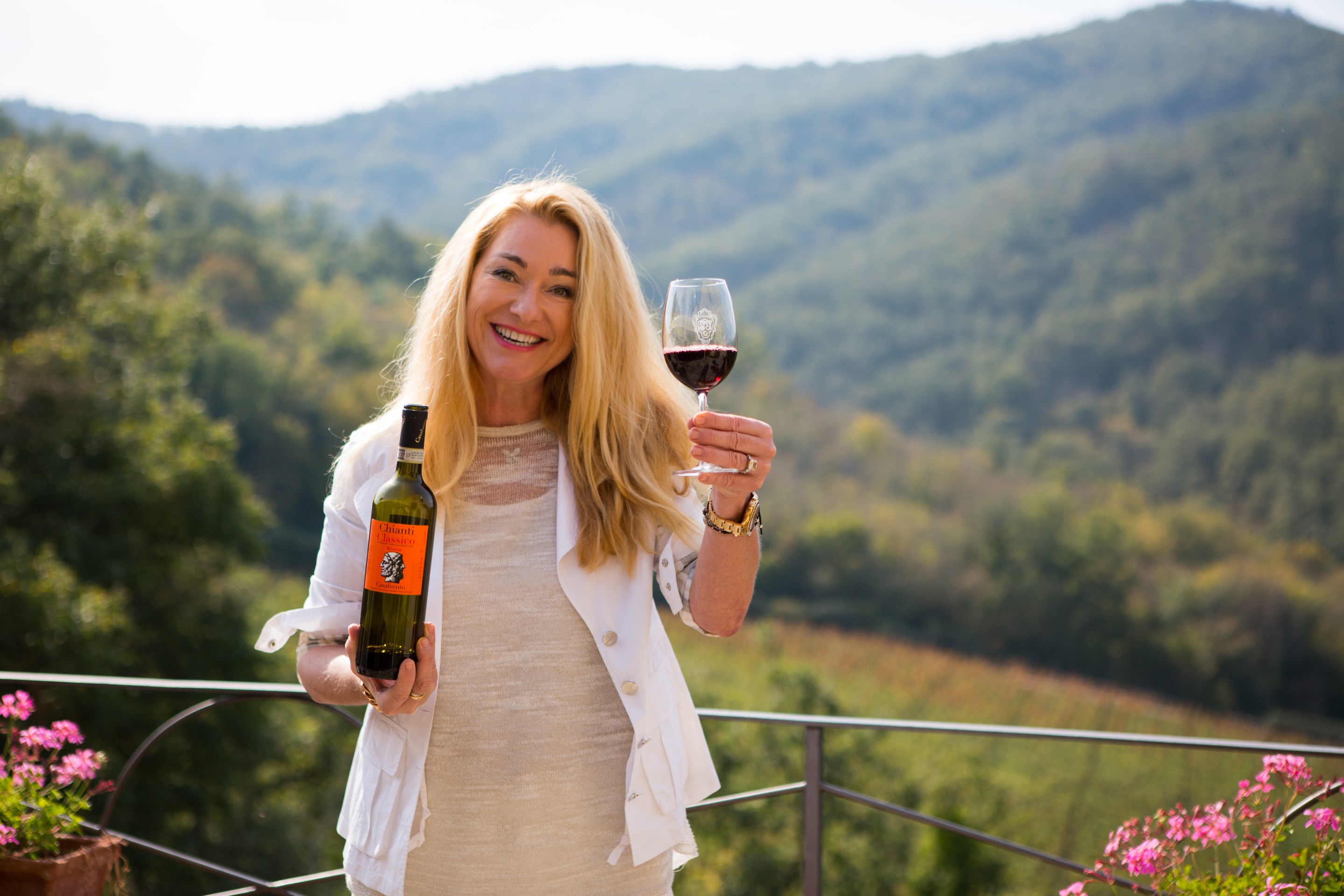
High in the hills of the historic part of Chianti Classico of Radda in Chianti, where cypress trees caress the horizon and the wind moves through vineyards like a choreographed ballet, sits Casalvento, the “House of the Wind.” What began as an abandoned property became something extraordinary: a winery, a restored medieval hamlet and a living testament to resilience.
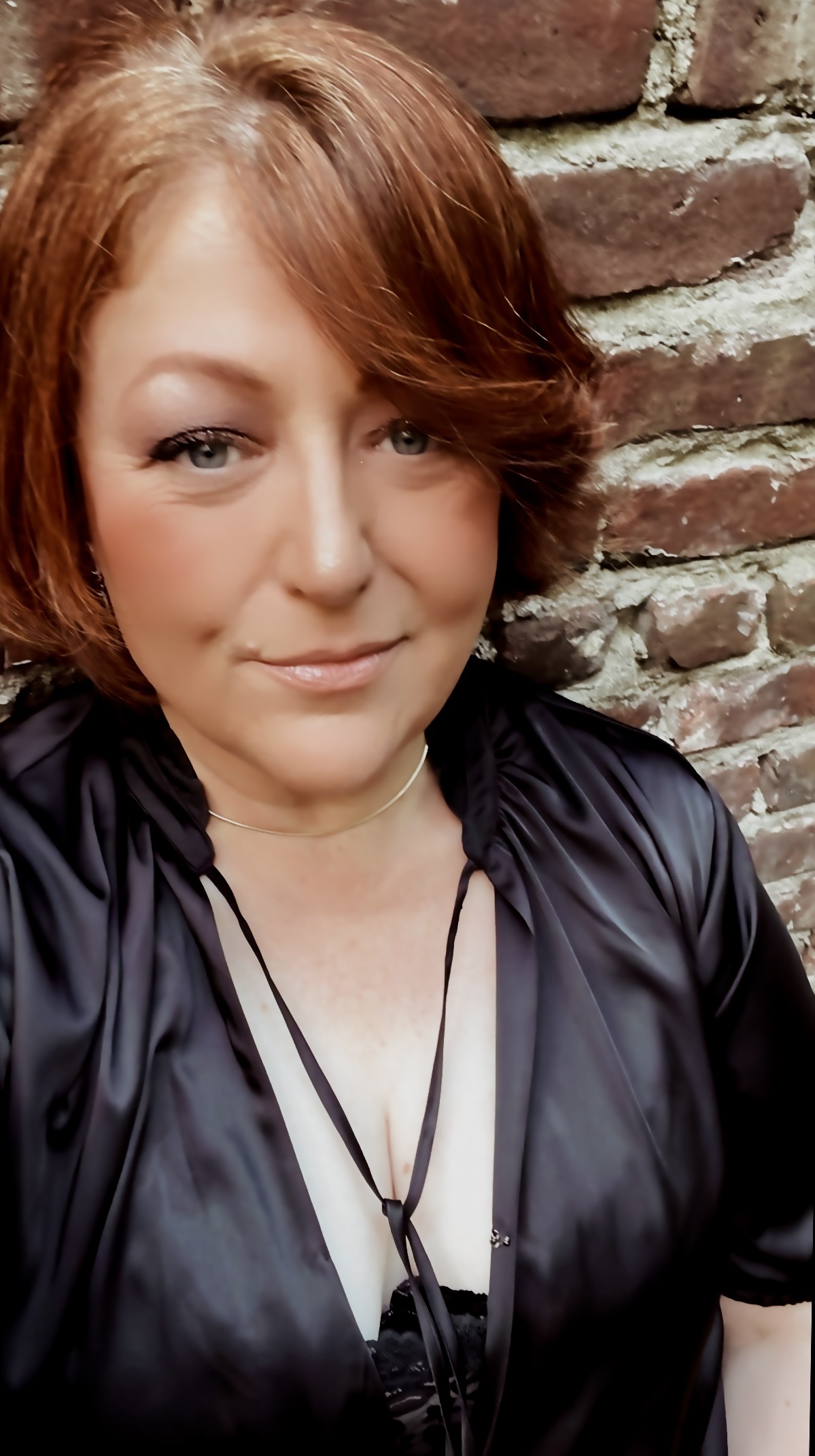
There are other properties with the same name peppered across Italy, but this Casalvento is the home of Gudrun Cuillo.
Together with her late husband Robert, Gudrun purchased what was little more than land and possibility. It began as a dream, followed by the transformation of Casalvento and neighboring Livernano into a place where Tuscan beauty, history and hospitality meet. A true Tuscan fairytale story, it is a daydream that turned into reality.
But Gudrun’s story is also one of love and loss, of perseverance and bereavement, and of the quiet strength required to carry forward a dream – alone.
Gudrun is also an author who brings the emotional landscape of Tuscany to life in her novels Casalvento: House of the Wind and Murder Under the Christmas Tree.
But for me, this story is also personal. Gudrun is more than a dear friend; she has become family. When we first met in Palm Beach years ago aboard Lady Kathryn V, owned by the Vecellio family, I gave her a tiger’s eye crystal and told her, “Hold this close for protection.” It was at that moment that we bonded, amici per sempre. Little did I know that a decade or so later we would create my namesake wine label, bearing my father Mario Tucci's legendary signature.
Today TUCCI wine is available at Gudrun’s vineyard and at Villa Tucci.
In our conversation, Gudrun reflects on rebuilding a hamlet, crafting certified organic wine and olive oil, and her profound life that unfolded because she followed her dream to Tuscany.
Read more from award-winning author Max Tucci.
Beginnings and discovery of Tuscany
When you first encountered Casalvento in the hills in Radda in Chianti, what was your first emotional reaction to the land? Did it feel like destiny?
I felt as if I had arrived in heaven. There are no cars, no noise, I am so far from everything and behind the gates — I hear only the choir of birds greeting the day. Nature greets me. I wake up smiling. To me, it feels like the presence of God.
You and your late husband Robert purchased what was essentially an abandoned medieval hamlet and vineyard. What did Casalvento look like the first time you walked the property?
It was simply a house surrounded by a great deal of land, lots of land. We later discovered the property carried Chianti Classico rights. Our lawyer told us we could sell those rights immediately, but my husband wanted to make his own wine. So we rolled up our sleeves, found the right people, and in 2000, planted seven hectares at Casalvento/Livernano. It became an incredible journey of learning and discovery.
At that moment, did you see the possibility — or did the magnitude of the restoration feel overwhelming?
Both. We believed deeply in the dream, but there were challenges—language barriers, Italian laws and a pace of life very different from what we Americans were used to. It was definitely not Palm Beach.
Many people dream of Tuscany, but few revive a borgo from the ground up. What was the first step in turning Casalvento into a working winery?
People. You must find workers who believe in your vision. In Italy, there is always “domani”— tomorrow. Americans want everything done today. At first, that was difficult, but once everyone shares the dream, they become the most dedicated partners you could ask for.
Want to be the first to know about Italian food events, restaurant openings and culinary travel? Subscribe to the Appetito newsletter.
Love and loss
Your life and the estate were built together with Robert. What role did he play in shaping the vision for Casalvento?
Robert loved to cook, and in Tuscany, he felt completely free from the pressures of his life in the United States. One day, we cooked together from morning until evening. When we finished, I asked him, “Who did we cook all this food for?” He smiled and said, “Just for you and me, my love.”
After Robert’s passing, you faced the difficult reality of continuing the project alone. What gave you the strength to carry forward?
You must believe in yourself. Be smart, listen and trust your instincts. I have learned to believe in myself and my instincts. I often think of the phrase per aspera ad astra — to the stars through difficulties. Life is short, so you must follow your inner voice and reach for the stars.
Was there ever a moment when you considered letting Casalvento go?
Never. Casalvento is my home and the place where all my memories with Bob live. I am Casalvento. As much as it is me. Livernano, the hotel, was more challenging for me because hospitality was not my background. But Casalvento itself was never a question.
What responsibility did you feel—to your husband, to the land, to the history of the hamlet, and to yourself—to keep the dream alive?
To be strong, to be wise, and never give up if you believe in something. And I believe so much in our dream. I could never abandon it. My greatest joy today is welcoming people from all over the world to the winery and to join our wine tours.
Reviving a hamlet
Restoring a winery is one experience, but restoring an entire medieval hamlet is another. What were the greatest challenges in bringing Livernano and Casalvento back to life?
Again, finding the right people. When you work with contractors and craftsmen who understand your vision, the process becomes easier. We wanted to preserve the soul of the place while creating comfort and a calming luxury.
When did you first feel that the hamlet and winery had truly come alive again?
When my husband looked around and said, “We did the unbelievable.” Many people thought we were crazy planting vineyards at 650 meters above sea level. The talk in the village was, “These crazy Americans don’t know what they’re doing.” In Tuscany, vineyards are rarely planted above 500 meters because the cooler temperatures and shorter growing season can prevent grapes like Sangiovese from fully ripening. But we believed in the land. Today, those vineyards produce some of the finest grapes in Tuscany—and wines that truly express the character of these hills.
How do you balance honoring the historical soul of a place while modernizing it for contemporary wine production and hospitality?
We are in one of the most historic areas of Chianti Classico. Our soil is “alberese” limestone, which stores water during the rainy season and releases it during the heat. For hospitality, nature does the rest—the sun, the soil, the woods, the aromas of the land. When people visit, they fall in love.
What makes the terroir of Casalvento so distinctive within the world of Chianti Classico?
The location is extraordinary. On clear days we can see Siena and even toward Montalcino. Our vineyards sit like an island surrounded by cypress trees, olive groves and forest. It is a beautiful patchwork of nature. I am blessed to call it home.
Wine and craft
Casalvento is known for its Chianti Classico and Gran Selezione. What philosophy guides your approach to winemaking?
Simplicity and purity. We focus on clean, bio wines that respect the grape and the land.
What does a glass of Casalvento wine represent to you personally?
My dream is that when someone opens a bottle, the scent of Tuscany rises from the glass. If they have visited our hills, I hope it brings them back to those memories.
If someone tasted your wine for the first time, what story do you hope they experience in the glass?
Making wine requires patience, work and faith. I hope people taste the dedication behind every bottle.
The author’s life
You are also an author, and your novels Casalvento: House of the Wind and Murder Under the Christmas Tree draw inspiration from life in Tuscany. When did you first feel compelled to write?”
I have always written—even if only in my diary. But when my husband became ill with dementia and Alzheimer’s, writing became my outlet. It helped me process the pain and continue forward.
How much of the landscape and characters in the book reflect your real experiences in Tuscany?
My first book began as fiction, but as I wrote, I realized it was becoming my story. The places, the lifestyle and many of the characters are inspired by real people.
Writing and winemaking are both acts of creation. Do you approach storytelling the same way you approach crafting wine?
Writing is easier. Wine depends on nature—we are always at the mercy of God, and her Majesty, Mother Nature. You never know what unfolds in the year. The climate can create an incredible year or destroy an entire crop.
Reflection and legacy
When you look across the vineyards today, what does Casalvento mean to you now compared to when you first arrived?
It is my home and my love. Every morning I wake up, look across the vineyards, and smile. I am at peace here.
If Robert could walk through the estate today and see what you have accomplished, what do you think he would say?
It makes me emotional to think about. I believe he would say, “I love you… and thank you– grazie di cuore!"
Tuscany is often romanticized, but your story shows the work behind the beauty. What truth about life in wine country do you wish more people understood?
You work with your hands. You get dirty. Your body aches at the end of the day. But when you pour a glass of wine that you and your team created, there is no greater satisfaction. And remember - life is too short to drink bad wine!
The Tucci label at Casalvento
Gudrun Cuillo and I share a deep love for Tuscany and for the wines that capture its soul. Together we created a special TUCCI label, produced at Casalvento/Livernano, which is available both at the vineyard and at Villa TUCCI-Florence.
It is a wine that reflects our friendship, the Chianti hills, the simple beauty of sharing life with people you love, and remembering our loved ones who have passed and our ancestors.
Pouring the wine and cheering to them calls their spirit to join you. What moves me most about Gudrun and her story is not only the wine, nor the beauty of Casalvento.
It is her courage.
To lose the person with whom you built a dream and still wake up every morning, walk into the vineyards, and continue nurturing that dream. That is the true spirit of Tuscany, and the ancient vineyards from which the gift of the grape derives.
And when Gudrun stands on the hill at Casalvento—wind dancing through her golden hair and the vines of the estate, with the scents of grapes, olives and cypress in the air—you understand why she calls it “heaven on earth.”