

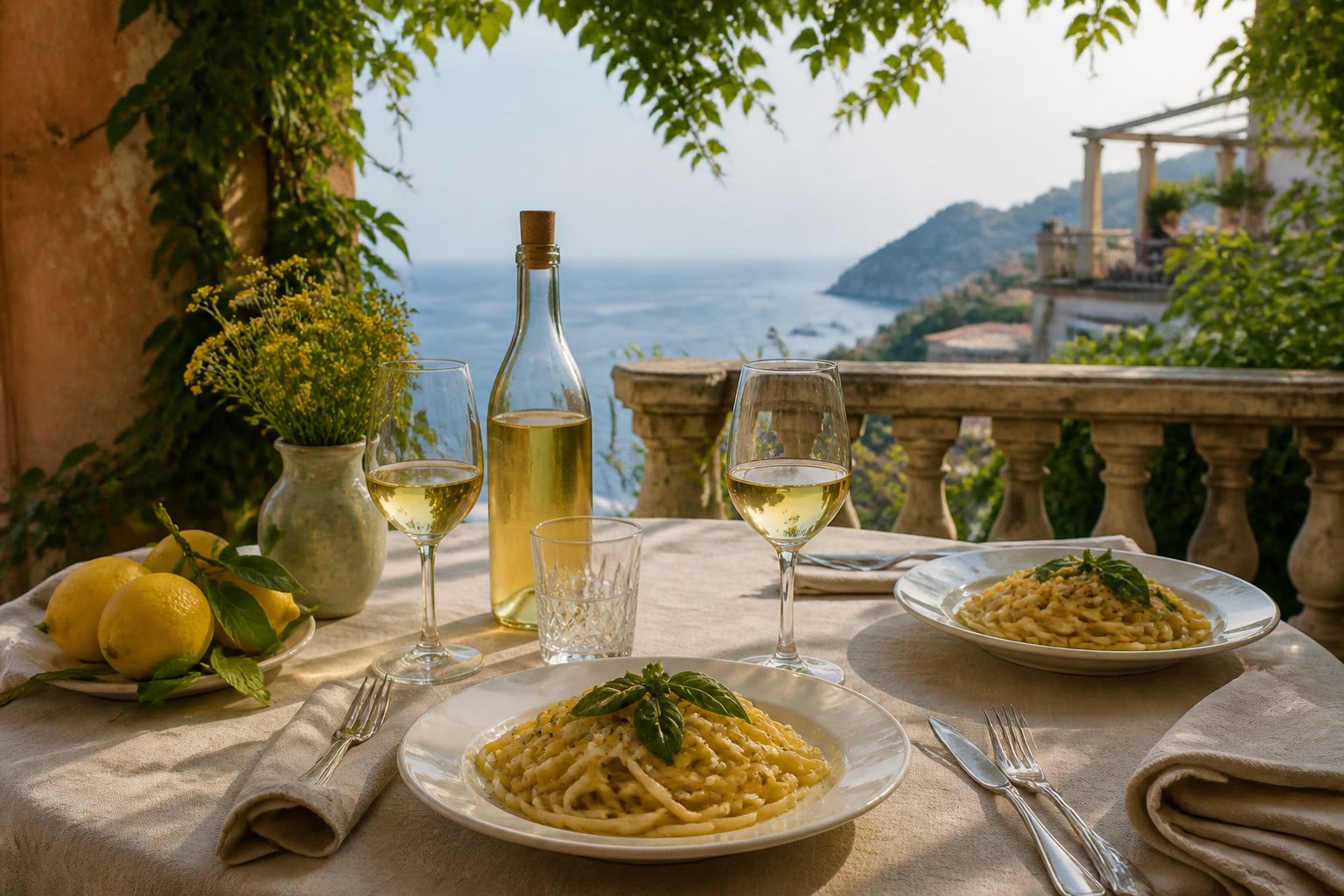
On the Amalfi Coast, lemon is not a last-second twist of peel. It is a tree on a terrace, a ladder, a basket, and a rind you work with your hands.
We lived there long enough for the yellow to stop looking like scenery. The groves hang on dry-stone walls above the Tyrrhenian. The trees are trained on chestnut pergolas so the fruit can take the light without scorching on the rock. After rain, the walls need mending. After wind, the pergola needs tying. The fruit does not arrive at the table as a garnish. It arrives as a crop.
The lemon of those terraces is the Sfusato Amalfitano: tapered, pale, almost seedless, grown from Positano across the coast toward Vietri. The oil lives in the peel. If you only squeeze the juice, you have used half the fruit, and the lesser half. A Sfusato is large enough that one lemon will scent a kitchen. The pith is thick and not bitter the way a supermarket pith is bitter. People on the coast eat the fruit in slices, with oil and salt. We learned that first. This lemon is food.
Zesting is the work that matters in a pan. You take the yellow and leave the white. You do it slowly, because what comes off the grater is the sauce. On a weekday, in a kitchen with the window cracked on salt air, that was the whole mise en place: a board, a grater, two lemons, butter, oil, a wedge of Parmigiano, a pot of water salted until it tasted like the sea. No cream. No ricotta. The silk is starch and fat and the oils you just pulled off the peel.
Mornings we walked the Path of the Gods the way you walk a neighborhood. The trail leaves the ridge at Agerola and threads the cliffs toward Nocelle. You smell the groves before you see them. Rosemary along the stones. A scooter far below. Lemon trees in rows that follow the mountain. We were out before the heat. We came home hungry.
The first pasta al limone we ate on the coast sat on a wooden table among the trees, high enough that the sea was a sheet of metal under the light. Checkered cloth. A carafe of Falanghina. Linguine, pale and glossy, tasting of lemon before it tasted of cheese. The sauce did not sit on the pasta. It clung. That is the dish.
What many American kitchens call Amalfi lemon pasta is a ricotta sauce, or a pour of heavy cream, or both. That can be a good plate. It is a different plate. On the coast’s weekday version, think cacio e pepe: fat, cheese, starchy water, and the one ingredient those terraces exist to grow. Brown the butter and you get nuttiness. Add garlic and you get a different aroma standing in front of the zest. We melt the butter. We keep the garlic out of the pan. We want the lemon.
The method is small, and it is fussy in the way Italian cooking is fussy: temperature, not a long list. Butter and olive oil, low heat, never brown. Zest into the fat until the kitchen smells like the grove, not like a skillet. Pasta cooked just shy of al dente. A cup of the cooking water saved as if it were stock. Off the heat, or nearly off, you toss: pasta, lemon fat, a ladle of water, then Parmigiano in a rain, then the juice last so it stays bright and does not seize the cheese. If the sauce looks thin, wait. If it looks tight, add water. Do not stop moving the pan.
We still cook it this way, years later, in a kitchen that is not on a cliff. The lemons are rarely true Sfusato. We look for large, thin-skinned fruit, unwaxed if we can find it, and we use more zest than a recipe that treats lemon as a finish. Two lemons for four people is not generous on the coast. It is correct.
You can make delizia al limone from the same fruit, or a seafood scialatielli, or totani with potatoes. Those are other jobs for the same grove. Pasta al limone is the one we reach for on a weeknight because it is honest about what the lemon is for. The peel works. The juice finishes. The cheese only binds.
What you taste, if the emulsion holds, is labor you did not do. Someone built the wall. Someone tied the pergola. Someone climbed for the fruit and carried it down the steps. The cook's job is not to hide that in cream. The cook's job is to get the oil out of the peel and onto the pasta before it fades.
That is pasta al limone as we learned it. A terrace dish. A weekday dish. A lemon that had a job.
Love lemons? Squeeze in more of our citrus coverage.

Pasta al Limone.
4
servings10
minutes15
minutesIngredients
Kosher salt
1 lb. 1 linguine or spaghetti
3 tablespoons 3 unsalted butter
3 tablespoons 3 extra-virgin olive oil
finely grated zest of 2 Sfusato Amalfitano lemons (or 2 large thin-skinned lemons)
3-4 tablespoons 3-4 fresh juice from those lemons
3/4 cup 3/4 finely grated Parmigiano-Reggiano, plus more for the table
freshly ground black pepper
A few A few basil leaves, torn (optional)
Directions
- Bring a large pot of water to a boil and salt it until it tastes like the sea.
- Add the pasta and cook until 1 minute shy of al dente.
- While the pasta cooks, melt the butter with the olive oil in a wide skillet over low heat. Do not brown the butter.
- Add the lemon zest and let it steep in the fat, stirring, for 1 to 2 minutes, until the kitchen smells sharply of lemon oil.
- Take the skillet off the heat.
- Before draining, ladle out at least 1-1/4 cups of the starchy pasta water.
- Drain the pasta.
- Return the skillet to low heat, add the pasta and 1/2 cup of the pasta water.
- Toss until the fat and water look like one pale sauce, 30 to 60 seconds.
- Take the skillet off the heat and add the Parmigiano in two additions, tossing constantly, and loosen with more pasta water a splash at a time until the sauce is glossy and clings (it should not puddle, and it should not clump).
- Add 3 tablespoons of the lemon juice and a few grinds of black pepper.
- Toss and taste.
- Add the remaining juice and a pinch of salt (only if it needs them).
- Serve at once, with more Parmigiano, the torn basil if using, and a last thread of olive oil.
Notes
- Gluten-free: Swap in gluten-free linguine or spaghetti. Reserve an extra 1/2 cup pasta water; gluten-free cooking water is often less starchy, so you may need more of it and a firmer toss to get the sauce to cling.
Did you make this recipe?
Tag @appetitomagazine on Instagram and hashtag it with #italianfoodanddrink
Like this recipe?
Follow @Appetitomagazine on Pinterest
Follow us on Facebook!
Follow us on Facebook
Love discovering Italy one bite at a time? Subscribe to the free Appetito newsletter for the latest restaurant openings and Italian travel news.