

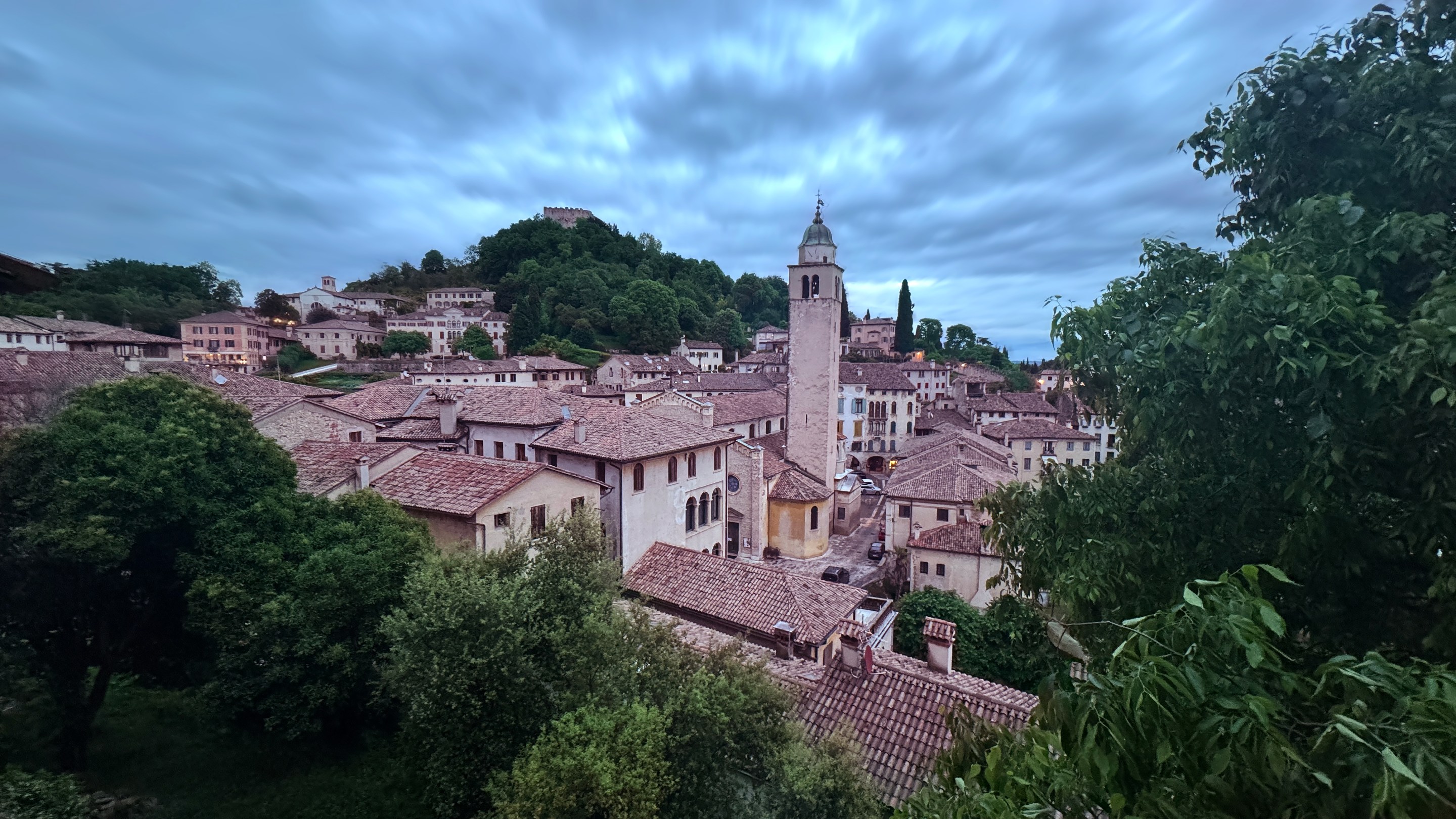
In the descending foothills of the Veneto, cool mountain air slowly sinks through rolling hills, cultivated orchards, and fertile vineyards. Evergreen pines and resilient oaks saturate the air with the sweet, moist scent of spring. Recent rains have washed the sky clean, and from the heights of the ancient town of Asolo, the City of a Hundred Horizons, you can see forever.
The Veneto region of northern Italy stretches from the Adriatic coast to the heights of the Dolomites, covering roughly 7,000 square miles. This vast and diverse region is a popular travel destination, home to some of Italy’s most famous cities: Venice, Padua, and Verona. For explorers and intrepid travelers, however, the Veneto is also a wonderland of back roads, small towns, and overlooked places.
Last spring, while traveling through the Veneto, I had the opportunity to leave the main highway, venture beyond the familiar routes, and visit Asolo. The town’s origins reach back to antiquity. Known to the Romans as Acelum and mentioned by Pliny the Elder, Asolo has a long and distinguished provenance.
A town of history
Its royal lineage is closely associated with Caterina Cornaro, Queen of Cyprus. In 1489, the Republic of Venice compelled Caterina to abdicate her throne and cede the Kingdom of Cyprus to Venetian control. She was permitted to retain the title of queen and was granted the lordship of Asolo. Under her patronage, the town became a celebrated court of art, literature, and culture. Today, her castle stands prominently in the center of town and remains an active theater hosting live performances.
Asolo is also recognized as one of I Borghi più belli d’Italia, an association dedicated to preserving and promoting Italian towns of exceptional historical, cultural, and artistic importance. The town’s contribution to Italian history remains visible in its carefully preserved architecture, particularly the Castle of Caterina Cornaro and the Rocca di Asolo.
Love discovering Italy one bite at a time? Subscribe to the free Appetito newsletter for the latest in Italian food, recipes, and travel stories.
The pre-Roman fortress stands prominently atop Monte Ricco. Its last recorded battle occurred in 1510, and over the course of its history, the Rocca has served as a hospital and place of learning. The short uphill hike is obligatory during a visit to Asolo. From the summit, the landscape unfolds into the celebrated view of a hundred horizons. On an exceptionally clear day, it is said that you can see as far as the Venetian Lagoon. The surrounding grounds can be explored throughout the year, while access to the fortress interior is generally limited to weekends and holidays.
Although you may lose yourself in Asolo, it is difficult to get lost. Slender cobblestone streets and patinaed stone walls wind through the compact town. In the central piazza, the 500-year-old Fontanella Zen continues to flow. Restaurants including Bonsai Asolo, with its inventive Asian cuisine; Epoca, a contemporary gastropub; and Canovio, with its regional Italian menu, offer distinctive dining experiences.
Planning a trip to Italy? Discover Appetito’s latest stories on Italian food, wine and travel.
Where to stay and eat
Asolo’s two five-star boutique hotels Albergo a Sole and Villa Cipriani provide markedly different but equally refined stays. We stayed at Albergo Al Sole, positioned slightly uphill from the town center. In operation since the 1920s and containing only 23 rooms, the hotel is an intimate affair. Its transitional European interior gently suggests that you should stay awhile.
The hotel’s restaurant, La Terrazza, offers an elevated dining experience. Its locally sourced, seasonal menu features inventive dishes such as Roman-style artichoke with blue cheese and quail egg, or hemp-and-charcoal gnocchi served with a rustic fennel meat sauce. Owned and operated by two sisters, Albergo Al Sole was one of the most memorable parts of our stay.
The wines of Asolo
Asolo is small, but its landscape is large. Beyond the medieval walls lies a countryside with ancient agricultural roots. Italy’s winemaking history extends back thousands of years, and the vineyards surrounding Asolo now produce one of the country’s most distinguished sparkling wines. A mere 5000 acres yields and bottles the highest quality Prosecco in Italy. The DOCG Denominazione di Origine Controllata e Garantita, which roughly translates to Controlled and Guaranteed Designation of Origin, is the premiere classification for wine growing regions in Italy. Even for the casual wine drinker, visiting the vineyards of Asolo is an experience that feels elegant, sophisticated, and rustic all at once.
Tasting fine wine while learning about the growing process and each winemaker’s distinctive approach is more than an excuse to day drink, it is a chance to immerse yourself in the culture and craftsmanship of Asolo
Our schedule was unsettled by the unscheduled rain limiting us to visit only two wineries Tenuta Amadio and Cartizze PDC. Tenuta is a family affair in the heart of the Asolo Hills dating back to 1850. Atop the highest sloping vineyard rests a century old church, which echoes the family’s history and devotion to their wine. Further down the valley, a right turn at small market and up a vine bordered dirt road Cartizze’s contemporary architecture and enormous concrete fermentation tanks create a grand first impression. Their organic approach to Prosecco produces exceptional wine in a sustainable environment. Although an entire day in the wine country would have been ideal, our brief excursion succeeded in ruining our palates for the jejune brunch Prosecco back home.
Beyond the wine tasting, the verdure of greater Asolo is broad and breathtaking. Even beneath cloudy skies, the gentle hills flow and recede like water. Each hilltop has its own identity, each revealing its own unrepeated view. Narrow back roads bend past ripening vineyards, cross harvested pastures, and climb into densely forested slopes. Seemingly random villages, painted in shades of pink, yellow, and orange, stand as sentinels of slower traditions.
Traveling into the rural and bucolic reveals the true spirit of a country. Small towns and villages are homes and families. Places where the unexpected become cherished memories are more than a vacation, they instill a wanderlust to see what lies ahead. Such is a trip to Asolo, it leaves you satiated with an appreciation for its unassuming elegance. Its inherent peacefulness settles into the soul, leaving everyone who comes and goes with a gift.
Love discovering Italy one bite at a time? Subscribe to the free Appetito newsletter for the latest in food, travel, recipes, and Italian culture stories.