

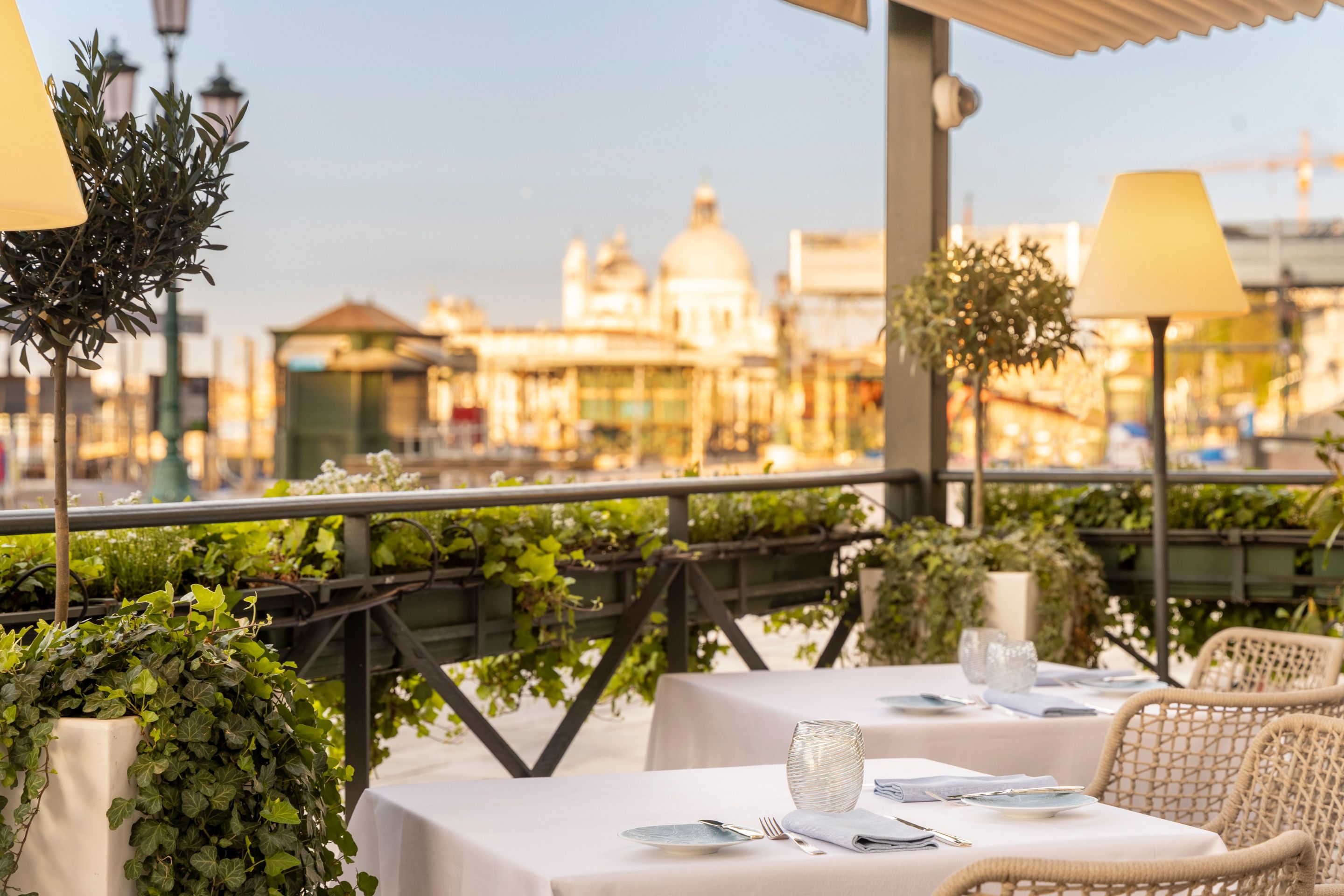
Few destinations are quite as enchanting as Venice, so it comes as no surprise that this one-of-a-kind city is home to a rich culinary repertoire. This complexity reflects the city’s historical significance as a powerful maritime trading port, along with the varied landscape of the Venetian lagoon and the surrounding Veneto region.
For centuries, these elements have inspired chefs like Daniele Galliazzo, the Executive Chef at LPV Ristorante at the prestigious Londra Palace Venezia hotel – a member of the exclusive Relais & Chateaux association. Born in nearby Treviso, Galliazzo spent a number of years working in Tuscany, Sardinia, and Switzerland, enabling him to master the art of adding a modern flair to traditional Venetian cuisine.
I had the pleasure of gaining insight into the guiding philosophy of this highly acclaimed chef, who was kind enough to share his thoughts with the readers of Appetito. This conversation with Chef Galliazzo is sure to inspire you to visit Venice, with a stop at LPV Ristorante an absolute must on your itinerary.
** In this interview, minor edits were made to quotes for clarity and readability, with changes indicated in brackets to preserve the speaker's original meaning. **
How did your upbringing influence your approach to Venetian cuisine?
My [upbringing] has totally influenced my cooking. I am Venetian, and therefore I have lived Venetian cuisine more than studied it. Over time, delving more and more into Venetian history, I discovered the cultural and gastronomic uniqueness of the city that for a long time was dominant in the known world.
[Furthermore,] I was also lucky enough to have grandparents who had garden animals, a vegetable garden and the peasant culture of respect for nature, what is now [known as kilometer zero], organic vegetables and non-intensive free-range farming.
You’ve trained in haute cuisine and place a strong emphasis on the organoleptic qualities of ingredients. How do you apply this philosophy to your dishes at Londra Palace Venezia?
I believe that the work of a “Modern” chef is partly also to preserve the historical-cultural value. Over time, it is normal that tastes, [trends] change [and] the needs of customers but those who are lucky enough to have a food and wine heritage like the Italian one must preserve traditions, [by] respecting seasonality and typical products.
After working in Switzerland, Costa Smeralda, and Tuscany, what drew you back to Venice and what do you love most about its food culture?
I had to move for professional growth and to broaden my horizons, but then the call of home and the products, flavors of my gastronomic culture prevailed. In my kitchen and in Venetian cuisine, I appreciate the fact that what we consider historical cuisine [of that time] was fusion cuisine and very innovative.
Londra Palace Venezia pays homage to the tripartite nature of Venetian cuisine. How do you bring these elements together?
Italy and consequently Venice excels in [biodiversity], this also culturally entails a good affinity with the entire food system, whether vegetarian, carnivorous or fish-eating. Historically for us, sitting at the table is not about feeding ourselves but about the conviviality of sharing and the joy of flavors, to do this I think what is needed is love for what you do and the pride of carrying on the traditions of your roots.
How do you achieve your signature style of honoring local tradition while introducing innovation?
There is no recipe that is successful, but I believe that when you grow up with those flavors, you know the raw materials, you have the possibility of modifying the recipes while maintaining the original spirit to propose a different result but at the same time respectful of tradition.
You have a strong focus on seasonal and vegetarian dishes. What inspires your plant-based creations, and how do you showcase the best of Venice’s seasonal produce?
Seasonality is a topic that is very close to my heart because Veneto has many unique vegetables from Radicchio di Treviso to White Asparagus from Bassano, which remain unique with specific periods, which require knowledge of the product to respect its characteristics.
The Rialto Market has historically been the heart of Venice’s food culture. Do you source ingredients from there? And if so, how does the market inspire your culinary creations?
The Rialto market is still the hub of Venetian gastronomy, where you experience seasonality and availability with the first fruits and the availability of the fish. Nowadays, I prefer to choose suppliers who work in the Rialto market because they keep this heritage alive.
What lesser-known Venetian dishes do you love to introduce to guests?
I believe that when we talk about Venetian gastronomy, the concept that must be conveyed is that there are dishes that can be made all year round and some that are seasonal and therefore only available in certain periods, making Venice a unique place twelve months a year, such [moeche, castradina, risi e bruscandoli], and so many others.
What is your favorite dish on the current LPV Ristorante menu, and why?
One of the dishes I am most attached to is my “Scampi in saor,” in which the original recipe is [influenced] by [eastern] cultures in a hypothetical Marco Polo-style journey between East and West, and in my opinion maintaining the Venetian spirit of the original dish.
If you could define the essence of Venetian cuisine in just a few words, what would they be?
Venice has been and will [remain] a unique city. You cannot talk about Venetian cuisine without talking about its history. It has always welcomed the world without ever losing itself, accepting comparison and integration, which was then also transmitted in the dishes (such as the use of spices).