


In Italian, food is rarely just food. It organizes time, relationships, and expectations. This column explores Italian sayings and proverbs as ways of thinking shaped at the table.
These expressions preserve that knowledge in compact form. Read literally, they speak about eating. Read more closely, they offer insight into how experience, pleasure, and social life are understood.
The aim is simple: to treat language as another ingredient—handled with care, tasted slowly, and shared. No prior appetite required. It tends to arrive along the way.
Buono come il pane; Brutto come la fame
Literal translation: “As good as bread;” “As ugly as hunger”
Meaning: Someone as genuinely kind and trustworthy; someone or something as extremely unattractive
If you want to understand how deeply food runs through Italian culture, don’t start with a recipe. Start with an insult—and a compliment. In Italian, the very best a person can be is bread. The very worst they can resemble is hunger. That contrast says more than any menu ever could.
Placing these two expressions side by side is no accident. They sit at opposite ends of the moral spectrum and, together, sketch a worldview. Between bread and hunger lies not just a meal, but a philosophy of life—one rooted less in abstraction than in appetite, less in theory than in experience.
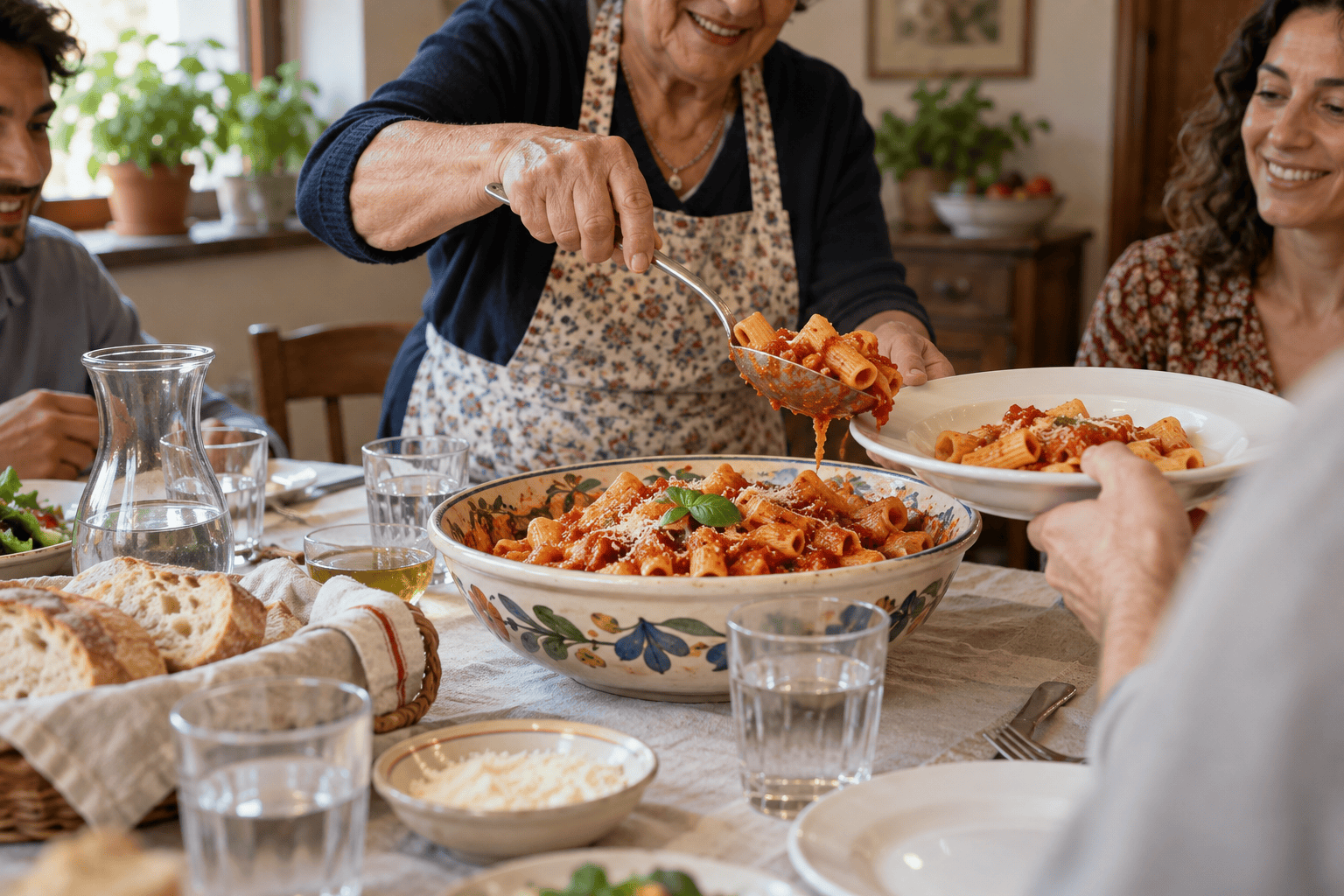
To call someone buono come il pane is not polite small talk. It is real praise. Bread in Italy is never decorative. It appears before the courses, remains through the meal, and quietly does its work. Long before cuisine became artistry and plating turned theatrical, bread was already there, performing its essential task: keeping hunger away.
For generations, bread was often the only certainty on the table—sometimes the only thing there. In leaner times, it stood between sustenance and emptiness. It was what you counted on. That memory still lingers in the language, shaping how goodness itself is imagined.
So when someone is described as “as good as bread,” the meaning is clear: dependable, steady, fundamentally kind. Not dazzling. Not dramatic. Just solid. Their goodness doesn’t glitter—it nourishes. In a country known for expressive gestures and operatic conversations, the highest moral compliment goes to something plain, crusty, and reliable. There’s a quiet, affectionate irony in that choice. The virtue that matters most is not spectacular; it is sustaining.
The point sharpens further in another common phrase: essere un pezzo di pane—to be “a piece of bread.” At that stage, comparison disappears. You are not like bread; you are bread. Your character feeds, comforts, and asks for nothing in return. Moral worth becomes something tangible, something that can be broken, shared, and passed around a table.
At the other end of the scale stands brutto come la fame. If bread represents balance, hunger marks its rupture. Hunger is not metaphorical flourish; it is physical fact. It pricks, distracts, leaves that hollow tightness in the stomach. To describe someone as “as ugly as hunger” is to suggest a discomfort that unsettles before you fully understand why. Unlike buono come il pane, which applies only to people, brutto come la fame stretches further. It may describe a face—but also a moment, a memory, a situation carrying that same hollow unease. It is not damnation. It is deprivation. It is the feeling of something essential missing.
The symmetry is precise, almost culinary in its logic. Bread removes hunger; hunger signals its absence. The best thing you can be is what satisfies the most basic human need. The worst is what reminds us of going without. In both cases, judgment begins not in heaven, but in the body.
Now compare that with American English. Someone might be “as good as gold,” where virtue gleams with economic value. When ugliness is described, you hear “as ugly as sin” or “as ugly as hell.” Gold and sin. Value and transgression. The metaphors tilt upward—toward money, morality, or metaphysics.
Italian stays in the kitchen.
It doesn’t reach for heaven or the stock market. It reaches for bread and hunger. One language looks upward—to wealth or salvation. The other looks to the table. One frames virtue in terms of shine or purity; the other frames it in terms of nourishment and lack. Neither is better. Each reveals what it fears—and what it values.
Between buono come il pane and brutto come la fame, the message is disarmingly clear: before we are anything else—saints, sinners, achievers, failures—we are eaters.
So the question is simple—
Is there bread on the table?
Or do we go hungry?
Hungry for more Italian food idioms? Discover more of Samuel Ghelli's articles.
L’Appetito Vien Mangiando: Why Appetite Comes With Eating
Avere Gli Occhi Foderati di Prosciutto: Ignoring What is Right in Front of You
Finire a Tarallucci e Vino: When the Table Has the Final Word