


In Italian, food is rarely just food. It organizes time, relationships, and expectations. This column explores Italian sayings and proverbs as ways of thinking shaped at the table.
These expressions preserve that knowledge in compact form. Read literally, they speak about eating. Read more closely, they offer insight into how experience, pleasure, and social life are understood.
The aim is simple: to treat language as another ingredient—handled with care, tasted slowly, and shared. No prior appetite required. It tends to arrive along the way.
Finire a tarallucci e vino
Literal translation: "To end with tarallucci and wine"
Meaning: To let an initially tense situation—a conflict or dispute—slide away without real consequences.
Finire a tarallucci e vino names a distinctly Italian way of handling tension: not by fully resolving it, but by letting it run its course until it loses steam. Something goes wrong, voices rise, positions harden—and then, somehow, everything loosens up. There is no real reckoning, no clearly assigned responsibility. Food appears. Wine is poured. The issue is set aside, as if nothing had happened—or, more precisely, as if it were no longer worth pursuing.
The expression is striking precisely because it seems to run against a familiar stereotype: Italy as loud, theatrical, and perpetually argumentative. In fact, the idiom reveals the other side of the coin. Disagreement can be intense, even spectacular, but it is rarely pushed to its extreme consequences. At a certain point, arguing stops being productive. Eating and drinking take over.
One caveat, though: this newly reached agreement never turns into a celebration. The ingredients on the table make that clear. Tarallucci—small, dry bread rings with no pretensions—carry nothing festive about them. The wine is the everyday kind. No special bottles, no toasts, no closing speeches. This is not really a happy ending; it is simply the most convenient one.
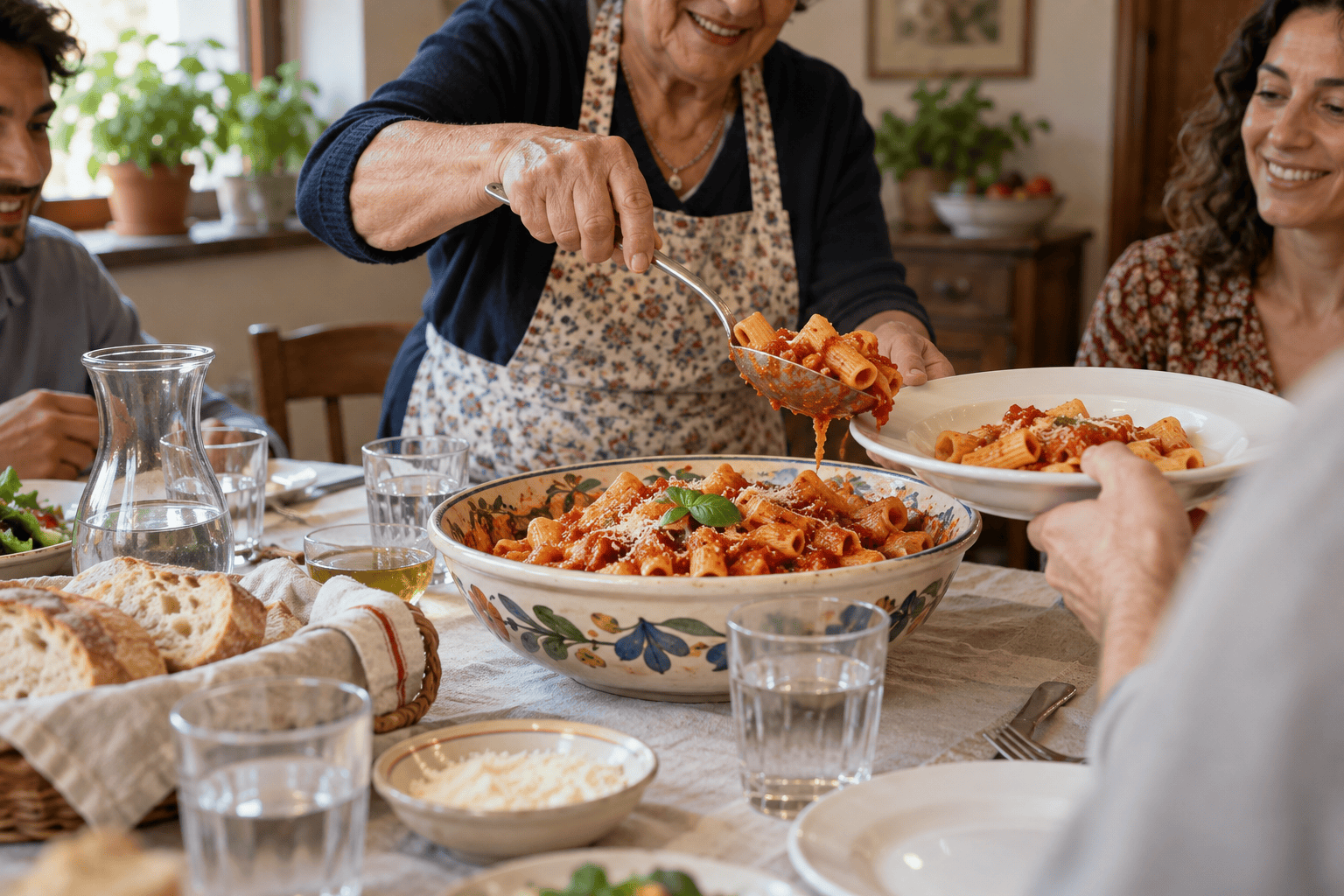
This is more than figurative language. Until relatively recent times, especially in rural and working communities of central and southern Italy—where tarallucci and taralli (with a strong association with Puglia) are a familiar presence—offering tarallucci and wine was a concrete, recognizable gesture. After a quarrel between neighbors, a family dispute, or a disagreement over work or land, people would sit down at the table “to talk it through.” And very often, without any formal solution, the table—and what was on it—did the rest.
Not because the problem had truly been resolved, but because continuing to live together mattered more than winning the argument. A calmer coexistence—even at the cost of a few mutual concessions—was preferable to a clear-cut victory that would leave resentment behind and make everyday life more difficult.
There is something undeniably wise in this attitude. But also something knowingly accommodating. That is why the idiom carries a subtle irony. To say that something ended up with tarallucci and wine ultimately suggests that it ended a bit too easily—and that, in fact, nothing was really solved.
From an American perspective, all this can feel ambiguous, if not suspicious. In a culture that values clarity, explicit closure, and taking responsibility, finire a tarallucci e vino can sound like a bargain-basement compromise disguised as hospitality. The expression does not deny this. On the contrary, it openly acknowledges it—with a hint of irony.
Sometimes harmony matters more than resolution. Sometimes staying at the same table matters more than being right. Whether this amounts to wisdom or surrender is deliberately left unresolved.