
My home has been in Bologna since 2001, when a job offer had me packing my bags in New York and moving to Bologna, Italy. With my fully Irish roots, and having never set foot in Italy before, I was eager to explore a new country, culture, language, cuisine, and what would ultimately become a new home for me.
Naturally, my first escapes in Italy were to the major sites that most American tourists visit first: Rome, Florence, Venice, Cinque Terre, Pisa, the Amalfi Coast.
Then, I started to discover incredible off-the-beaten-path places near Bologna.
From Bologna to Romagna
One of those places is Romagna, the eastern half of the rectangular region of Emilia Romagna. While the main draw of Romagna is its beaches, since it borders the Adriatic Sea, I personally love to explore its tranquil agricultural landscape and beautiful hills.
Over time, I have become friends with the Romagnoli, the people of Romagna, who form a spirited, tight-knit community distinct from the Emiliani to the west, who are often considered more “intellectual.” The Romagnoli share the same love for food, family, and their place of origin as most Italians, but tend to be more outspoken about it and, in general, get quite lively when you get a group of them together. For an outsider like myself, I feel immediately welcomed and at ease when I spend time with the Romagnoli.
Meeting the Romagnoli at the Table
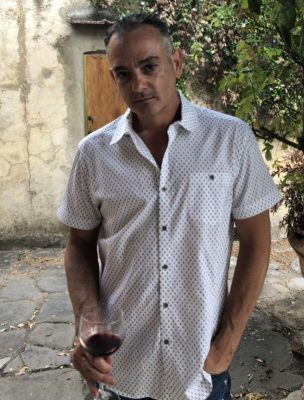
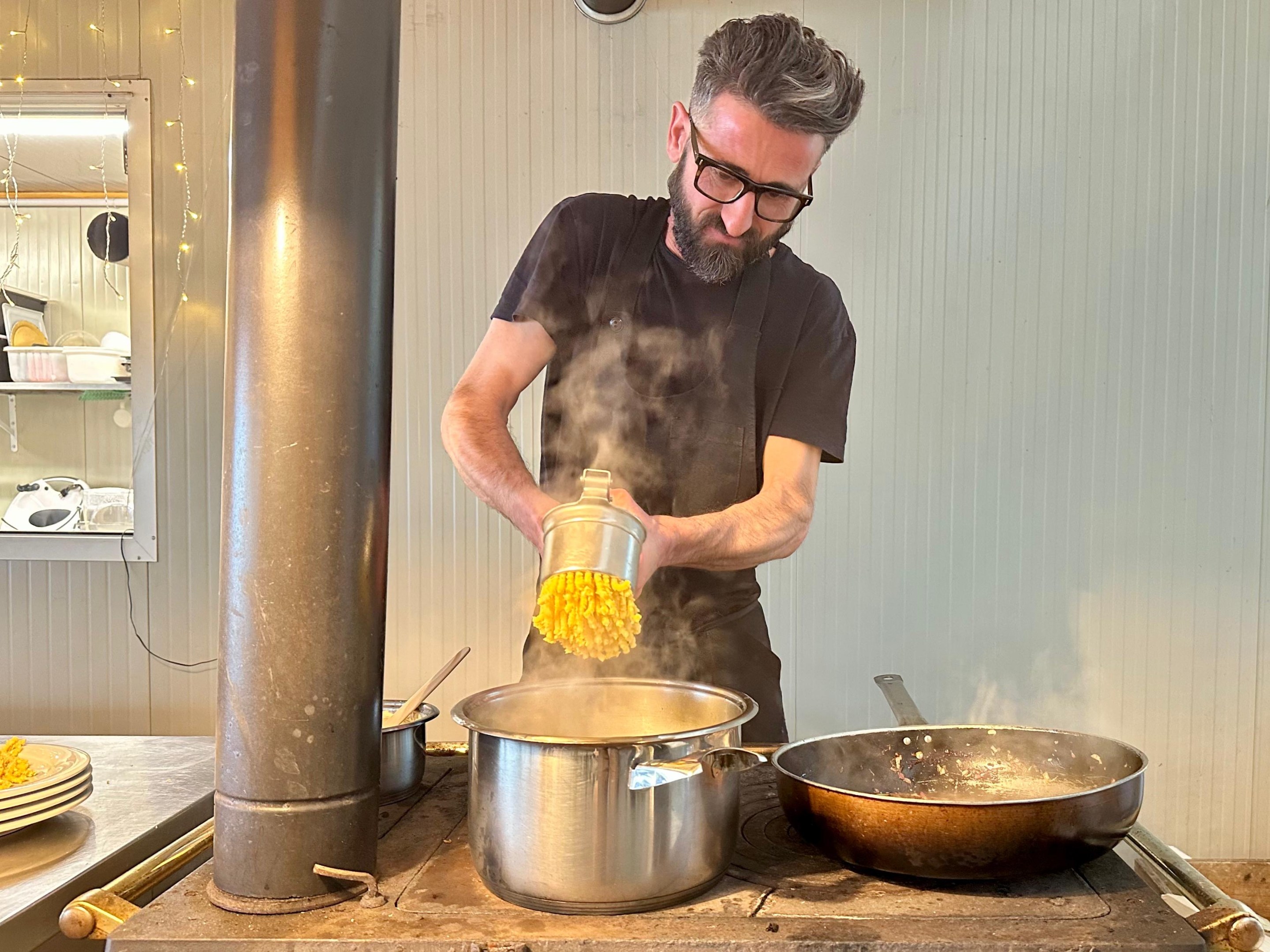
Yearning to get my fix of all things Romagnolo, and being the foodie that I am, I recently gathered a group of Romagnolo friends for lunch. The plan was to go to the home restaurant of a remarkably talented chef, Riccardo Severi, who, during the Covid lockdowns and while without a job, got the idea to start a restaurant on his family’s property.
Romagnoli, like many Italians, are particularly attached to their land. In fact, agriculture is a key industry in Romagna, helping contribute to Emilia Romagna’s designation as Italy’s Food Valley. While Riccardo Severi’s father worked in construction, the family’s fruit and vegetable garden was a mainstay and heavily influenced Riccardo growing up. He often says he grew up between “a head of lettuce and a cherry tree.”
Chef Riccardo Severi and Sovescio
Riccardo has lived his entire life in Romagna. Although he initially followed in his father’s footsteps and became an electrician, his desire to elevate his Romagnolo roots and the fruits of the land and nearby sea led him to study the culinary arts and become a chef.
His home restaurant project is called Sovescio, located on the outskirts of Cesena, which Riccardo defines as taking the story of his life and transforming it into food creations with their own identity. Think of it as both farm-to-table and slow food taken to the max. Visiting his restaurant is an experience in itself, one where you lose track of time and experience Romagna in a deeply intimate way.
All of Riccardo’s dishes share these key elements:
- Curating from his family’s garden, along with other locally sourced, fresh ingredients
- Innovative takes on traditional Romagnolo dishes
- Igniting synergies between carefully selected ingredients to create a unique melding of authentic flavors
A Winter Feast Rooted in Tradition
Chef Riccardo inspired our souls and appetites on a recent wintertime visit to Sovescio.
He explained that at the start of winter, local farmers turn their focus to making use of fattened pigs. Every part of the animal is used, from salumi, sausage, and cotechino to ciccioli, or crispy pork rinds. This festa di maiale, or pig feast, became the theme of the dishes Riccardo prepared for us, from antipasto to primo and secondo.
Each dish also incorporated freshly picked, seasonal vegetables or fruits from Riccardo’s garden, including broccoli rabe, radicchio, cabbage, persimmons, and giardiniera, the pickled mixed vegetables he prepared over the summer.
We began with an antipasto centered on piadina. If there is one food that defines Romagna, it is piadina. With roots dating back to the Etruscans, it is a simple cibo povero made from flour and pork fat that sustained everyday people for thousands of years. Today, piadina kiosks dot the Romagnolo landscape, turning it into a daily ritual for locals and visitors alike.
The primo piatto featured homemade passatelli, which, like piadina, is made from ingredients commonly found in a Romagnolo kitchen: breadcrumbs, often from day-old bread, eggs, and Parmigiano Reggiano. The mixture is shaped into a ball and pressed through a potato ricer to form pasta strands. Passatelli is quite versatile, traditionally served with ragu, or in broth, although Riccardo served it asciutti, meaning dry, sauteed in a pan with sausage and radicchio, and finished with a fondue of formaggio di fossa, a traditional Romagnolo cheese that is aged underground.
The secondo piatto had cotechino, a fresh pork sausage which is the main ingredient of many holiday dishes. It had an innovative touch with a reduction of Sangiovese wine mixed with roast drippings poured on top. Sangiovese is the go-to wine for Romagnoli, made with the sangiovese grape that Romagnoli claim originated in Romagna, instead of neighboring Tuscany.
The delightful meal and time with Romagnoli friends concluded with persimmons picked from Riccardo’s trees, followed by mandarin orange cake topped with custard and passion fruit seeds. For those whose curiosity has been piqued and who wish to visit Chef Riccardo in Romagna, Sovescio can be found on Instagram at @sovescio.