

In Italian, food is rarely just food. It organizes time, relationships, and expectations. This column explores Italian sayings and proverbs as ways of thinking shaped at the table.
These expressions preserve that knowledge in compact form. Read literally, they speak about eating. Read more closely, they offer insight into how experience, pleasure, and social life are understood.
The aim is simple: to treat language as another ingredient—handled with care, tasted slowly, and shared. No prior appetite required. It tends to arrive along the way.
Aria fritta
Literal translation: “Fried air”
Meaning: Empty talk; words without substance
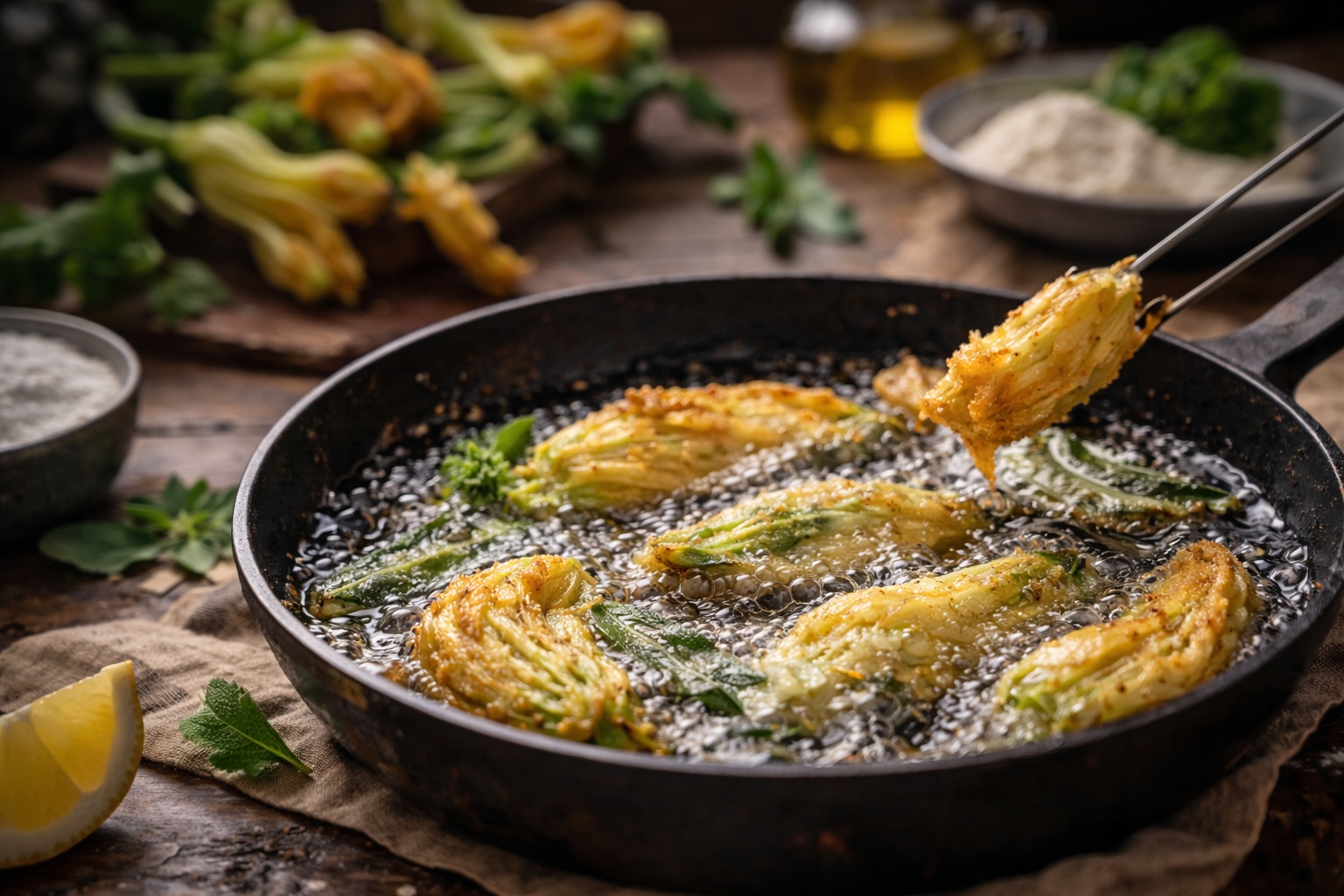
Few techniques reveal the quiet ingenuity of the home kitchen better than frying. In that Italian setting, a pan of hot oil seems to possess a curious power: place it on the stove and almost anything appears destined to end up inside it. Moments later a small transformation occurs—something crisp on the outside, soft and fragrant within.
From north to south across the country, every corner of Italy has its own way of celebrating this technique. Grains, vegetables, meat, and fish are coated and crisped in hot oil. Leftovers are sliced and given new life. Even the most unexpected ingredients—leaves, flowers, stuffed morsels, or sweet custards—may meet the same fate. During Carnival the imagination expands further, and fruit and delicate doughs emerge in clouds of powdered sugar.
In the Italian culinary imagination, frying is more than indulgence; it is transformation. It rescues what might otherwise go to waste, elevates modest ingredients, and creates textures and flavors that define entire regional traditions. It is a technique that blurs the line between necessity and creativity, turning simplicity into pleasure and making the most ordinary ingredients feel unexpectedly generous.
Want to be the first to know about Italian food events, restaurant openings and culinary travel? Subscribe to the Appetito weekly newsletter.
Popular wisdom has long recognized this almost magical power. A playful Italian saying captures the idea perfectly: “Fritta è buona anche una ciabatta.” Fry it, and even a slipper would taste good.
Almost anything, it seems. Because there remains one stubborn ingredient: air.
No matter how inventive the cook, air refuses to cooperate. It offers nothing to coat, nothing to crisp, nothing that hot oil can convincingly transform. And yet this small culinary impossibility gave Italian one of its most vivid expressions: aria fritta.
The phrase refers to words that sound elaborate but contain no real substance. Speeches full of promises, explanations that circle endlessly without arriving anywhere, arguments inflated with rhetoric yet empty at the center—Italians dismiss them with a simple verdict: è tutta aria fritta. In this way food becomes once again a shorthand for judgment, a quick and vivid way of translating experience into language.
By the twentieth century the phrase had become common in journalism, political commentary, and cultural criticism. Commentators and essayists invoked aria fritta to dismiss theories that appeared impressive yet ultimately inconclusive—grand rhetorical constructions that produced more words than substance. The expression proved especially effective in intellectual polemics, where a single culinary image could puncture pages of elaborate argument.
From there the expression moved naturally into everyday speech, where it now describes far more ordinary situations: long explanations that lead nowhere, promises unlikely to be kept, or conversations that sound busy but say very little. In Italian conversation the phrase often appears with a small shrug or a wry smile, as if acknowledging that language, like cooking, sometimes produces more aroma than nourishment.
Other languages have their own ways of dismissing empty rhetoric. English, for instance, begins with the same basic element, but develops it differently. “Hot air,” as the familiar phrase goes, evokes words that swell, rise, and disperse without leaving substance behind. The image belongs to the atmosphere rather than the kitchen: something that expands, floats upward, and eventually dissolves.
Italian, by contrast, takes that same element and puts it straight into the frying pan.
In a cuisine where almost everything seems possible, it was perhaps inevitable that someone would eventually try the air. A few years ago, the Michelin-starred chef Nicola Dinato even served a dish called Aria Fritta—a delicate cloud of fried tapioca batter, creating the illusion that the air itself had finally made it into the pan.
And yet the impossibility remains the point.
When a speech sounds impressive but ultimately says nothing, Italians still reach for the same verdict—simple, culinary, and devastatingly precise:
È tutta aria fritta.
Fried air.
Hungry for Italian food idioms? Discover more of Samuel Ghelli's articles.
Fare la Scarpetta: The Last Sweep of the Plate
Finire a Tarallucci e Vino: When the Table Has the Final Word