

In Italian, food is rarely just food. It organizes time, relationships, and expectations. This column explores Italian sayings and proverbs as ways of thinking shaped at the table.
These expressions preserve that knowledge in compact form. Read literally, they speak about eating. Read more closely, they offer insight into how experience, pleasure, and social life are understood.
The aim is simple: to treat language as another ingredient—handled with care, tasted slowly, and shared. No prior appetite required. It tends to arrive along the way.
Fare la scarpetta
Literal translation: “To make the little shoe”
Meaning: Using a piece of bread to wipe the remaining sauce from a plate at the end of a meal.
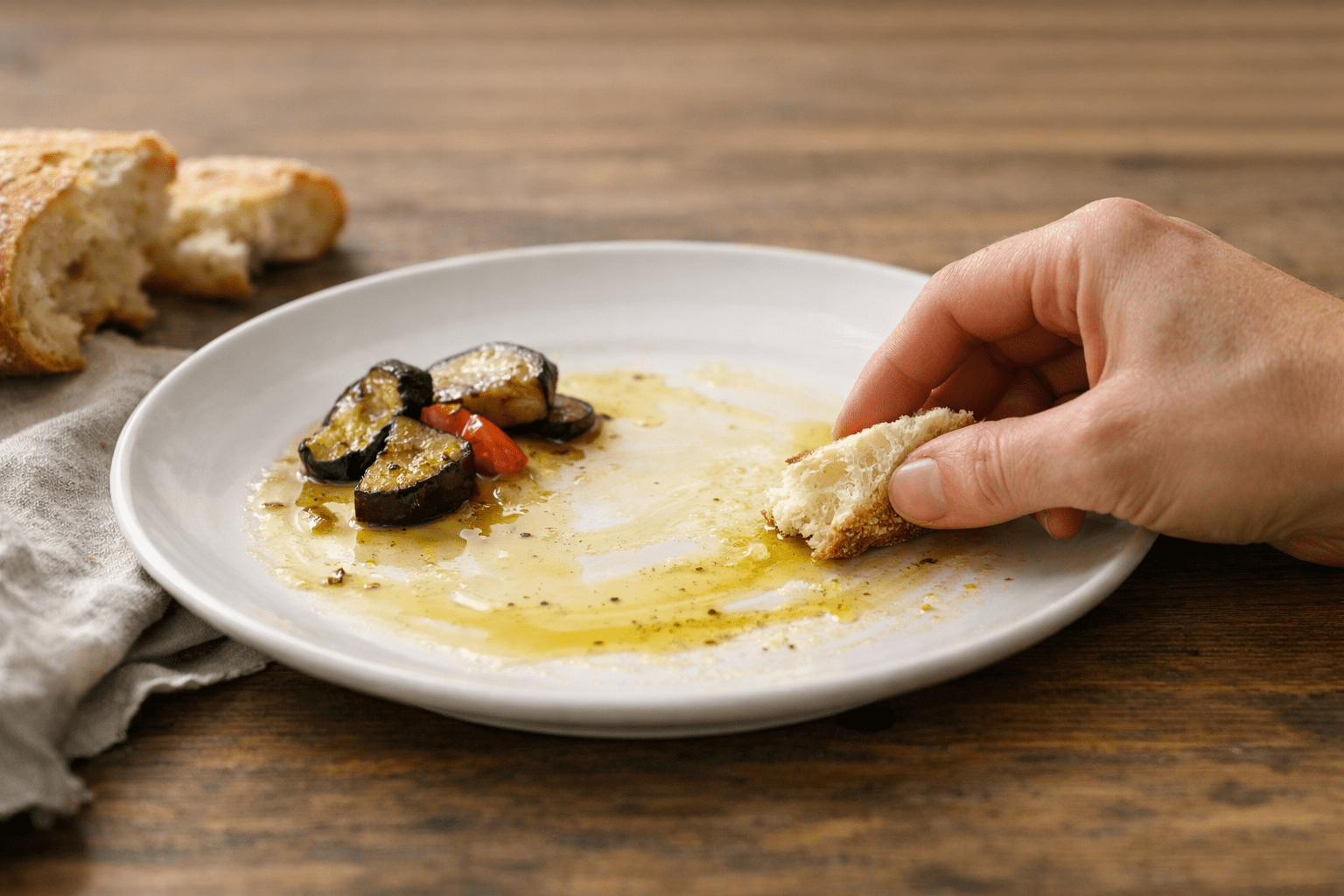
The pasta is gone, but the sauce is not quite done. A faint red sheen of tomato still clings to the porcelain, thin streaks the fork could not quite gather. At this point, a familiar ritual begins. Someone tears off a piece of bread, presses it lightly against the plate, and sweeps the last traces of sauce into the crumb. In a single pass, the plate returns to white.
The gesture itself may exist elsewhere, but it rarely earns a name. In Italy, by contrast, even this final movement has one: fare la scarpetta.
Strictly speaking, this expression differs from many of the food sayings that populate Italian. It is not a proverb, nor an idiom that turns food into metaphor for character, virtue, or social behavior. Fare la scarpetta is simply a phrase that names a specific action—and the action it names never really leaves the table. If bread becomes goodness, hunger ugliness, and wine reconciliation, fare la scarpetta, by contrast, belongs to the practical choreography of eating. It does not interpret life. It simply finishes the plate.
Want to be the first to know about Italian food events, restaurant openings and culinary travel? Subscribe to the Appetito weekly newsletter.
The gesture reflects a deeper culinary logic. In Italian cooking, bread is not merely accompaniment but instrument. It appears beside the plate not only to be eaten but to interact with the dish itself. Sauces—whether a slow ragù, a bright tomato sauce, or the olive oil left from grilled vegetables—are meant to be enjoyed fully. Bread provides the final tool for doing exactly that. In this sense, fare la scarpetta completes the dish, allowing its flavors to reach their natural conclusion.
Only afterward does the language step in and give the gesture its playful name. Most explanations trace the phrase to the bread moving across the plate like a small shoe gliding over the surface, or to the curved piece of bread itself, which in the hand resembles a tiny slipper as it gathers the sauce. Hence scarpetta, literally “little shoe.” Italians, after all, have a weakness for diminutives—especially when the gesture itself is small and slightly affectionate.
Yet the gesture has long occupied an ambiguous social space. If, in the language of appetite, it feels perfectly natural, in the language of etiquette it has often been viewed with suspicion. Already in the sixteenth century, Giovanni della Casa’s Galateo—the classic Italian manual of table manners—warned against gestures that seemed overly eager or involved touching food too directly with bread or fingers. The concern was not hygiene but composure. A well-bred diner, according to this tradition, was expected to show restraint and avoid movements that revealed too much enthusiasm for what remained on the plate.
And yet the rule has always struggled to compete with the sauce.
Outside the pages of etiquette, fare la scarpetta continued to thrive exactly where Italian food culture is most alive: around the domestic table, where appreciation for the cook easily outweighs the subtleties of decorum. Today the gesture has even returned to many restaurants—especially those proud of their sauces—where the invitation is almost implicit, waiting quietly beside the plate in the basket of bread.
And so fare la scarpetta endures exactly where it always has: at the end of the meal, when the plate is nearly clean, but the sauce still refuses to be left behind. Etiquette may have advised restraint, yet the gesture persists. A small piece of bread makes one last quiet sweep across the plate, and the meal is complete.
Hungry for more Italian food idioms? Discover more of Samuel Ghelli's articles.
L’Appetito Vien Mangiando: Why Appetite Comes With Eating
Finire a Tarallucci e Vino: When the Table Has the Final Word
Essere una Minestra Riscaldata: After the First Simmer