

In Italian, food is rarely just food. It organizes time, relationships, and expectations. This column explores Italian sayings and proverbs as ways of thinking shaped at the table.
These expressions preserve that knowledge in compact form. Read literally, they speak about eating. Read more closely, they offer insight into how experience, pleasure, and social life are understood.
The aim is simple: to treat language as another ingredient—handled with care, tasted slowly, and shared. No prior appetite required. It tends to arrive along the way.
Essere alla frutta
Literal translation: “To be at the fruit course”
Meaning: To have reached the end of one’s resources; to have nothing left.
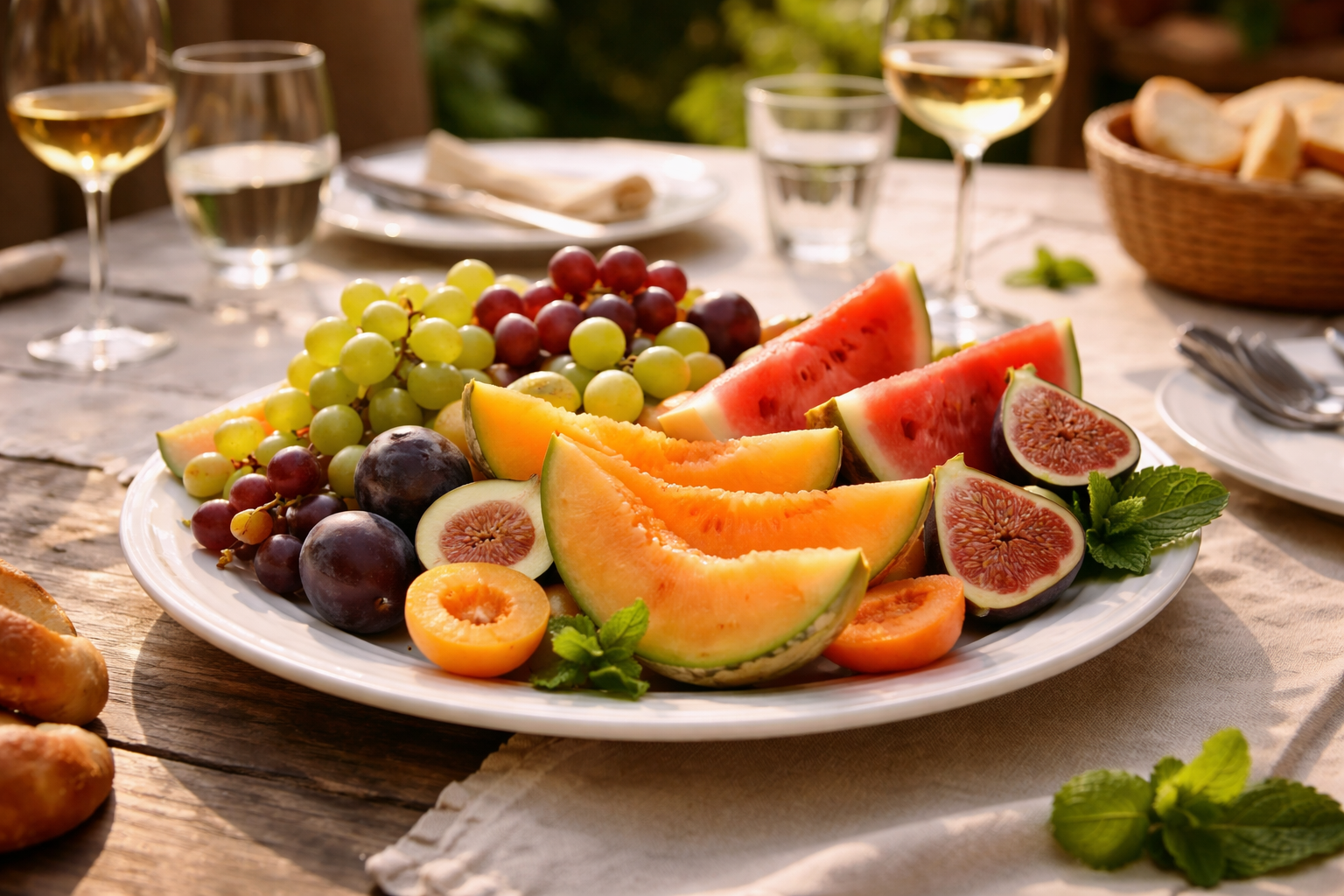
In the carefully ordered rhythm of an Italian meal, every dish has its assigned place. Courses follow one another according to a logic that is both culinary and social: antipasto awakens the appetite, the primo sustains the meal, and the secondo—often accompanied by its contorno—marks its most substantial moment. Toward the end, something lighter appears at the center of the table: a bowl of fresh fruit, quietly announcing that the meal is drawing to a close. Plates begin to empty, chairs relax, and the pace of conversation gently slows—the small, familiar moment when everyone realizes, with a hint of regret, that the meal is almost over.
What seems obvious and natural today, however, reflects a much older way of thinking about food and the body. For centuries, the order of dishes followed principles inherited from ancient medicine. Greek and Roman physicians believed that digestion unfolded gradually, like a controlled cooking process inside the stomach. Meals therefore progressed from heavier foods to lighter ones, allowing the body to complete its work without strain. Fruit—fresh and light—naturally brought the sequence to a refreshing close. Long before nutritionists appeared on television, the table already seemed to know what it was doing.
From this familiar scene comes the Italian expression essere alla frutta, literally “to be at the fruit course.” Like many idioms born from everyday gestures, it takes the structure of the meal and carries it into ordinary life. The metaphor follows the quiet logic of the table: to say that someone è alla frutta means that a situation has reached its limit. Resources are nearly exhausted, options have narrowed, and whatever remains feels like the final stage before everything runs out.
By the mid‑sixteenth century, the expression was already fully intelligible as a metaphor for the last phase of something. The Venetian humanist Ludovico Dolce, in his Osservazioni nella volgar lingua (1550), notes that when people wished to describe extreme poverty or a state of near ruin, they would say that someone had “reached the fruit,” since fruit was the final food brought to the table. Dolce records the phrase not as a literary invention but as living speech—an expression circulating on people’s lips rather than confined to the page.
In contemporary Italian, the phrase remains remarkably flexible. A politician facing dwindling support may be described as alla frutta. A failing business, a depleted budget, or a project that has consumed every available resource may earn the same verdict. Even students approaching the final days before an exam might joke that they are alla frutta—their energy spent, their patience exhausted, and the coffee machine working overtime.
Despite its apparently bleak meaning, essere alla frutta rarely carries true despair. Italians often use it with a touch of ironic exaggeration. Declaring oneself alla frutta is less a statement of defeat than a wry acknowledgment that things have gone about as far as they can go. It is an expression that allows a situation to be recognized with a smile rather than a sigh—an elegant way of admitting that resources are nearly exhausted, even when the drama is only half real.
And yet the image that gave birth to the expression contains its own quiet consolation. Anyone who has lingered at an Italian table knows that endings are rarely abrupt. Even when the fruit bowl is empty, conversation continues. Coffee appears. Perhaps a small glass of something stronger. In that sense, being alla frutta may signal that the main course of events has run its course—but, as at the table, it does not always mean that the evening is over.
Hungry for more Italian food idioms? Discover other articles from Samuel Ghelli.
Fare la Scarpetta: The Last Sweep of the Plate
Avere Gli Occhi Foderati di Prosciutto: Ignoring What is Right in Front of You
Finire a Tarallucci e Vino: When the Table Has the Final Word