

The holidays draw me back to the grand tables of my life—naturally, Delmonico’s, and certainly my family's villa in Firenze. I'm reminded of my family gathered in the kitchen. The Christmas kitchen was far different from the everyday kitchen. The aromas, the energy, the excitement—all different! I knew something special was happening; dishes would shimmer brighter than ornaments on our Christmas tree. And one in particular glistened beautifully— aspic, yes, aspic. Zia Mary's aspic. And she would remind me that during Christmas, in some regions, aspic was more important than panettone.
Before the retro, wiggly American J-E-L-L-O of mid-century lore, aspic was an elegant, glistening jewel of classic cuisine. Its story reaches far deeper into history than you imagine. As early as the 14th century, Italian and French cooks discovered that naturally gelatinous broths could preserve meats. By the 19th century, Carême had transformed aspic into culinary sculpture—shimmering cold chaud-froid masterpieces served to nobles, diplomats, and tastemakers across Europe and in the United States at Delmonico’s.
In America, powdered gelatin later brought aspic into home kitchens, sometimes with charm, sometimes with kitsch. But in Italy, especially in Milan, aspic never lost its dignity. There, it has remained what it always was: elegant, refined, celebratory. A Christmas essential, a Milanese Christmas icon.
Enjoying this article? Sign up for the Appetito newsletter and receive new recipes, stories, and Italian inspiration straight to your inbox.
In Milano, a city that has always known how to marry design with appetite, aspic is as synonymous with Natale as panettone. And in Milano, one shimmering icon rules all: Peck’s! Peck's legendary veal pâté aspic, prepared with the exact same recipe since 1883. Stepping into Peck during the holidays is entering a sanctuary of culinary artistry—amber pâtés, golden chickens, pearly lobsters, all gleaming beneath lights like Venetian glass. Milanese families queue patiently for these treasures; the wait is long, so much so that Peck sells nearly a third of its annual aspic during the holiday season.
Anna Prandoni calls aspic “a dish of memory," often resisted in youth, but deeply craved as an adult. Italy's love for aspic continues long after Christmas. Esselunga offers little aspic tartlets; gourmet institutions like In Nuovo Principe and Grassi & Rossi never take aspic out of their displays. Classic cookbooks, from The Delmonico Way to Perna Bozzi to Fabiano Guatteri, don’t treat aspic as relics; they treat it as a foundation. Guatteri himself refers to it as “the appetizer of the aristocracy.” And as I write in my cookbook, “Since the nineteenth century, the Delmonico menu featured aspic dishes. Created in fancy decorative molds, seafood aspic menu items became favorites.” Favorites that I still continue to prepare for the holidays.
Some historians trace Milan’s affinity for aspic to Napoleon’s arrival in Lombardy in 1796, when French culinary technique swept across northern Italy. Whether through conquest or cultural cross-pollination, Milan absorbed the tradition and refined it with unmistakable Milanese style.
Today, an aspic renaissance is underway, and not only in Italy’s modern kitchens, but also in The New York Post. I recently read an article about the resurgence of Aspic, thinking that The Post was late to the aspic party. In 2022, I had already resurrected aspic in The Delmonico Way! However, journalist Gabriele Zanatta noted its return in high-end restaurants, while chefs like Marco Ambrosino, formerly of 28 Posti and now at Sustanza in Naples, are reimagining aspic in contemporary, evocative dishes such as Pecora, proving that this shimmering tradition still evolves.
Aspic also sparkled on American tables, especially at Delmonico’s, where our chefs molded shimmering seafood, vegetable, and pâté aspic from the Gilded Age through the late 1900s. They were edible jewels, symbols of refinement, served at society balls, presidential dinners, and legendary New York banquets, and yes, even as regular dinner specials.
My personal romance with aspic continues. As does my pal Chef Andrew Zimmern, who in a personal email shared with me his thoughts on aspic:
“Aspic gets a bad rap these days. Gelatin in any form seems odd to some but is naturally occurring in foods and I find the textural nuances to be thrilling. The methodology dates back to ancient cookery techniques when anaerobic environments, like how fat and gelatin-rich liquids stayed solid in lower temperatures and preserved cooked meats. In fancy European kitchens, terrines, chaud froid, and aspics became popular and crossed over into restaurant dining in the 19th century, when ice boxes allowed for easier preparation. And in the 1950s there was an explosion of home entertaining. Jello gelatin dessert and unflavored gelatin used to create molded dishes, both savory and sweet, became very popular. I have never stopped making them, and one recipe in particular has been enjoyed by four generations of Zimmerns. My updated version is easy and sublime, a beautiful marriage of tomato, lemon, herb, and seafood. And a dish that I would love to serve President Lincoln if I had been lucky enough to have been cooking back in the day at Delmonico’s.”
In The Delmonico Way, I honor the aspic legacy with a seafood aspic from my friend Chef Andrew Zimmern, whose grandmother’s recipe remains a beloved heirloom. Together, we brought this shimmering classic into the modern kitchen, respectful of history, revitalized with a new curiosity for this wiggly concoction. (And why not Zia Mary's aspic recipe? Ahhhh, because some recipes must never be shared publicly.) So, in the spirit of Christmas curiosity, below is Andrew's Nonna's recipe:
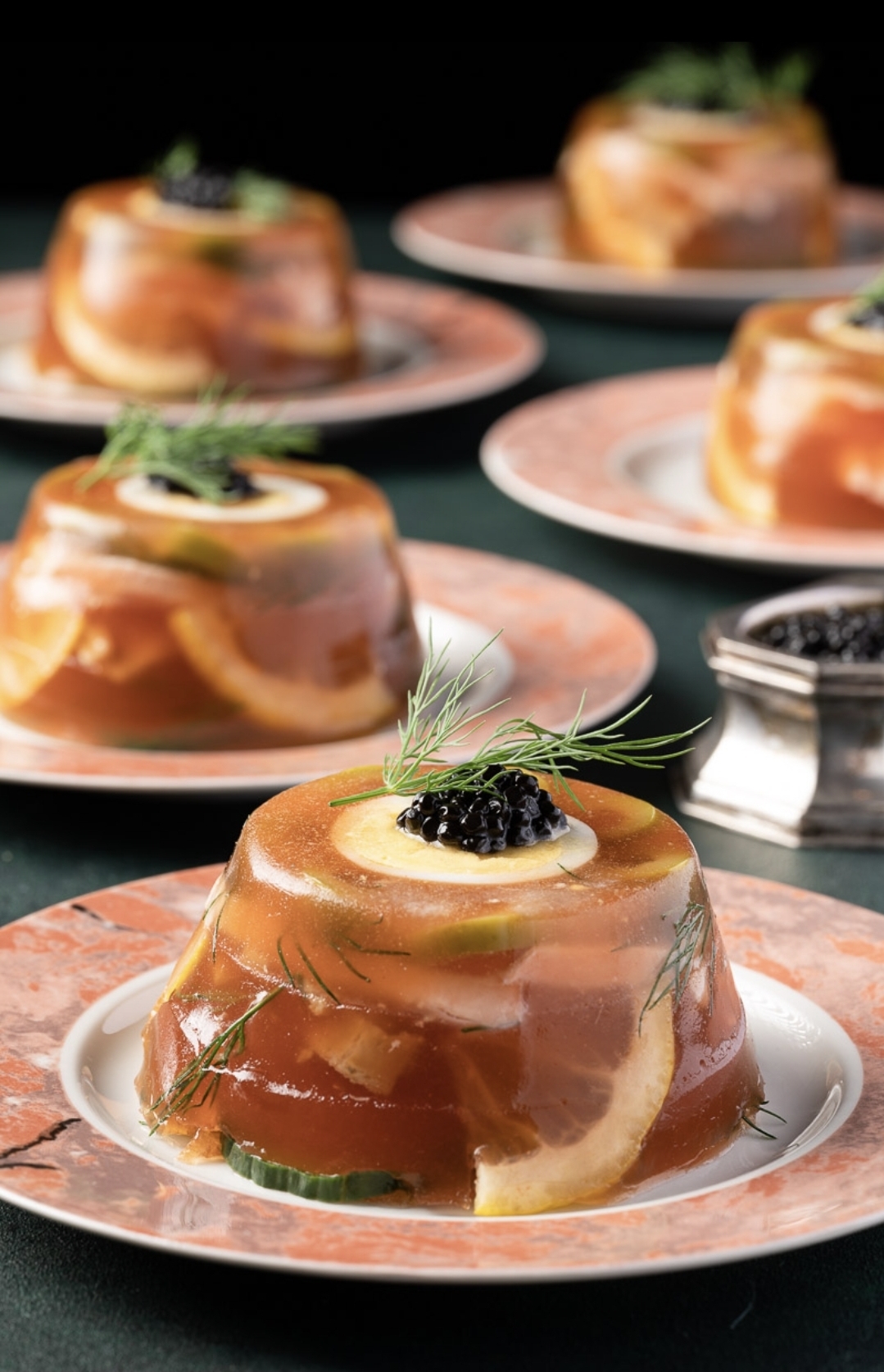
Grandma Zimmern’s Salmon-Tomato Aspic
6
servings1
hour30
minutes* Includes overnight refrigeration.
Ingredients
Base
1 32 oz. can 1 chopped tomatoes
1 1 fresh bay leaf
6 6 black peppercorns
4 4 whole cloves
1/2 tsp 1/2 coriander seeds
1 tbsp. 1 sugar
1 cup 1 diced shallot
3 3 sprigs fresh tarragon
1 1 sprig fresh dill
1 tbsp. 1 cider vinegar
1/2 cup 1/2 chicken broth
2 envelopes 2 unflavored gelatin (1 tbsp. plus 1 1/2 tsp.)
juice of 1/2 lemon
salt to taste
- Filling and Garnish
2 2 hard-boiled eggs, thinly sliced
1/4 cup 1/4 sliced Castelvetrano olives
1 tbsp. 1 chopped fresh dill
10-12 oz. 10-12 cold poached salmon, flaked
1/2 lb. 1/2 jumbo lump crabmeat
6 6 paper-thin lemon slices
18 18 thin cucumber slices
1 tbsp. 1 tbsp. caviar
fresh dill sprigs
Directions
- Combine tomatoes, bay leaf, peppercorns, cloves, coriander seeds, lemon juice, sugar, shallot, tarragon, and dill in a medium saucepan. Bring to a boil, then reduce to a simmer for 20 minutes.
- Strain through a fine-mesh sieve, pressing the solids. Discard solids. Stir in vinegar and salt.
- Heat chicken broth to a boil. Remove from heat; whisk in gelatin until dissolved. Add to tomato mixture.
- Place one slice of hard-boiled egg in each of six 4–5 oz molds. Add olives and remaining egg slices; sprinkle with dill. Pour in one-third of gelatin and add one-third of the salmon and crab. Refrigerate 30 minutes.
- Add lemon quarters, half of remaining seafood, and half of remaining gelatin. Refrigerate 30 minutes.
- Add remaining seafood and gelatin. Chill 10 minutes, then top with cucumber slices. Refrigerate overnight.
- To unmold, run a knife around the edge, dip mold briefly in hot water, and invert onto chilled plates.
- Top each with caviar and fresh dill.
Did you make this recipe?
Tag @appetitomagazine on Instagram and hashtag it with #italianfoodanddrink
Like this recipe?
Follow @Appetitomagazine on Pinterest
Follow us on Facebook!
Follow us on Facebook
This Christmas, as Milanese families cut into veal pâté aspic beneath twinkling lights, and as Delmonico’s holiday memories glow warmly in my heart, I’m reminded that food is lineage, storytelling, and time travel. Aspic may wobble, but its legacy never does.
Buon Natale, and may your table sparkle with something luminous, perhaps even a little something set in gelatin. Or better yet: J-E-L-L-Ho Ho Ho!
For those celebrating the season in New York, the table is set.
Christmas Eve and Christmas in New York:
Join us at Delmonico’s for Christmas Eve and Christmas Day - For reservations visit: www.theoriginaldelmonicos.com
And if you are interested in the Feast of the Seven Fishes Dinner in New York on December 24th, book your reservations at Fresco By Scotto: www.frescobyscottony.com