

In Italian, food is rarely just food. It organizes time, relationships, and expectations. This column explores Italian sayings and proverbs as ways of thinking shaped at the table.
These expressions preserve that knowledge in compact form. Read literally, they speak about eating. Read more closely, they offer insight into how experience, pleasure, and social life are understood.
The aim is simple: to treat language as another ingredient—handled with care, tasted slowly, and shared. No prior appetite required. It tends to arrive along the way.
Domani sarà più buono
Literal translation: “Tomorrow it will be better”
Meaning: Certain foods are believed to taste better the day after they are cooked; more broadly, some things benefit from the simple passage of time.
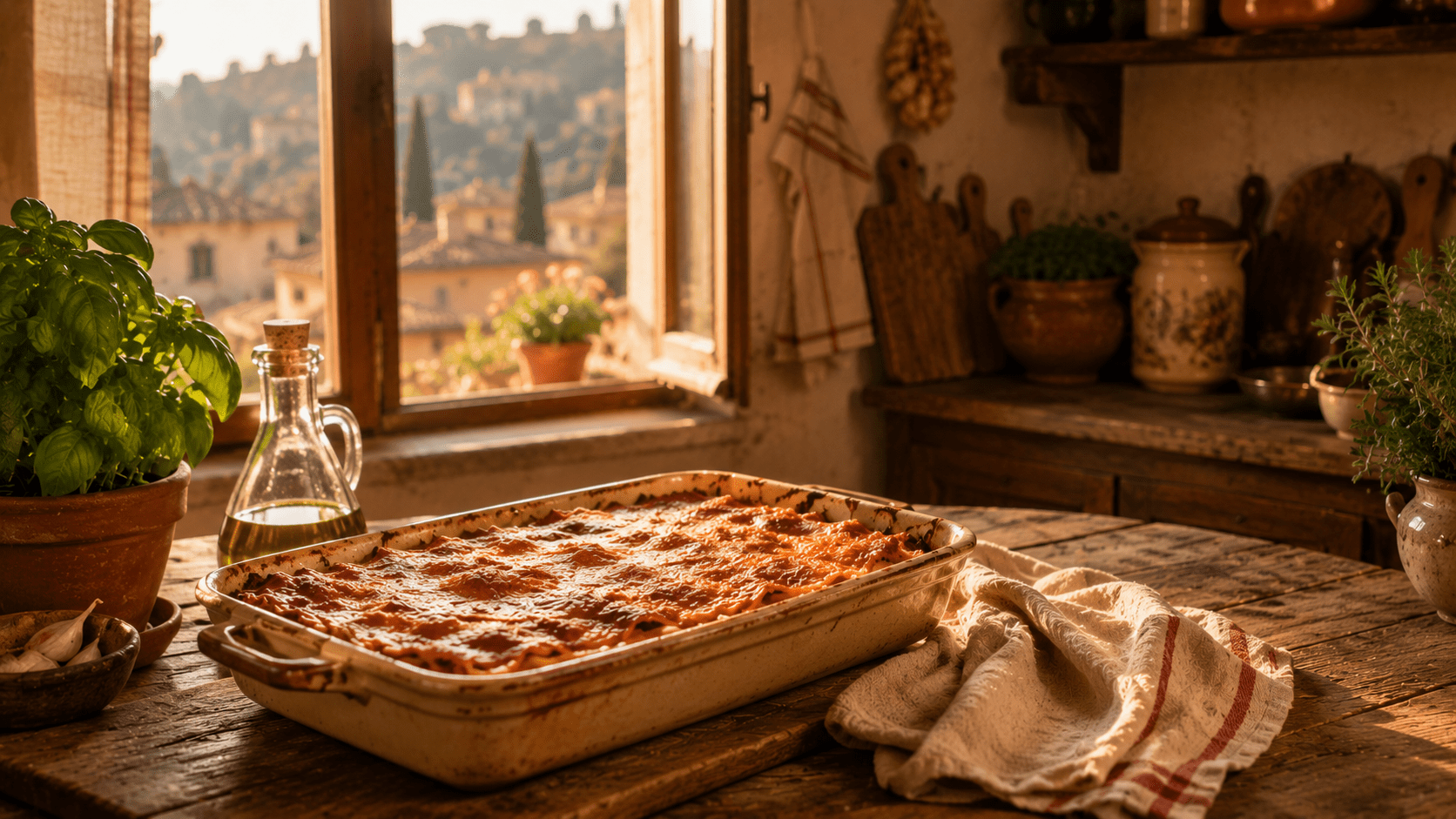
A guest compliments a lasagna. The cook smiles politely, accepts the praise, and then offers a surprising prediction: Domani sarà più buono.
Tomorrow it will be better.
The statement may sound almost paradoxical. The dish has just emerged from the oven. It is hot, fragrant, and sitting at the center of the table. Yet according to a widespread Italian conviction, it has not quite reached its peak. The best version may arrive the next day.
The expression is not a formal proverb and rarely appears in dictionaries, but it belongs to a large family of culinary observations that circulate naturally in Italian homes. It is commonly applied to dishes such as lasagna, ragù, vegetable soups, baked vegetables, and many preparations based on slow cooking. The explanation usually offered is simple: flavors need time to blend and settle. What seemed complete at dinner may reveal greater depth the following day.
In these foods, time functions almost like an ingredient. Not because it transforms them into something new, but because it helps the various elements find their balance. A tray of stuffed vegetables, a pot of minestrone, a pan of meatballs, or a savory tortino remains essentially the same dish after one night. Yet the flavors become more integrated, and the result often feels richer and more coherent than it did a few hours earlier.
Something can be ready without being at its best.
Hungry for More? Check out these Appetito recipes that taste even better the next day.
How to Make Lasagna Bolognese like the Chef of Greenwich Village
Caponata with Artichokes is a Twist on the Classic Sicilian Dish
Baked, Fried, or Simmered Raw: Which Meatball Is Best?
The idea emerged from a domestic world in which food was rarely conceived as a single, isolated event. Before refrigeration became commonplace, many dishes simply remained where they were. A pot of soup stayed on the stove. A tray of baked vegetables cooled overnight beneath a cloth. Other preparations rested on a kitchen table or inside a wooden cupboard. The passage from one meal to the next was often not a matter of preservation but of continuity.
In that world, the night itself became part of the recipe. Food crossed the hours between dinner and lunch almost naturally. The goal was not to stop the effects of time but to live with them. Nobody expected a dramatic transformation, yet something happened. Flavors settled. Aromas mingled. What had been cooked became more unified. The hours quietly completed what the cook had begun.
Modern refrigeration has changed this relationship. The refrigerator is designed to slow time down, preserving food in its current state and protecting it from change. The older culinary imagination often treated time differently. It was not necessarily an enemy to be defeated but an ally that could be trusted. Food was not merely surviving until the next day; it crossed the night and arrived with something more to offer
More broadly, the expression reflects a culture that does not always equate value with immediacy. The best moment is not necessarily the first one. Sometimes a little distance allows qualities that were already present to emerge more clearly.
For this reason, domani sarà più buono expresses more than a culinary preference. It reflects a way of thinking in which time is not always a force of decline. Sometimes it is a collaborator.
In Italy, time is often treated as one of life's ingredients.
Want to be the first to know about Italian food events, restaurant openings and culinary travel? Subscribe to the Appetito weekly newsletter.