
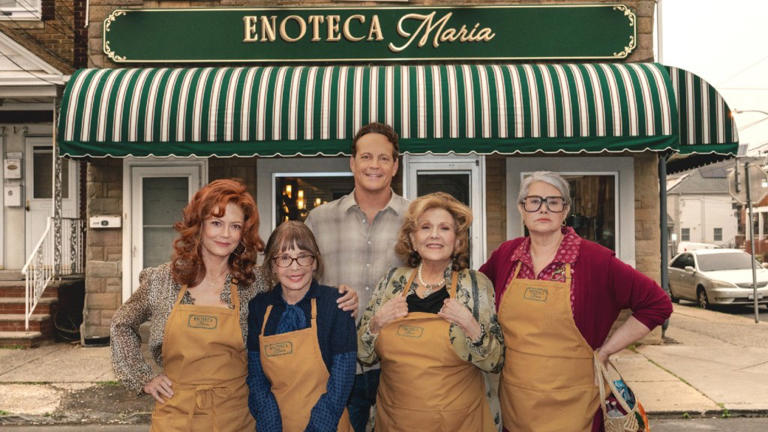
When Nonnas premieres on Netflix this May, audiences will be introduced to a story of second chances. Vince Vaughn plays a struggling restaurateur who finds unlikely salvation in a group of grandmothers from around the world, each bringing with her a lifetime of recipes, and a kind of wisdom you can’t fake. With Joe Manganiello, Susan Sarandon, Linda Cardellini, Talia Shire, and Drea de Matteo rounding out the cast, the film has all the ingredients of a charming, heartwarming comedy.
But behind the story is something much richer than a movie premise. Nonnas is inspired by Enoteca Maria, a real restaurant quietly operating on Staten Island since 2007. And while the film may be fictionalized, the heart of it—the women, the food, the sense of history tied into every dish is very real.
Enjoying this article? Sign up for the Appetito newsletter and receive new recipes, stories, and Italian inspiration straight to your inbox.
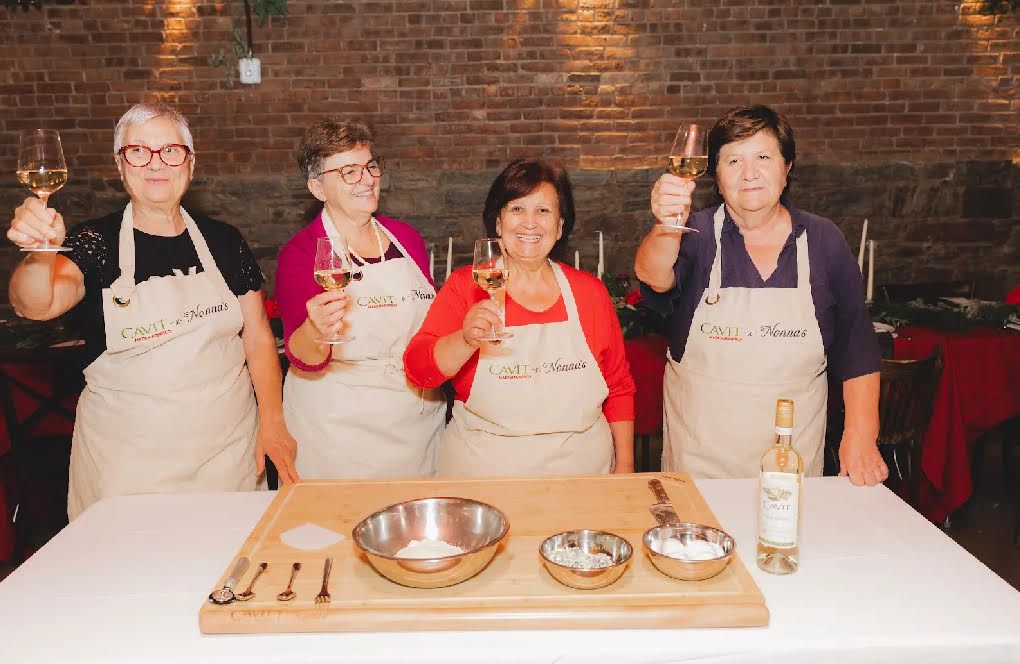
Jody Scaravella didn’t intend to start a movement. After losing his mother, he found himself reaching backward to memory, to food, to the comfort of something homemade. That pull led to Enoteca Maria, a restaurant designed around a deceptively simple idea - invite local Italian grandmothers to cook the food they’ve spent a lifetime perfecting.
At first, the kitchen rotated among Italian nonnas, one from Naples, one from Genoa, another from Sardinia. Each woman brought a menu entirely her own, reflecting the distinct flavors of her region. Then Scaravella did something quietly unexpected. He expanded the idea beyond Italy.
Over time, the kitchen opened to grandmothers from Bangladesh, Syria, Ecuador, Poland, Egypt, and more. Today, Enoteca Maria hosts women from every corner of the world, each of them preparing the dishes of her childhood. One evening might feature homemade Palestinian maqluba; another, a Dominican sancocho. There’s no set menu, no predictable rotation. You come in not just to eat but to be surprised.
What Gets Preserved When a Meal Is Made by Hand
There’s something that happens when food is passed down, not written down. Many of the women who cook at Enoteca Maria never trained professionally. Their recipes often exist only in their heads and hands. A pinch of this, a handful of that, knead until it feels right.
That kind of knowledge doesn’t come from books. It’s tactile. Intuitive. It carries with it not only taste but time.
Nonna Sahar, from Alexandria, Egypt, is one of the recent cooks featured in the kitchen. Her menu included lentil soup, molokhia, a dark green, garlicky stew made from jute leaves, and rice pudding, just like she served it at home. For foodies, it’s an opportunity to taste something they may never have encountered before. But for her, it’s more than dinner. It’s memory, migration, and identity on a plate.
In a world where food is increasingly mass-produced, the restaurant offers something slower and more grounded.
In most restaurant kitchens, hierarchy rules. There’s a head chef, a sous-chef, a system that dictates speed and efficiency. But Enoteca Maria doesn’t operate like that.
Here, the grandmother is the authority. Her recipes take precedence. Her methods, whether they align with industry standards or not, are respected. The women are not “helping out” in someone else’s kitchen. They are the kitchen.
Some don’t speak English. Some have never used professional equipment. But that doesn’t matter. What they bring is something far more valuable than textbook technique. They bring lived experience.
What the Film Can—and Can’t—Capture
The release of Nonnas will likely bring a fresh wave of attention to the restaurant. More press, more bookings, more interest. But the truth is, Enoteca Maria doesn’t need to be a media darling to matter. It never tried to be trendy or viral. It just tried to do something honest, and in doing so, created something extraordinary.
Will the film capture that? Maybe. Maybe not. Movies can’t always hold the complexity of real life, especially when that life is measured in stories told over a simmering pot of stew. But if Nonnas leads people to walk through the door of a place like Enoteca Maria, to sit down and taste something they’ve never tasted before, then it’s done something right.
The film premieres on Netflix May 9.