

Every year, toward the end of summer, the ritual begins.
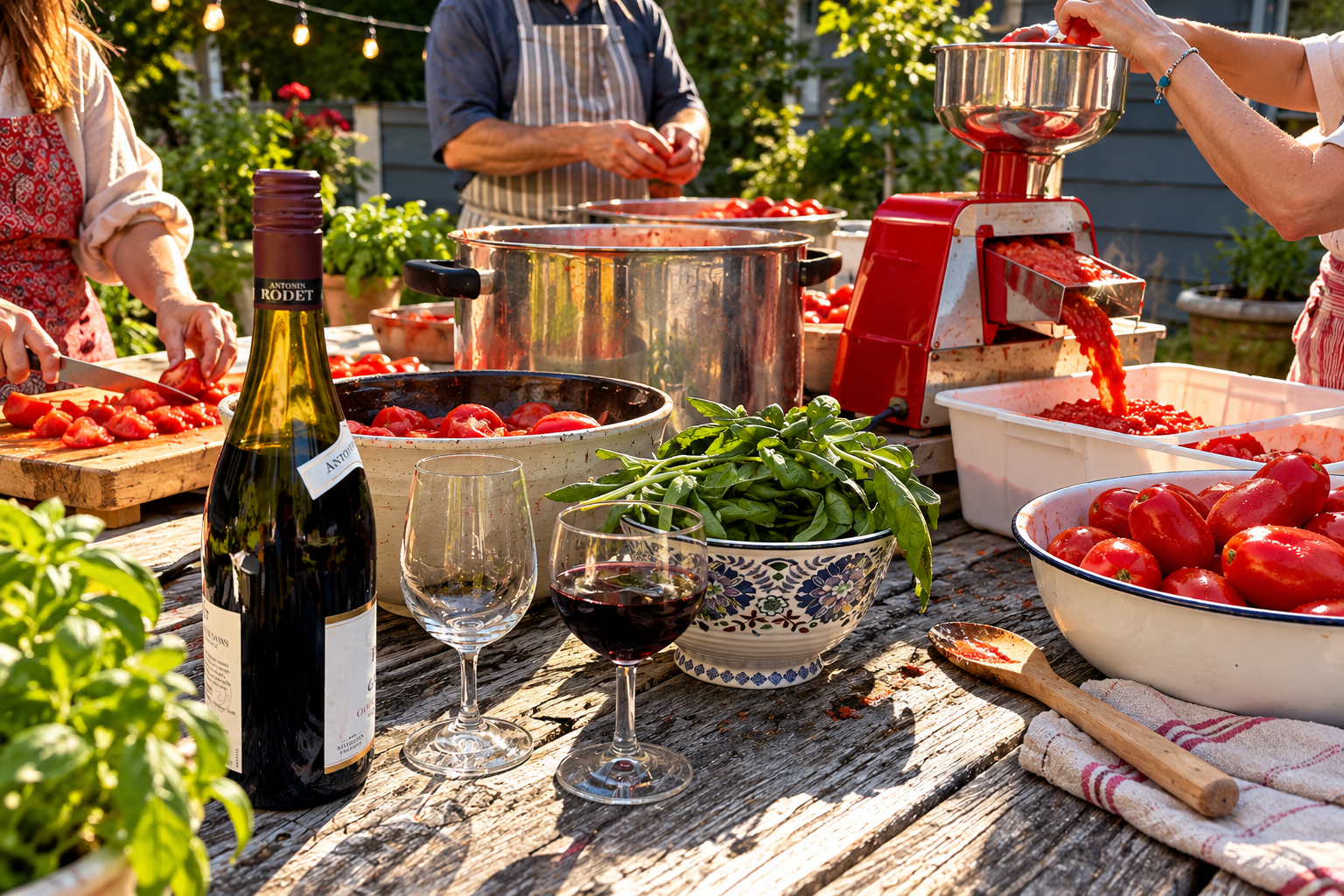
Crates of ripe tomatoes arrive at markets. Tables are set up in backyards, garages and kitchens. Large pots come out, bottles and jars are washed and lined up, and families and friends gather for a long day of washing, cooking, milling and bottling.
For Italian families around the world, making passata, Italian tomato sauce, at the end of summer has become much more than a way of filling the pantry.
But it began with something much more practical: preserving food when it was plentiful so there would be enough when it was not.
Preserving the summer
In rural Italy, families preserved food when it was abundant so they would have enough to eat through the colder months. Tomatoes ripened in large quantities during summer, but once the season ended, fresh tomatoes were no longer readily available. Before refrigeration and supermarkets made produce accessible throughout the year, preserving the harvest was simply part of preparing for the months ahead.
Making enough for an entire household was not a small undertaking. Families might process dozens of crates, so it made sense to do the work together.
Parents, grandparents, children, cousins and neighbors all had a role. Someone washed the tomatoes. Someone tended the pots. Someone worked the mill. Others filled and sealed bottles or cleaned up behind the operation.
By the end of the day, rows of bottles represented months of future meals.
Then the tradition traveled
When Italians left the country in large numbers during the postwar decades, they carried more than their belongings. Since the unification of Italy in 1861, an estimated 31 million Italians have left the country, settling across the Americas, Europe, Africa, Australia and elsewhere.
Many went looking for work and opportunities they could not find at home, particularly in rural areas and the south. Some moved to the growing economies of northern Europe; others traveled much farther, building new lives in Australia, Canada and the United States.
With them went the everyday practices of home, including the annual ritual of preserving the summer tomato harvest.
The setting changed. A courtyard in an Italian village might become a suburban garage in Melbourne, a backyard in Montreal or Toronto, or a driveway in New Jersey.
Growing up in Australia, I knew when tomato sauce season had arrived. My Italian neighbors would open their garage doors and out would come the generations: grandparents, grown children, siblings and cousins. The garage and backyard became a temporary production line, with everyone taking a job.
Years later, I started the tradition myself in Montreal. There is something fitting about doing it here. Jean-Talon Market sits in the heart of Montreal's Little Italy, a neighborhood shaped by generations of Italian migration. Toward the end of summer, crates of tomatoes arrive from farms around the region. Ask the vendors which tomatoes to use for sauce, and San Marzano is invariably the gold standard—sweeter, less acidic and with juicier flesh. Together with friends, we make our annual batch.
Love discovering Italy one bite at a time? Subscribe to the free Appetito newsletter for the latest in Italian food, travel and favorite recipes.
The equipment has evolved, too. I started with a hand-cranked tomato mill, which requires a fair amount of elbow grease. This year, I finally tried an electric one. I reuse my glass jars from year to year, replacing the sealing lids each season.
Recipes change from household to household as well. One of my neighbors adds garlic and onion to her sauce immediately. I keep mine simple, adding only salt and a leaf of basil, because I use it for far more than pasta: chilli, soups and curries.
A tradition that belongs to the diaspora and to Italy
Of course, tomato sauce-making did not leave Italy when Italians migrated. The tradition continues there too.
My friend Mimma, from Abruzzo, tells me that families there still gather to make their passata each summer. She has also noticed younger people becoming interested again, returning to older ways of cooking and preserving food and asking parents and grandparents to teach them how their families did it.
That matters because so much of this knowledge was never written down. Another friend from Calabria tells me that once the person who holds that knowledge is gone, it can be difficult to reconstruct. Keeping these traditions alive means continuing to practice them, whether in an Abruzzese kitchen, an Australian garage or a Montreal backyard.
And you don't have to be Italian to make your own tomato sauce. Good tomatoes, a few willing hands and an afternoon are enough to get started.
How the Passata is made
Every family has its own method, but sauce day usually follows the same rhythm.
1. The tomatoes
Start with ripe tomatoes — lots of them. Wash and sort them, removing any bruised or damaged ones.
2. The first cooking
Put the tomatoes into large pots and heat them until their skins begin to split. This helps release their juices and makes them easier to put through the mill.
3. The milling
Feed the tomatoes through a hand-cranked or electric tomato mill, separating the skins and seeds from the pulp. Put the skins and seeds through the machine a couple of times to extract as much tomato as possible.
4. The passata
Return the milled tomatoes to large, clean pots and cook over medium heat until the sauce reaches the thickness you want, stirring intermittently. Depending on the size of your pot and how much sauce you are making, this can take several hours.
This is also where family traditions diverge when it comes to seasoning. Some add basil, some add salt, some add both and others insist the tomatoes need nothing at all. Techniques vary according to region, family and, quite often, whichever nonna or nonno taught you how it should be done.
5. Preparing the jars
The jars need to be thoroughly cleaned and hot before filling. Putting them through a hot dishwasher cycle is a useful way to prepare a large batch at once. Glass jars can be reused if they remain in good condition, but the flat sealing lids should be replaced each time.
6. Bottling and preserving
Ladle the hot sauce into the clean, hot jars, leaving the recommended headspace. Wipe the rims carefully, position the new sealing lids and secure the screw bands.
The filled jars are then heat-processed in boiling water. For food safety, tomatoes should be acidified, and processing times should follow a current tested canning recipe appropriate to the jar size and altitude.
And then comes one of the most satisfying sounds of sauce day.
Pop. Pop. Pop.
As the jars cool, a vacuum forms and pulls the lids down. Once the jars are completely cooled, check every seal. The jars can then be wiped down and stored in a cool, dry place.
At the end of the day, there they are: rows of tomato sauce ready for the months ahead, summer preserved in a bottle.